
When you purchase through links on our site, we may earn an affiliate commission. Here’s how it works .
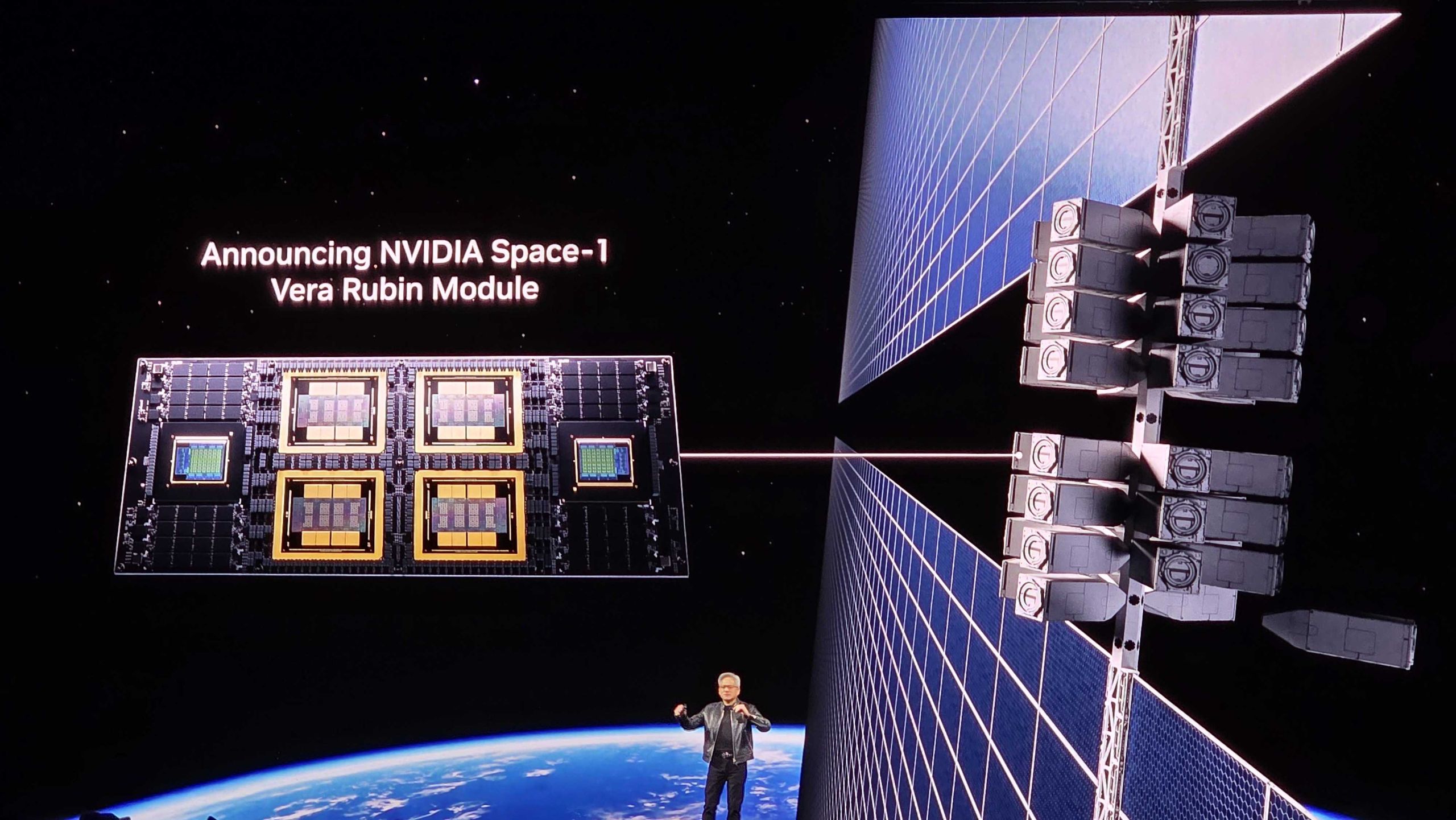
Nvidia CEO Jensen Heung has announced the Vera Rubin Space Module at the company’s ongoing GTC 2026 event, claiming up to 25 times more AI compute than the H100 for orbital inference workloads. Six commercial space companies are understood to have already deployed the platform.
According to the official Nvidia press release, the Vera Rubin Space Module is designed for orbital data centers running LLMs and advanced foundation models directly in space, with a tightly integrated CPU-GPU architecture and high-bandwidth interconnect built to handle large data streams from space-based instruments in real time.
Below that sits the Nvidia IGX Thor, targeting mission-critical edge environments with support for real-time AI processing, functional safety, secure boot, and autonomous operation. The Nvidia Jetson Orin, meanwhile, handles the smallest form factor, targeting SWaP-constrained satellites for onboard vision, navigation, and sensor data processing.
You may like Nvidia launches Vera Rubin NVL72 AI supercomputer at CES Nvidia CEO confirms Vera Rubin NVL72 is now in production Nvidia delivers first Vera Rubin AI GPU samples to customers Back on planet Earth, Nvidia has positioned the RTX PRO 6000 Blackwell Series Server Edition GPU for geospatial intelligence workloads, claiming up to a 100 times performance uplift versus legacy CPU-based batch processing systems when analyzing large image archives.
Nvidia says that six companies are currently using its platforms across orbital and ground environments: Aetherflux, Axiom Space, Kepler Communications, Planet Labs PBC, Sophia Space, and Starcloud, with Kepler deploying Jetson Orin across its satellite constellation for AI-driven data management. "Nvidia Jetson Orin brings advanced AI directly to our satellites, allowing us to intelligently manage and route data across our constellation," said Mina Mitry, the company’s CEO, in Nvidia’s official press release.
Last October, Amazon and Blue Origin founder Jeff Bezos predicted that gigawatt-scale data centers in orbit were 10 to 20 years away, citing continuous solar power and the simplified cooling environment of space as the primary advantages. Starcloud, one of Nvidia's six partners, is already building what it describes as purpose-designed orbital data centers aimed at running training and inference workloads in orbit.
"Space computing, the final frontier, has arrived," said Jensen Huang, adding that "AI processing across space and ground systems enables real-time sensing, decision-making and autonomy, transforming orbital data centers into instruments of discovery and spacecraft into self-navigating systems."
Get Tom's Hardware's best news and in-depth reviews, straight to your inbox.
Key considerations
- Investor positioning can change fast
- Volatility remains possible near catalysts
- Macro rates and liquidity can dominate flows
Reference reading
- https://www.tomshardware.com/pc-components/gpus/SPONSORED_LINK_URL
- https://www.tomshardware.com/pc-components/gpus/nvidia-announces-vera-rubin-space-module#main
- https://www.tomshardware.com/subscription
- AMD's former pound-for-pound gaming champ hits its historic low again — Ryzen 7 9800X3D offers unmatched value for gamers at $429
- NVIDIA and Thinking Machines Lab Announce Long-Term Gigawatt-Scale Strategic Partnership
- Save $290 on this all-AMD gaming PC with a 9800X3D and RX 9070 XT for 4K gaming — just $2,259 for an elite CyberPowerPC rig with 32GB of DDR5 RAM and a huge 2TB
- Fiber internet provider says it can detect leaking water pipes using existing infrastructure, prevented loss of 2 million liters a day over three months — Light
- Chocolate 3D printer startup Cocoa Press levels up with former Prusa executive
Informational only. No financial advice. Do your own research.