
When you purchase through links on our site, we may earn an affiliate commission. Here’s how it works .
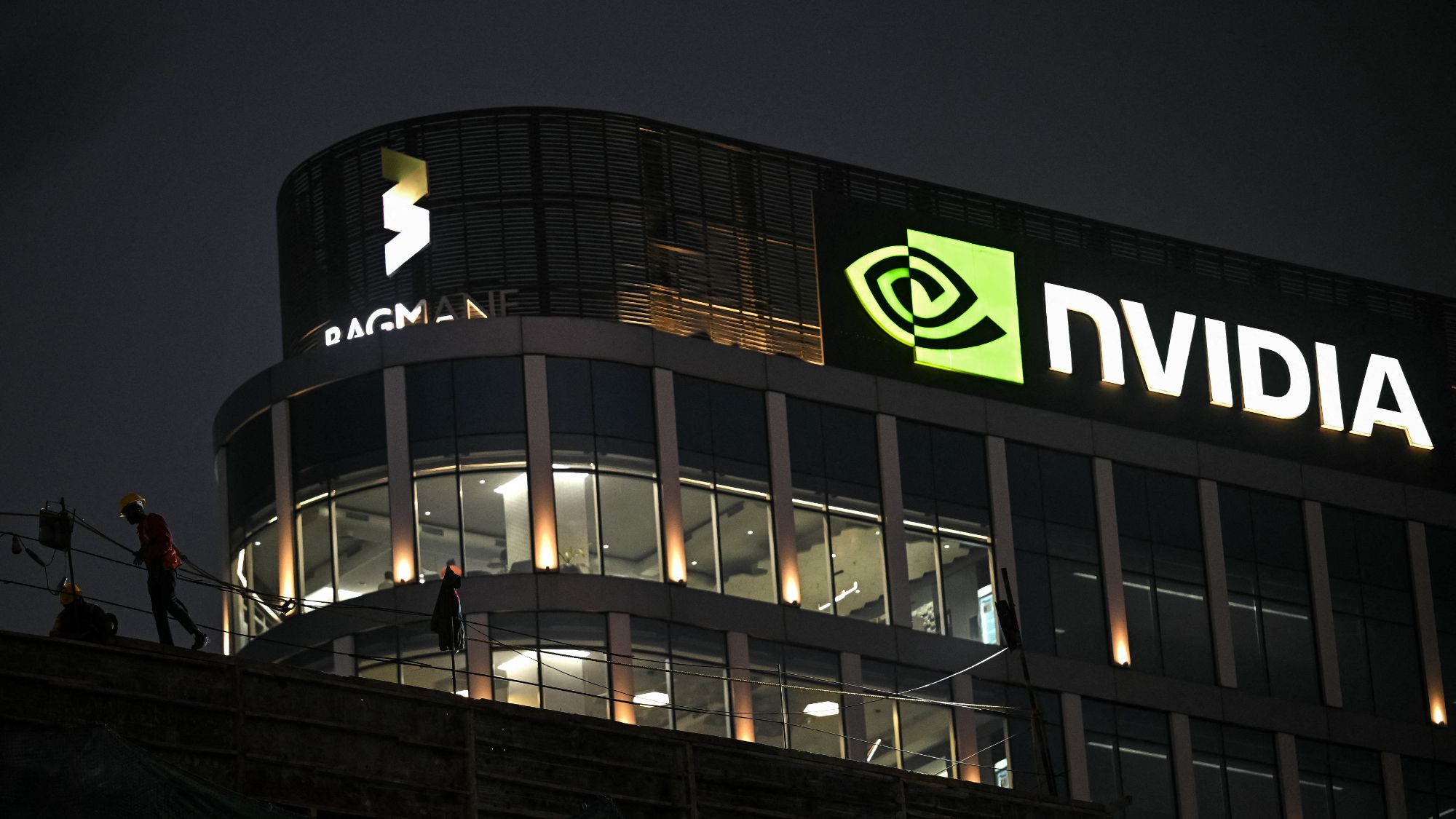
(Image credit: Getty / Idrees Mohammed) Share Share by: Copy link Facebook X Whatsapp Reddit Flipboard Share this article 8 Join the conversation Follow us Add us as a preferred source on Google Even though Nvidia's AI GPUs and rack-scale solutions remain the most sought-after AI accelerators, curbs set on exports of Nvidia's AI processors to China, first by the White House and then by Beijing, are having a drastic effect on the company's presence in the People's Republic. As a result, the company's share in China could drop to just 8% in the coming years as domestic suppliers can satisfy around 80% of local demand, reports Nikkei, citing analysis from Bernstein.
"The new products meet the needs of domestic developers," said Zhang Jianzhong, chief executive of Moore Threads, at a news conference while announcing the codenamed Huashan product, the company's first GPU dedicated solely for the acceleration of AI workloads. "There will be no more need to wait for advanced products from overseas."
Analysts from Bernstein cited by Chinese media expect Nvidia's share of China’s AI processor market to drop to around 8% this year from 66% in 2024 as Huawei, Cambricon, and other local independent hardware vendors (IHVs) together approaching 80%. The rise of Chinese hardware accelerators is a result of a combination of events, including restrictions set on Nvidia hardware, progress of hardware from companies like Huawei, Cambricon, Moore Threads, and MetaX, as well as substantial improvements in their software stacks.
Nvidia's China presence hits zero, says CEO Jensen Huang, and companies are already working around it
China’s GPU cloud consolidates around Baidu and Huawei as domestic AI chips scale up
Moore Threads' Huashan can compete against Nvidia's Hopper H100 and H200 products, the company's previous-generation AI accelerators that the U.S. recently allowed to export to China, but with some serious strings attached . However, they are considerably slower than Nvidia's existing Blackwell B200 and B300 GPUs, which are barred from export to the People's Republic.
Meanwhile, Huawei's AI CloudMatrix 384 can beat both GB200 NVL72 and GB300 NVL72 systems in BF16 FLOPS, a popular format used for AI training, albeit with four times more power consumption. The company's next-generation Atlas 950 SuperCluster, based on 524,288 Ascend 950DT AI accelerators, is projected to offer up to 524 FP8 ExaFLOPS for AI training and up to 1 FP4 ZettaFLOPS for AI inference ( MXFP4 to be more specific) sometimes in 2026 – 2027 and 4 ZettaFLOPS by the end of 2028 . This is still behind leading Blackwell-based clusters, such as Oracle's OCI Supercluster running 131,072 B200 GPUs and offering peak performance of up to 2.4 FP4 ZettaFLOPS for inference , but it is evident that Chinese developers are rapidly increasing the performance of their AI hardware.
Given the progress, the remaining hurdle is completing the transition from an ecosystem long centered on Nvidia to a fully domestic hardware and software stack, which may not be that easy to achieve, as many existing AI deployments use Nvidia hardware and Nvidia CUDA software stack and porting them to Chinese hardware and software is hard and expensive.
Yet, transition to domestic AI hardware (and domestic hardware in general) is China's long-term national goal. A draft five-year plan reportedly circulated by the Communist Party in October calls for semiconductor self-reliance under a 'new national system' that directs state bodies, private companies, and financial institutions. At the heart of this effort are the so-called 'four little dragons' of Chinese GPUs: Moore Threads, MetaX, Biren Technology, and Suiyuan Technology (Enflame).
Get Tom's Hardware's best news and in-depth reviews, straight to your inbox.
Key considerations
- Investor positioning can change fast
- Volatility remains possible near catalysts
- Macro rates and liquidity can dominate flows
Reference reading
- https://www.tomshardware.com/tech-industry/artificial-intelligence/SPONSORED_LINK_URL
- https://www.tomshardware.com/tech-industry/artificial-intelligence/nvidia-china-market-share-to-drastically-decrease-from-66-percent-to-8-percent-analysts-claim-export-curbs-and-homegrown-success-to-blame#main
- https://www.tomshardware.com
- Shareholders sue Oracle over misleading statements related to $300 billion OpenAI data center build-out — disgruntled plaintiffs say the company lied about how
- Gamers face another crushing blow as Nvidia allegedly slashes GPU supply by 20%, leaker claims — no new GeForce gaming GPU until 2027
- Nvidia China market share to drastically decrease from 66% to 8%, analysts claim — export curbs and homegrown success to blame
- Asus's recently released ROG Xbox Ally handheld gets a $100 price drop – get the Ryzen Z2 A-powered version with 16GB of RAM for under $500
- U.S. slashes Taiwan tariffs in new semiconductor trade deal — Washington to reduce tariffs to 15% in exchange for $500 billion stateside manufacturing investmen
Informational only. No financial advice. Do your own research.