
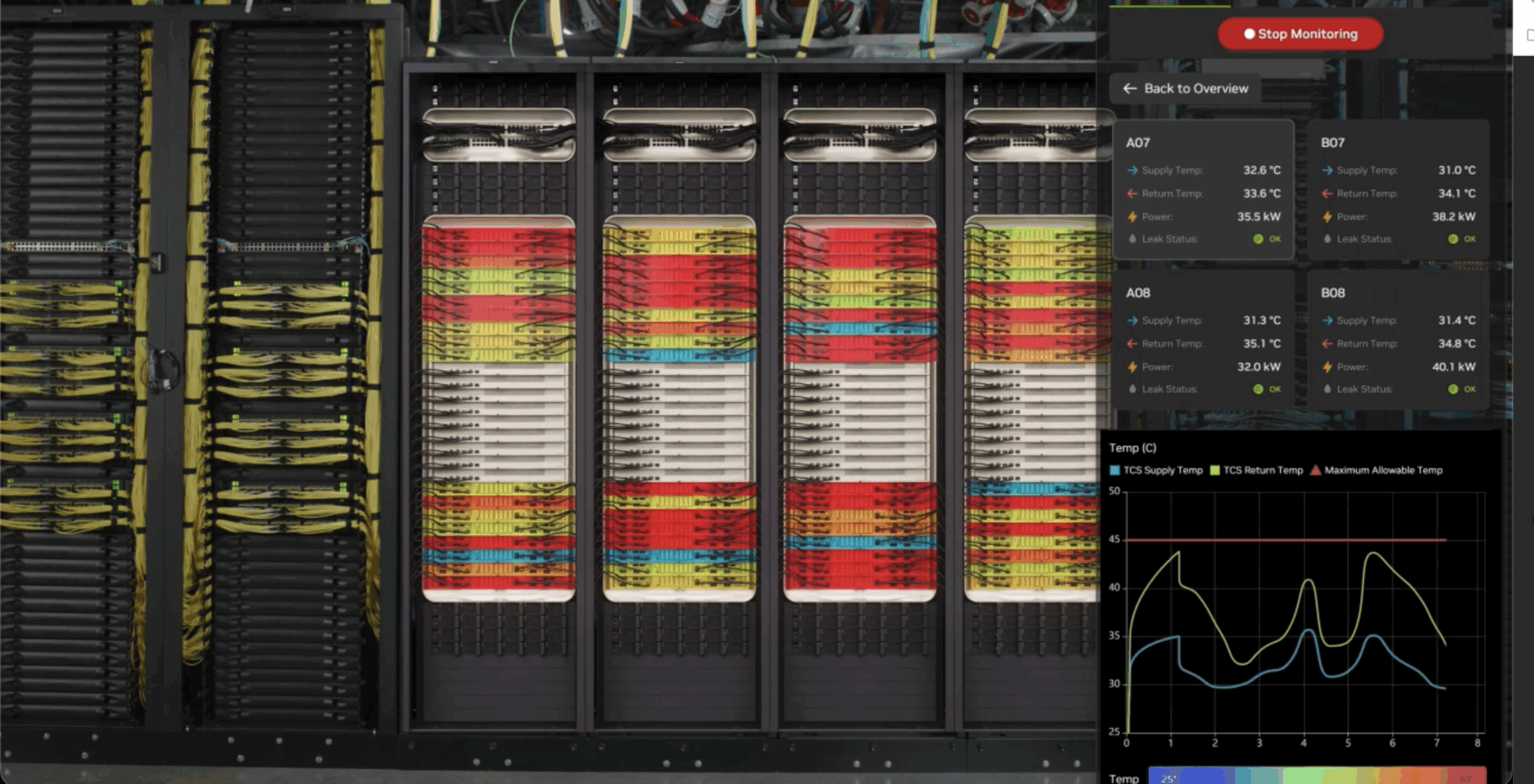
During the GTC Washington, D.C., keynote today, NVIDIA founder and CEO Jensen Huang introduced NVIDIA Omniverse DSX, a comprehensive, open blueprint for designing and operating gigawatt-scale AI factories — validated at the new AI Factory Research Center at Digital Realty’s site in Manassas, Virginia.
The blueprint brings together ecosystem partners across the industry that are tapping into NVIDIA Omniverse libraries and OpenUSD to set a new standard for building and operating gigascale AI factories. For the first time, the building, power and cooling can be codesigned with NVIDIA’s AI Infrastructure stack — and the process of the Virginia research center build out is captured as a scalable, repeatable recipe validated in a real-world deployment.
It starts with the digital twin , where engineering and construction partner Jacobs can design the building, then optimize compute density and overall layout to maximize token throughput according to power constraints.
Jacobs engineers aggregate SimReady OpenUSD assets for power, electrical and cooling equipment from partners including Siemens , Schneider Electric , Trane Technologies and Vertiv into PTC’s product lifecycle management system — allowing cross-functional teams to collaborate in real time on photorealistic 3D models, accelerate design decisions and reduce development risk with shared, version-controlled product data.
The advancement of SimReady assets from hardware partners and growing adoption of OpenUSD across industries plays a crucial role in the acceleration of building out these highly complex designs.
The Cadence Reality Digital Twin platform has been purpose-built on top of the blueprint, with integrated Omniverse libraries and accelerated by NVIDIA CUDA . This allows engineers to simulate thermals and electricals in a high-fidelity, physically accurate 3D environment to test designs, predict failures and optimize operations in the digital twin before construction.
Once the AI factory has been designed virtually, NVIDIA partners like Bechtel and Vertiv deliver prefabricated modules that are factory built, tested and ready to plug in. This significantly reduces build time and allows for modular scalability, helping achieve faster time to revenue.
The architecture of the DSX blueprint means once the physical AI factory comes online, the digital twin can be used as an operating system to monitor, inspect and further optimize processes.
For example, AI agents from partners including Phaidra and Emerald AI are trained in the digital twin, and then allow engineers to prompt and optimize power consumption to reduce strain on both the AI factory and the power grid. Phaidra AI agents continuously optimize power, cooling and workloads, turning the AI factory digital twins into a self-learning system that boosts grid flexibility, resiliency and energy efficiency.
DSX maximizes GPU productivity and energy efficiency across the compute fabric with a single digital twin environment that can be simulated, optimized and used for operations. Prefabricated modules from infrastructure partners prove how AI factories can be designed, assembled, validated and expanded with speed and consistency.
DSX Flex – Dynamic Grid Collaboration: Balances energy demand with real-time grid conditions using Omniverse telemetry and AI agents, improving efficiency and grid cooperation to help tap some of the 100 gigawatts of underutilized grid capacity.
DSX Boost – Performance-Per-Watt Optimization: Applies NVIDIA’s power-optimization technologies at the data center level, running workloads at Max-Q efficiency — the point of optimal performance per watt — for up to 30% higher GPU throughput within the same power envelope.
DSX Exchange – Unified IT/OT Integration: Acts as the secure data and control fabric linking operational systems for power, cooling and safety with NVIDIA’s software stack and Omniverse digital twins through real-time application programming interfaces and partner integrations.
Scalability: Common architecture for AI factories from 100 megawatts to multi-gigawatts.
Efficiency: DSX Boost maximizes token throughput per megawatt.
Key considerations
- Investor positioning can change fast
- Volatility remains possible near catalysts
- Macro rates and liquidity can dominate flows
Reference reading
- https://blogs.nvidia.com/blog/omniverse-dsx-blueprint/#content
- https://www.nvidia.com/en-us/
- https://blogs.nvidia.com/?s=
- NVIDIA and General Atomics Advance Commercial Fusion Energy
- NVIDIA Contributes to Open Frameworks for Next-Generation Robotics Development
- Intel opens pop-up stores across five cities featuring AI PCs from laptop manufacturers — we stopped by the NYC store, and one visitor in Munich found Panther L
- TP-Link routers face potential U.S. ban over alleged China-related national security concerns — company "vigorously disputes" Department of Commerce's findings
- Taiwan increases penalty for damaging undersea cables amid increased suspected sabotage attempts — offenders face up to 7 years in prison and $325,000 in fines
Informational only. No financial advice. Do your own research.