
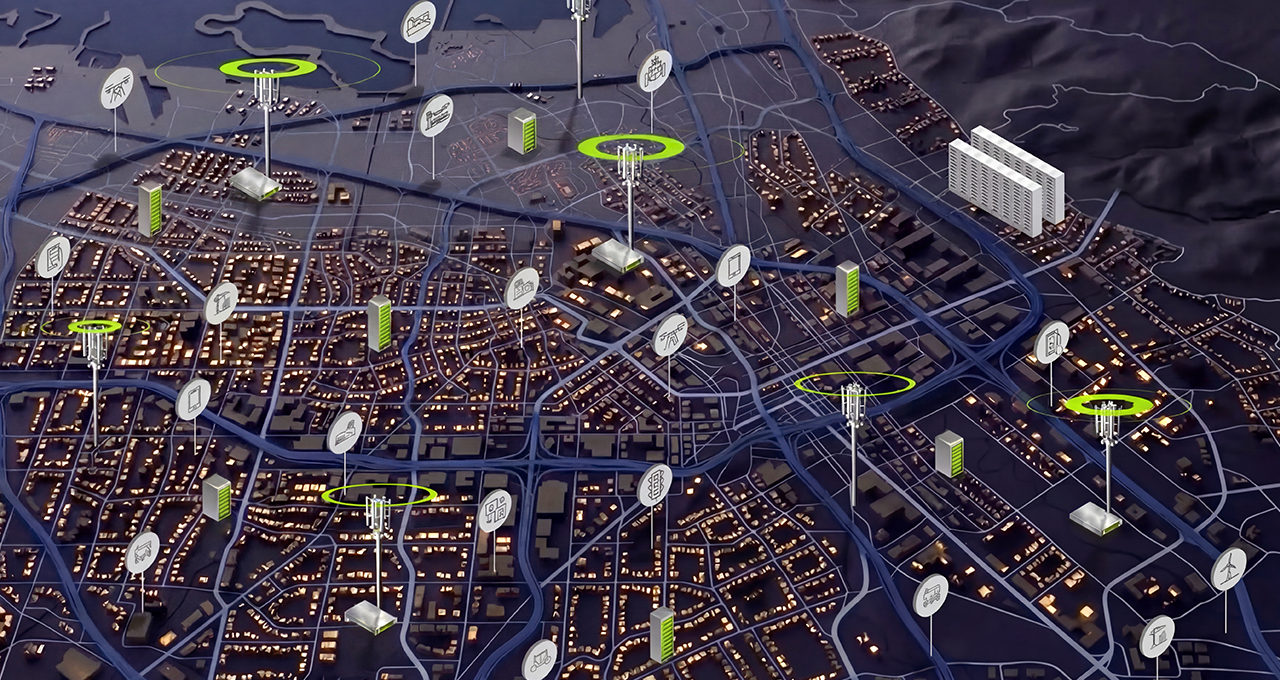
AT&T , a leader in connected IoT with over 100 million connections across thousands of device types, is partnering with Cisco and NVIDIA to build an AI grid for IoT. By running AI on a dedicated IoT core and moving AI inference closer to where data is created, AT&T can support mission‑critical, real‑time applications like public‑safety use cases with Linker Vision, enabling faster detection, alerting and response while helping keep sensitive information under customer control at the network edge.
“Scaling AI services that are both highly secure and accessible for enterprises and developers is a core pillar of our IoT connectivity strategy,” said Shawn Hakl, senior vice president of product at AT&T Business. “By combining AT&T’s business‑grade connectivity, localized AI compute and zero‑trust security while working with members of the NVIDIA Inception program and harnessing Cisco’s AI Grid with NVIDIA infrastructure and Cisco Mobility Services Platform, we’re bringing real‑time AI inference closer to where data is generated — accelerating digital transformation and unlocking new business opportunities.”
Comcast is developing one of the nation’s largest low‑latency broadband footprints into an AI grid for real‑time, hyper‑personalized experiences. Working with NVIDIA, Decart , Personal AI and HPE , Comcast has validated that its AI grid keeps conversational agents, interactive media and NVIDIA GeForce NOW cloud gaming responsive and economical even during demand spikes, with significantly higher throughput and lower cost per token.
Spectrum has the network infrastructure to support an AI grid that spans more than 1,000 edge data centers and hundreds of megawatts of capacity less than 10 milliseconds away from 500 million devices. The initial deployment focuses on rendering high-resolution graphics for media production using remote GPUs embedded across Spectrum’s fiber-powered, low-latency network.
Akamai i s building a globally distributed AI grid, expanding Akamai Inference Cloud across more than 4,400 edge locations with thousands of NVIDIA RTX PRO 6000 Blackwell Server Edition GPUs. Akamai’s AI grid orchestration platform matches each request to the right tier of compute, improving the token economics of inference while powering low-latency, real-time AI experiences for applications like gaming, media, financial services and retail.
Indosat Ooredoo Hutchison is connecting its sovereign AI factory with distributed edge and AI‑RAN sites across Indonesia to build an AI grid for local innovation. By running Sahabat-AI — a Bahasa Indonesia-based platform — on this grid within Indonesia’s borders, Indosat can bring localized AI services closer to hundred millions of Indonesians across thousands of islands, giving local developers and startups a sovereign platform to build AI applications that are fast, culturally relevant and compliant by design.
T‑Mobile is working with NVIDIA to explore edge AI applications using NVIDIA RTX PRO 6000 Blackwell Server Edition GPUs, demonstrating how distributed network locations could support emerging AI-RAN and edge inference use cases. Developers including LinkerVision, Levatas, Vaidio, Archetype AI and Serve Robotics are already piloting smart‑city, industrial and retail applications on the grid, connecting cameras, delivery robots and city‑scale agents to real-time intelligence on the network edge. This demonstrates how cell sites and mobile switching offices can support distributed edge AI workloads while continuing to deliver advanced 5G connectivity.
AI grids are becoming foundational to a new class of AI‑native applications — real‑time, hyper‑personalized, concurrent and token-intensive.
Personal AI is using NVIDIA Riva to power human‑grade conversational agents on the AI grid. By running small language models closer to users, it achieves sub-500 millisecond end-to-end latency and over 50% lower cost-per-token, enabling voice experiences that feel natural while remaining economically viable at scale.
Linker Vision is transforming city operations by running real‑time vision AI on the AI grid. By processing thousands of camera feeds across distributed edge sites, it delivers predictable latency for live detection and instant alerting — enabling safer, smarter cities with up to 10x faster traffic accident detection, 15x faster disaster response and sub‑minute alerts for unsafe crowd behavior.
Decart is redefining hyper‑personalized distributed media by bringing real‑time video generation to AI grids. By running its Lucy models at the network edge, it achieves sub‑12-millisecond network latency, enabling interactive video streams and overlays that adapt instantly to each viewer, delivering smooth, immersive live video experiences even when viewership peaks.
The NVIDIA AI Grid Reference Design defines the building blocks — including NVIDIA accelerated computing, networking and software platforms — for deploying and orchestrating AI across distributed sites.
A growing ecosystem of full‑stack partners including Cisco and infrastructure partners like HPE are bringing AI grid solutions to market on systems built with the NVIDIA RTX PRO 6000 Blackwell Server Edition . Armada , Rafay and Spectro Cloud are among the partners building an AI grid control plane to seamlessly orchestrate workloads across distributed AI infrastructure.
“Physical AI is accelerating the shift from centralized intelligence to distributed decision making at the network edge,” said Masum Mir, senior vice president and general manager provider mobility at Cisco. “Our partnership with NVIDIA brings together the full stack — from NVIDIA GPUs to Cisco’s networking and mobility capabilities — enabling operators to power mission-critical applications, deliver real-time inferencing and participate in the AI value chain.”
Together, this ecosystem is helping telcos and distributed cloud providers redefine their role in the AI value chain — transforming the network edge into a unified intelligence layer that runs, scales and monetizes AI workloads.
Hear from NVIDIA CEO Jensen Huang live on stage at SAP Center. Arrive early to catch the GTC Live 2026 pregame show for an insightful discussion on the latest in AI, accelerated computing and transformative tech with industry leaders.
Key considerations
- Investor positioning can change fast
- Volatility remains possible near catalysts
- Macro rates and liquidity can dominate flows
Reference reading
- https://blogs.nvidia.com/blog/telecom-ai-grids-inference/#primary
- https://blogs.nvidia.com/blog/author/kanikaatri/
- https://blogs.nvidia.com/blog/telecom-ai-grids-inference/#disqus_thread
- Jensen Huang expects Nvidia to sell $1 trillion of AI hardware through 2027 — AI buildout intensifies as Agentic AI takes hold
- Nvidia launches BlueField-4 STX storage architecture for agentic AI at GTC 2026
- Meta's new MTIA lineup joins hyperscalers' unified push for dedicated inferencing chips — companies diversify AI chips in effort to diversify from sole reliance
- Seagate FireCuda X1070 2TB SSD review: Entry-level hardware meets premium support
- Nvidia GTC 2026 keynote live blog — Vera Rubin GPUs and CPUs, DLSS 5, and the 'future of technology'
Informational only. No financial advice. Do your own research.