
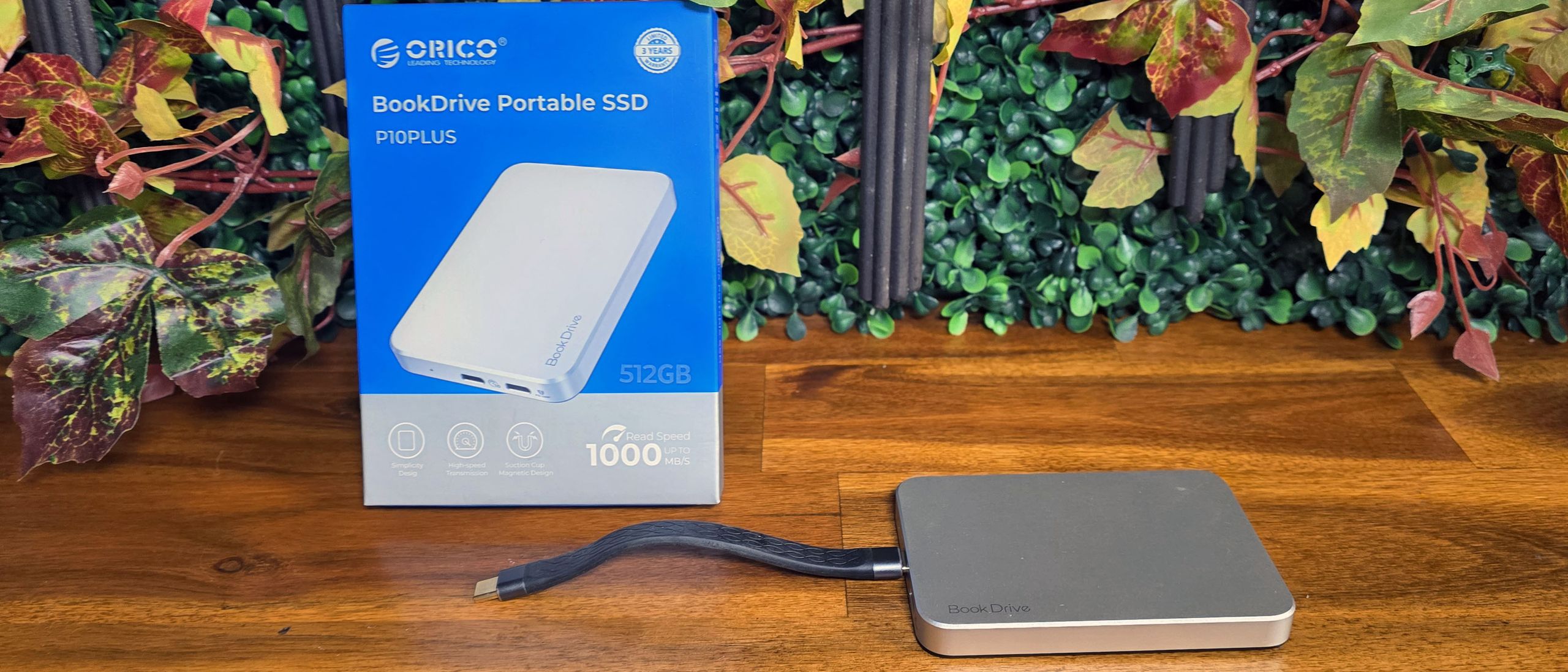
In early 2025, we updated our external storage testbed to an AMD Ryzen 7600X-based PC with an Asus ROG Crosshair X870E Hero motherboard, installed in Lian Li’s Lancool 217 case . This was done in part because we needed a system with native USB4 support for upcoming drives (like this one).
All the drives in the charts below have been re-tested on the new X870E system, with the exception of the final Iometer sustained sequential test. That benchmark is less about top speed and more about how long a drive can write before depleting any fast cache onboard. We also updated to CrystalDiskMark 8, rather than the older (and non-comparable) version 7 we used on the previous testbed.
PCMark 10 is a trace-based benchmark that uses a wide-ranging set of real-world traces from popular applications and everyday tasks to measure the performance of storage devices.
Orico's BookDrive started out our testing looking quite good. Its score of 1221 put it just behind the fastest 10 Gbps drives we've tested (both from Crucial), and well ahead of big-name brands like Samsung and SK hynix.
In this real-world file transfer test, the Orico BookDrive lands in the lower-middle portion of our charts, competing with Kioxia's 10 Gbps Exceria drive, but falling slightly behind.
CrystalDiskMark (CDM) is a free and easy-to-run storage benchmarking tool that SSD companies commonly use to assign product performance specifications. It gives us insight into how each device handles different file sizes. We run this test at its default settings.
Moving back to synthetic tests, the Orico drive lands last in synthetic reads and writes, but it's still close on the heels of SK hynix's Beetle and Samsung's T9.
But looking at small file performance, the Orico drive jumps back up the charts, landing in third place among 10 Gbps drives on reads and is neck-and-neck with the best in its class when it comes to writes.
A drive's rated write specifications are only a piece of the performance picture. Most external SSDs (just like their internal counterparts) implement a write cache , or a fast area of flash, programmed to perform like faster SLC, that absorbs incoming data.
Sustained write speeds often suffer tremendously when the workload saturates the cache and slips into the "native" TLC or QLC flash. We use Iometer to hammer the SSD with sequential writes for 15 minutes to measure the size of the write cache and performance after the cache is saturated.
Ouch. We've weeded out some of the competition here, to make this chart more legible, but that doesn't exactly help Orico's BookDrive. Its performance was fine on this test for the first 140 seconds or so, hovering in the mid-900 MB/s range. But after the drive's cache was used up, its performance cratered into the 60-80 MB/s range for the rest of the test, occasionally dipping below 50 MB/s. Now, for this drive's primary purpose of recording video from a smartphone, that should still generally be OK so long as you aren't straying much beyond 4K/60. But note that even the Kingston DataTraveler Max, which is one of the best flash drives , did noticeably better on this sustained write test. And the Crucial X9 hovered at or above the mid-900 Mbps range for the duration of this test, making its sustained write speed about 14x faster than the Orico drive, while costing about $12 less. To be fair, the Orico drive suffers somewhat here from the smaller 512GB capacity that the company sent for testing. The competing SSDs were tested at 1 or 2TB capacities, and an Orico rep told us that the SLC cache is configured to be roughly 20% of the drive's total capacity. But a larger SLC-style would only delay / mask what is clearly extremely slow native write performance. You might not notice it in many mainstream workloads, but if you do lots of large writes, this is definitely not the drive for you.
Orico's BookDrive P10PLUS brings passthrough charging and MagSafe support to an otherwise saturated and, frankly, boring 10 Gbps external storage field. Its features are welcome, particularly for smartphone users. And its performance in bursty tasks is at least decent. But its sustained write speeds scrape the bottom of the barrel of performance that we've seen from competing drives in recent years. That, combined with a price that's much more than big-name competition that's faster, makes it hard not to judge this book by the flash that is under its cover.
After a rough start with the Mattel Aquarius as a child, Matt built his first PC in the late 1990s and ventured into mild PC modding in the early 2000s. He\u2019s spent the last 15 years covering emerging technology for Smithsonian, Popular Science, and Consumer Reports, while testing components and PCs for Computer Shopper, PCMag and Digital Trends. ","collapsible":{"enabled":true,"maxHeight":250,"readMoreText":"Read more","readLessText":"Read less"}}), "https://slice.vanilla.futurecdn.net/13-4-17/js/authorBio.js"); } else { console.error('%c FTE ','background: #9306F9; color: #ffffff','no lazy slice hydration function available'); } Matt Safford After a rough start with the Mattel Aquarius as a child, Matt built his first PC in the late 1990s and ventured into mild PC modding in the early 2000s. He’s spent the last 15 years covering emerging technology for Smithsonian, Popular Science, and Consumer Reports, while testing components and PCs for Computer Shopper, PCMag and Digital Trends.
Key considerations
- Investor positioning can change fast
- Volatility remains possible near catalysts
- Macro rates and liquidity can dominate flows
Reference reading
- https://www.tomshardware.com/pc-components/external-ssds/SPONSORED_LINK_URL
- https://www.tomshardware.com/pc-components/external-ssds/orico-bookdrive-p10plus-512gb-review#main
- https://www.tomshardware.com
- India’s Global Systems Integrators Build Next Wave of Enterprise Agents With NVIDIA AI, Transforming Back Office and Customer Support
- Behind the scenes of our massive CPU retest for Bench — testing at 1080p, choosing new apps, and gathering data for a decade of CPUs
- All About the Games: Play Over 4,500 Titles With GeForce NOW
- OpenAI strikes deal with Pentagon following Claude blacklisting — Anthropic to challenge supply chain risk designation in court
- Finance techie says they cloned Bloomberg's $30k-a-year Terminal with Perplexity's Computer — project draws both praise and sizable skepticism
Informational only. No financial advice. Do your own research.