
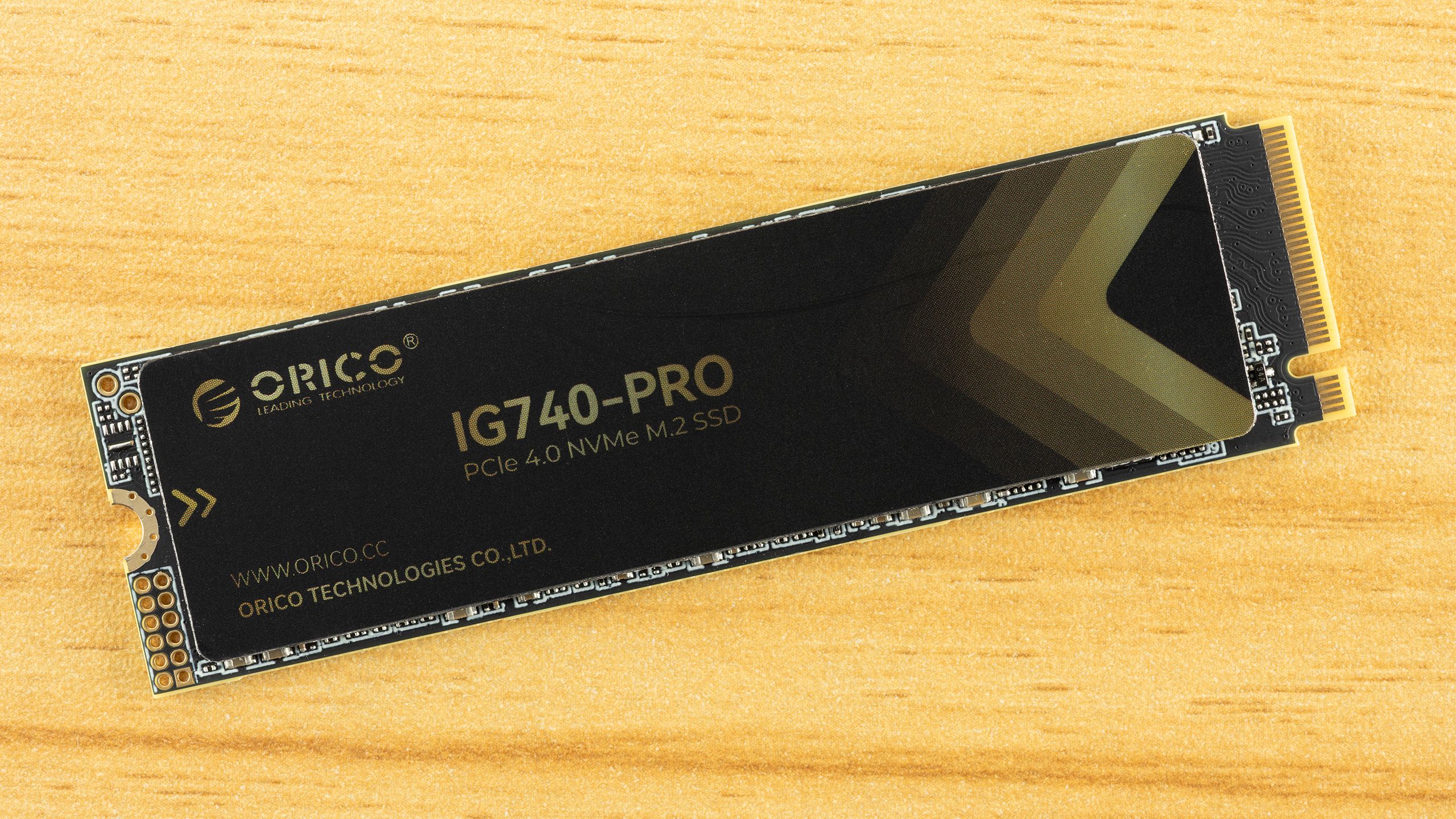
The Orico IG740-Pro comes in 512GB, 1TB, 2TB, and 4TB flavors. This is a decent capacity range, but we would generally not mention the 512GB SKU, and it might be impossible to find, anyway. That capacity is getting harder to support with denser flash, although market changes and some relatively recent flash news – like Kioxia’s/SanDisk’s BiCS9 going back to fewer layers and smaller dies – might change this. Flash is always the most expensive part of a drive, but right now the ratio is much higher than usual. Speaking of expensive, the IG740-Pro is not currently listed for sale in the U.S., but the 1TB should be going for under $150, which would be the current $156 for the Biwin Black Opal NV7400 and closer to the $145 for the Lexar NQ780.
The drive can reach up to 7,450 / 6,500 MB/s for sequential read and write workloads, which is pretty close to the limit of the PCIe 4.0 interface. The drive also reaches up to at least 1,000K / 800K random read and write IOPS. The exact limit is in this ballpark, but honestly, it’s plenty fast for its class of drive. Orico backs it with a five-year, 600TB of data written per TB of capacity (TBW) warranty, which is interesting. This is standard for drives with TLC flash; however, this drive – at least at 1TB – has been reported as also coming with QLC flash.
So, why would Orico have this TBW regardless of flash type? Well, a set TBW can make flash swapping easier if the specification is low enough, and while we have only heard that the 1TB model can come with QLC flash, the 512GB would almost certainly be TLC, for what it’s worth, the 2TB and 4TB models could technically come with QLC as well. The fact is, YMTC’s 232-Layer QLC flash has enough endurance to reach this TLC-level of TBW. Luckily, flash wear should be the least of your worries with a consumer drive and a five-year warranty unless you’re doing enterprise -level workloads. In that case, you really shouldn’t be looking at a 1TB, off-the-shelf, QLC-based, DRAM-less drive in the first place, but if, for some reason, you are, then 600TBW per TB is still a decent amount of writes. Plus, we have no hard evidence to indicate Orico has made any such switch.
If you’re looking for health and general drive information, we recommend the free CrystalDiskInfo utility . It will quickly give you information like the amount of writes to the drive, link width and speed, firmware revision, and more. For data backup and drive cloning on Windows, the free MultiDrive is an excellent choice. For a bootable solution or other operating systems, Clonezilla remains the standard.
Get Tom's Hardware's best news and in-depth reviews, straight to your inbox.
Key considerations
- Investor positioning can change fast
- Volatility remains possible near catalysts
- Macro rates and liquidity can dominate flows
Reference reading
- https://www.tomshardware.com/pc-components/ssds/SPONSORED_LINK_URL
- https://www.tomshardware.com/pc-components/ssds/orico-ig740-pro-1tb-ssd-review#main
- https://www.tomshardware.com
- Orico IG740-Pro 1TB SSD Review: A small budget sleeper
- China's top chip execs claim ASML alternative 'small, fragmented, and weak' — Chinese industry titans call for national effort to invest in advanced chipmaking
- Pocket $219 in savings when you buy this blistering 9800X3D, motherboard, and 32GB RAM bundle — start your AM5 4K gaming rig for less than $1,000
- March Into the Cloud With 15 New Games Coming to GeForce NOW
- Nvidia reportedly working on RTX 5050 with 9GB of VRAM on a 96-bit bus, featuring 28 Gbps GDDR7 modules — RTX 5060 with cut-down GB205 GPU also planned
Informational only. No financial advice. Do your own research.