
At this rate, finding the last digit is probably just a few years down the road.
When you purchase through links on our site, we may earn an affiliate commission. Here’s how it works .
(Image credit: StorageReview) Share Share by: Copy link Facebook X Whatsapp Reddit Flipboard Share this article Join the conversation Follow us Add us as a preferred source on Google The competition to calculate digits of Pi was initially an informal pursuit but grew more serious over time. Our server-oriented colleagues at StorageReview have proven that storage performance can make or break a Pi run, setting their latest record at a whopping 314 million digits with a single server that ran for four months.
Calculating Pi quickly became a way to benchmark the floating-point performance of CPUs. As the calculations grew ever larger, however, the task became more complicated, as RAM, I/O architectures, and storage systems came into play. That's a point StorageReview clearly illustrated by achieving a record with a single 2U server over a four-month calculation run.
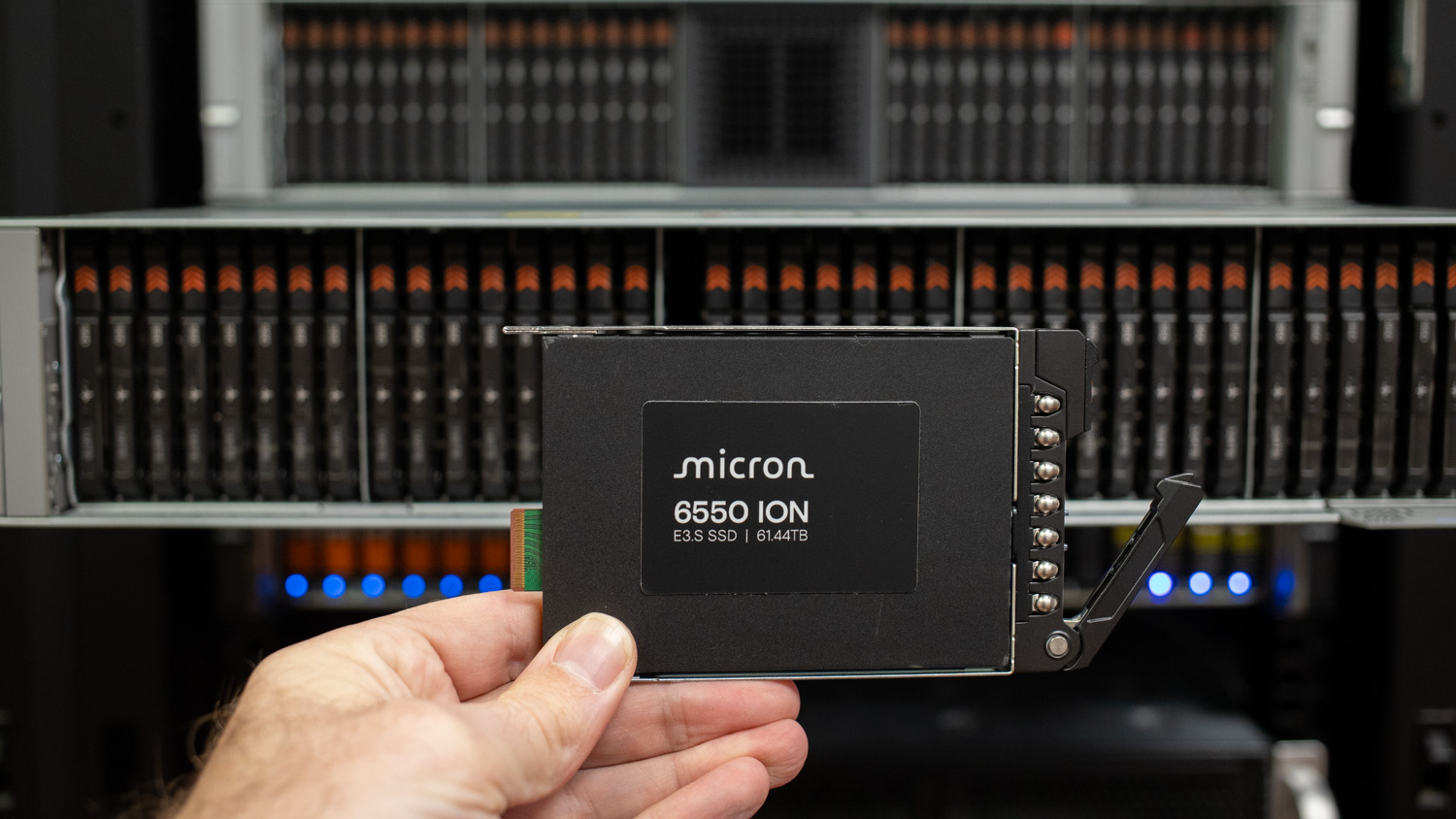
The said machine is a Dell PowerEdge R7725 unit fitted with two AMD Epyc 192-core chips, for a total of 384 cores, along with 1.5 TB of DDR5 memory, an amount that could probably buy a small country at today's prices. The storage array is where this setup shines, though, with 2.5 peta bytes of storage thanks to a 40-drive array of Micron 6550 Ion SSDs at 61.44 TB each.
Veteran dev’s newest computer is ‘200,000 times’ faster than his oldest in custom benchmarks
Toshiba touts industry-first 12-disk HDD stacking technology, will pair with microwave-based recording tech
AI data centers are swallowing the world's memory and storage supply, setting the stage for a pricing apocalypse that could last a decade
It's long been the case that calculating Pi to such long extents requires a significant amount of bytes to store intermediate computations. After all, you're dealing with factors that are trillions of digits long. Past approaches, such as Google 's 100-trillion record in 2022, used cloud server instances, and Linus Media Group and Kioxia's 300-trillion-digit run earlier this year used a Weka cluster with shared storage. But StorageReview opted to prove a point by using plain ol' simple fast local SSDs.
It's worth noting that one key factor enabling the 314-trillion-digit run is that, unlike the previous generation, the 17th-generation Dell servers used don't have a PCIe switch in their storage backplane; instead, they use a direct connection to the CPUs' PCIe lanes. With 40 bays, that works out to 2 to 4 lanes per SSD, but that still worked out to a meaty 280 GB/s of read/write performance, much higher figures than StorageReview's own past experiments.
There were additional relevant optimizations as well. The team tweaked the machine's scratch array for the patterns generated by the y-cruncher software at large digit counts. It also changed the server's standard air-cooling configuration to a CoolIT AHx10 setup, resulting in higher steady-state load clocks for the Epyc chips.
The power consumption was only 1,600W, a high number on its own but actually a pretty impressive figure as far as efficiency is concerned. Last but not least, the OS was changed from Windows Server to Ubuntu 24.04.2, a simple switch that resulted in better I/O performance on its own. We can't help but wonder if using the latest Windows Server release with native NVMe support would have been comparable. If you're curious about more details, go ahead and read the entirety of StorageReview's write-up .
Get Tom's Hardware's best news and in-depth reviews, straight to your inbox.
Key considerations
- Investor positioning can change fast
- Volatility remains possible near catalysts
- Macro rates and liquidity can dominate flows
Reference reading
- https://www.tomshardware.com/pc-components/storage/SPONSORED_LINK_URL
- https://www.tomshardware.com/pc-components/storage/pi-calculating-record-shattered-at-314-trillion-digits-with-a-four-month-run-on-a-single-server-storagereview-retakes-the-crown-thanks-to-storage-bandwidth#main
- https://www.tomshardware.com
- Copy of Grand Theft Auto that runs in a web browser gets taken down by DMCA — Take Two says DOS Zone infringed company’s intellectual property rights despite di
- [Daily Due Diligence] NVDA NVDA
- Save $650 on this powerful RTX 5070 Ti gaming PC with 32GB RAM and 2TB SSD — now just $1649, this formidable MSI Aegis Z2 machine is perfect for a 1440p setup
- AMD's dual-cache Ryzen 9 9950X3D2 appears in first benchmark leaks — gaming-focused CPU features 192MB of L3 cache stacked across both CCDs
- Nvidia reportedly backs away from its effort to make its own public cloud, team reorg eases friction with customers — chipmaker shifts unit's focus to internal
Informational only. No financial advice. Do your own research.