
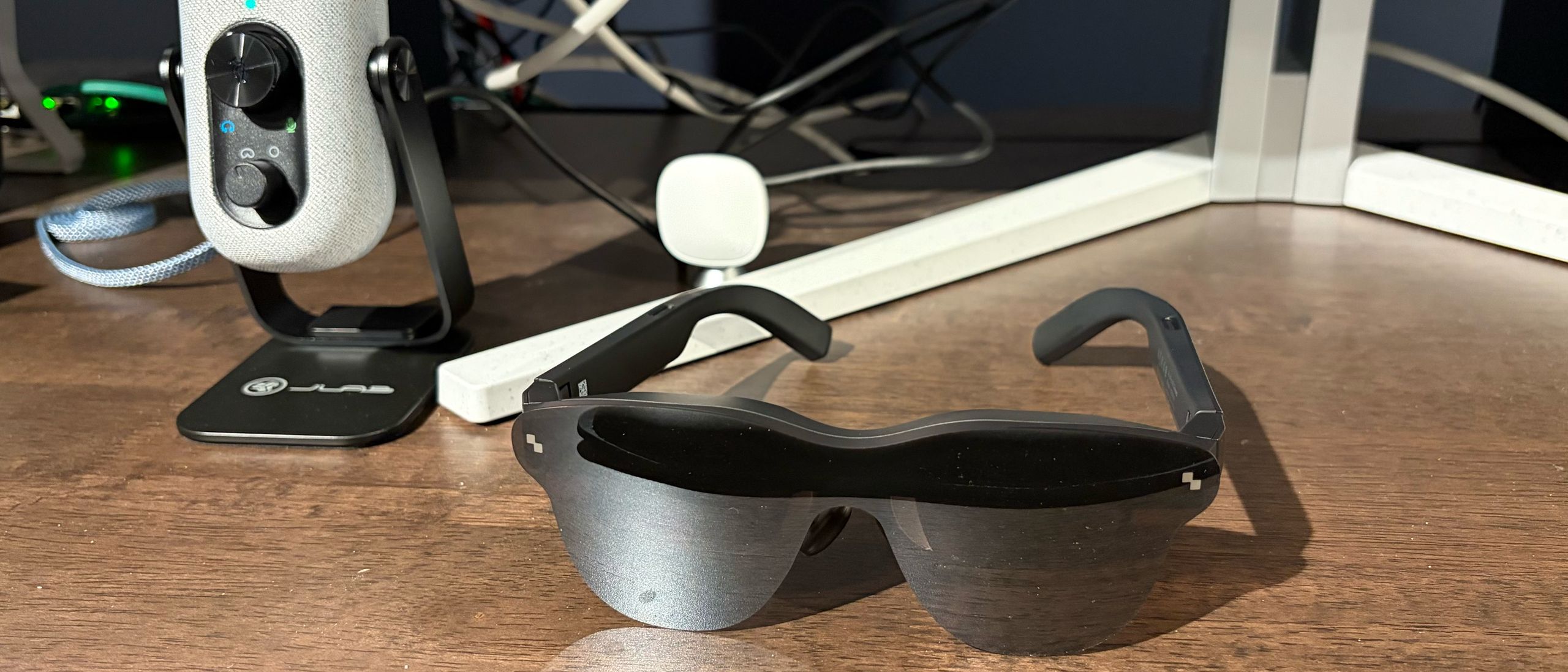
The Air 4 Pro uses new 0.6-inch MicroLED projectors (1920 x 1080 per eye, 3840 x 1080 in 3D mode) from SeeYa, and includes dual bird bath lenses, up to a 120 Hz refresh rate, HueView 2.0 technology, and a native contrast ratio of 200,000:1. The most significant addition is support for HDR10, which RayNeo says is a first in this category. HDR10, developed by the UHD Alliance and the Consumer Electronics Association (CEA), is an open-source, 10-bit standard for delivering higher contrast and a wider color gamut than traditional SDR content.
The Air 4 Pro uses the same felt case I disliked on the Air 3s Pro, though it’s black instead of grey this time. It’s an obvious example of cost-cutting compared to the hard zipper case that came with the previous RayNeo AR glasses. One annoyance is that you have to press the button closure on the flip cover just right to snap it closed. RayNeo continues to provide a USB-C to USB-C cable, cleaning cloth, and a frame for prescription lens inserts in the box (along with the aforementioned plastic light blocker).
Given my familiarity with RayNeo’s “Air” family, using the Air 4 Pro was like second nature to me. The controls fall easily to hand, so I quickly dialed the brightness up to the maximum level using the rocker on the left temple. The first thing I did with the glasses was plug them into my iPad Pro and open an HDR10 video on YouTube. However, every time it tried to select the HDR stream for the video, I received a playback error.
Doing frequent back-to-back tests with the Air 3s Pro (SDR) and Air 4 Pro (HDR10) showed minimal differences in image quality. The colors perhaps looked a tad richer with a tiny bit more contrast on the Air 4 Pro, but it wasn’t a knock-your-socks-off upgrade. I also watched about 15 minutes of Marvel’s Thunderbolts on Disney Plus in HDR10, and again saw minimal gains compared to watching the same scenes on the Air 3s Pro.
My “eyes on” testing continued with an iPhone 17, a Lenovo Legion Go, and a MacBook Air. There wasn’t much of a visual quality difference between using the devices, but I found myself using the iPhone 17 and Legion Go while lying on the couch. I’d watch movies and YouTube clips with the iPhone, while I’d play Microsoft Flight Simulator on the Legion Go. When using my MacBook Air, I was happy to sit upright in my recliner and enjoy the massive virtual screen that the Air 4 Pro provides.
The light blockers came in handy for the brief time I sat on my back porch in the bitter cold to test how the glasses performed under outdoor light. Looking out at the trees in my backyard, the content was projected uninterrupted. Without the light blockers, I could see the outline of the trees and the sky through what I was watching.
While the visual upgrade wasn’t earth-shattering, the improvement to the audio quality was more tangible. Let me start by saying that the speakers on the Air 3s Pro are excellent, with good clarity, plenty of volume without distortion, and a hint of bass (or as much as can be expected in a glasses form-factor).
I found that the Surround mode sounded best to me, giving a “3D” effect to the audio experience. However, in every audio mode, the volume sounded slightly lower than what I experienced on the Air 3s Pro. The maximum volume level on the Air 3s Pro was already pretty loud, so dialing it back slightly wasn’t that big of an issue to me. That said, Surround mode was more effective than the “Spatial” option on the Air 3s Pro, and overall, speech in movies and music sounded better on the Air 4 Pro.
Slow and steady wins the race, and that seems to be the mantra for RayNeo. The company has steadily iterated on its Air family, as we’ve seen with the Air 3s, Air 3s Pro, and now the Air 4 Pro. The Air 3s brought about a thorough improvement to the speaker system; the Air 3s Pro delivered brighter Micro-OLED projectors; and the Air 4 Pro comes with further tweaks to the speaker system, thanks to a collaboration with Bang & Olufsen and HDR10 support.
The result is an unbeatable value among AR glasses, with an MSRP of $299. The closest competition is the Xreal One, which has a street price of around $449 . The Xreal One has better build quality, but it’s not worth the $150 price premium of the Air 4 Pro. And if you want to go even cheaper, the Air 3s Pro is now an even more compelling option with its lower $229 street price (down from $299).
Brandon Hill is a senior editor at Tom's Hardware. He has written about PC and Mac tech since the late 1990s with bylines at AnandTech, DailyTech, and Hot Hardware. When he is not consuming copious amounts of tech news, he can be found enjoying the NC mountains or the beach with his wife and two sons. ","collapsible":{"enabled":true,"maxHeight":250,"readMoreText":"Read more","readLessText":"Read less"}}), "https://slice.vanilla.futurecdn.net/13-4-17/js/authorBio.js"); } else { console.error('%c FTE ','background: #9306F9; color: #ffffff','no lazy slice hydration function available'); } Brandon Hill Social Links Navigation Brandon Hill is a senior editor at Tom's Hardware. He has written about PC and Mac tech since the late 1990s with bylines at AnandTech, DailyTech, and Hot Hardware. When he is not consuming copious amounts of tech news, he can be found enjoying the NC mountains or the beach with his wife and two sons.
Key considerations
- Investor positioning can change fast
- Volatility remains possible near catalysts
- Macro rates and liquidity can dominate flows
Reference reading
- https://www.tomshardware.com/peripherals/wearable-tech/SPONSORED_LINK_URL
- https://www.tomshardware.com/peripherals/wearable-tech/rayneo-air-4-pro-ar-glasses-review#main
- https://www.tomshardware.com
- Amazon invests $50 billion in OpenAI, comitting to 2 gigawatts of Trainium silicon — AWS to become exclusive cloud distributor for Frontier enterprise platform
- India Fuels Its AI Mission With NVIDIA
- All About the Games: Play Over 4,500 Titles With GeForce NOW
- California introduces age verification law for all operating systems, including Linux and SteamOS — user age verified during OS account setup
- Save $177 on this epic Newegg combo with AMD Ryzen 7 9800X3D, 32GB DDR5 RAM, and a Gigabyte X870E motherboard — $1,000 deal gets you the barebones of a powerhou
Informational only. No financial advice. Do your own research.