
When you purchase through links on our site, we may earn an affiliate commission. Here’s how it works .
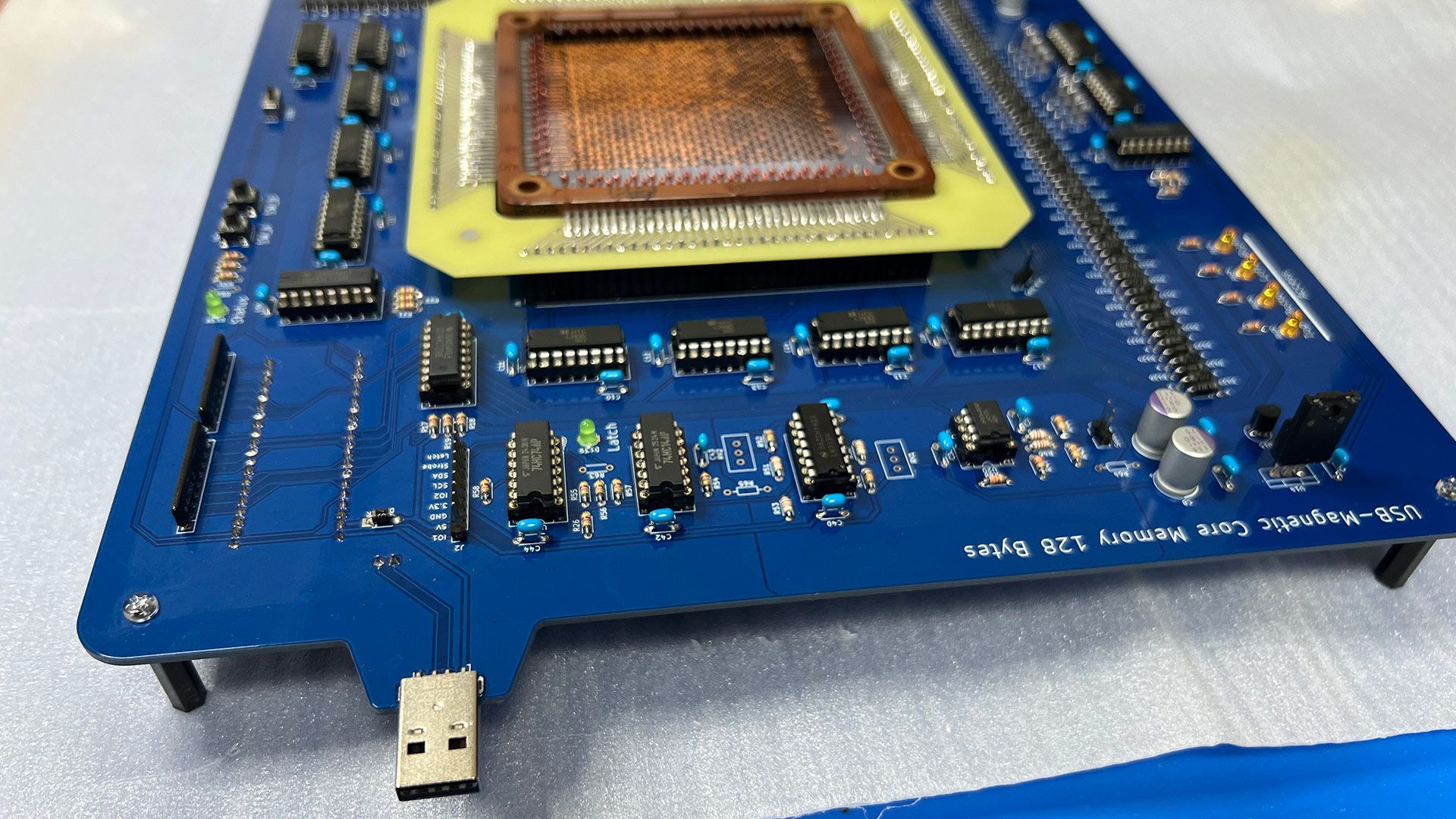
(Image credit: @dyd_Nao on X ) Share Share by: Copy link Facebook X Whatsapp Reddit Pinterest Flipboard Email Share this article Join the conversation Follow us Add us as a preferred source on Google A computing enthusiast has assembled one of the most bizarre USB drives we have ever seen. Despite being the size of a dinner plate, this drive holds just 128 bytes of data. The incredibly poor data density is largely due to the use of the archaic Magnetic Core Memory technology, which predates integrated circuits. Moreover, data saved to this drive is non-volatile (good), but bits are erased during the read process (bad). Despite the drawbacks and impractical nature of this device, created by space science researcher @dyd_Nao on X (machine translation), we applaud the effort.
部品一通り載せ終わった ちゃんとUSB-A端子ついてるしどう見てもUSBメモリやな pic.twitter.com/Lnpbrxmczn January 31, 2026
The Japanese tech enthusiast has mixed this curiously old memory tech with modern ICs and interfaces to come up with this bizarre USB flash drive. Built around the central non-volatile core are modern components like driver chips, sense amplifiers, LEDs, and the USB functionality is provided by a Raspberry Pi Pico . The Pico also handles the rewrite cycle.
Of course, this project was more ‘can I?’ rather than ‘should I,’ as 128 bytes of kinda-NV-RAM on a very large USB drive is of no practical purpose that we can fathom. Actually, 128 bytes isn’t even enough to store the full text from an old-school Twitter Tweet. One of the original post commenters notes that Magnetic Core Memory has good resistance to radiation. But what of all the supporting components…?
Legendary Windows Pinball developer rescues 200lb magnetic disc drive from the 1980s
A tiny 0.5MB SmartMedia card wins the Small Capacity Memory Card Championship (Japan)
Retro computing enthusiast creates perforated tape reader that reads at 50 bytes/sec
Magnetic Core Memory was used as RAM before the semiconductor DRAM breakthrough in the 1970s. You can read more about it at places like Wikipedia , but, in brief, it stored data on tiny ferric rings wrapped in wire. If you look at the example photos from @dyd_Nao, you’d observe the central grid-like structure, which is the core plane.
On the plus side, it was non-volatile RAM technology. However, amongst its many drawbacks were its expense, low density, and lack of scalability due to its sometimes hand-woven construction. Moreover, reading the data was ‘destructive’ – or in other words, reading the data would erase the data, so a system would need to re-write it immediately if it wanted the data to persist post-read.
Magnetic Core Memory was first used by a computer in 1953, in MIT’s Whirlwind computer. It is a memory technology that predates integrated circuits, and was actually a RAM standard from 1955 to the early 70s. Intel actually pioneered semiconductor DRAM with its 1103 DRAM ICs in late 1970, commercially debuting cheaper, faster, and denser computer memory tech.
Follow Tom's Hardware on Google News , or add us as a preferred source , to get our latest news, analysis, & reviews in your feeds.
Get Tom's Hardware's best news and in-depth reviews, straight to your inbox.
Key considerations
- Investor positioning can change fast
- Volatility remains possible near catalysts
- Macro rates and liquidity can dominate flows
Reference reading
- https://www.tomshardware.com/pc-components/usb-flash-drives/SPONSORED_LINK_URL
- https://www.tomshardware.com/pc-components/usb-flash-drives/researcher-builds-bizarre-128-byte-usb-drive-the-size-of-a-dinner-plate-using-ancient-pre-semiconductor-magnetic-core-memory-technology-data-disappears-once-it-is-read-requiring-special-handling#main
- https://www.tomshardware.com
- Intel mandates at least 7,467 MT/s RAM speed for Panther Lake — Slower memory will relabel the Arc B370 & B390 iGPUs as generic "Intel Graphics" in Task Manager
- Into the Omniverse: Physical AI Open Models and Frameworks Advance Robots and Autonomous Systems
- ZX Spectrum flies simulated spacecraft using BASIC, Python, and serial — Kerbal Space Program Lunar lander powered by 1980s hardware
- Smart ways to help your PC survive through the PC component pricing apocalypse — check temps, replace old AIOs and PSUs, keep an eye on your boot drive's TBW, a
- Trump administration plans $12bn critical minerals stockpile to offset China supply risk — initiative to create 60-day reserve of rare earths for electronics ma
Informational only. No financial advice. Do your own research.