
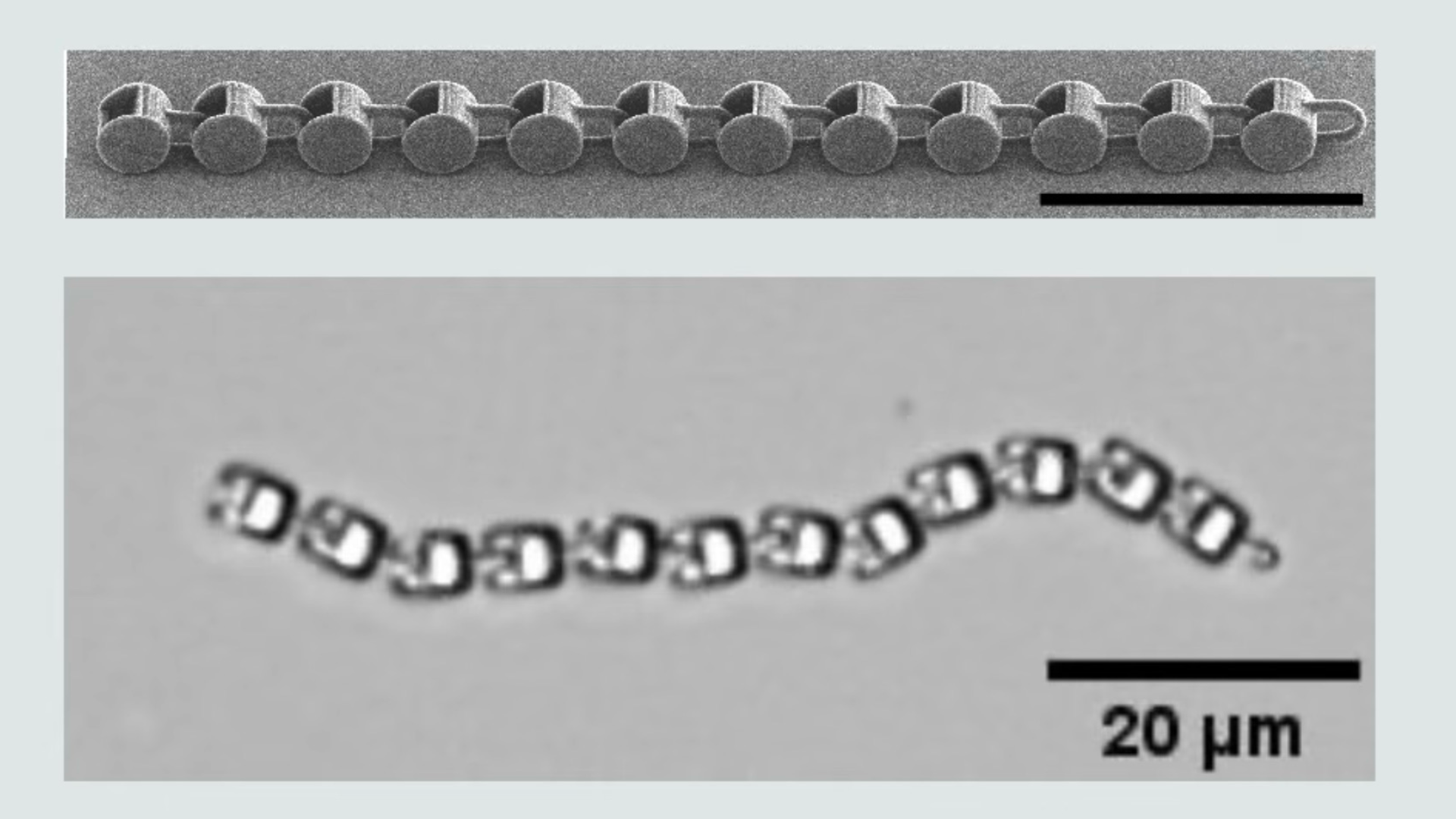
These robots are smaller than a strand of human hair but can move independently even without a motor and sensors.
When you purchase through links on our site, we may earn an affiliate commission. Here’s how it works .
Researchers from Leiden University in the Netherlands successfully 3D printed a microscopic robot that moves around like a single-celled organism, despite not having a brain. According to the institution , these robots measure between 0.5 and 5 micrometers and can travel at speeds of 7 micrometers per second. By comparison, human hair is about 70 to 100 micrometers thick, showing how tiny these 3D robots are. The university also noted that these devices are printed at the very edge of what is technically possible at the moment.
Watch On But what’s more interesting is how these microrobots achieve movement without sensors, motors, a processor, or even external control. Instead, they propel themselves based on their shape and how the environment interacts with that. These bots are inspired by the movements of similar biological creatures.
“Animals like worms and snakes constantly adapt their shape as they move, which helps them to navigate their environments,” Prof. Daniela Kraft, one of the researchers who worked on the project, said. “However, until now, microrobots were either small and rigid or large and flexible. We wondered if we could realize small and flexible microrobots in our lab.”
You may like Harvard researchers develop novel 3D printing method for soft robotics MIT-developed 3D printer can output a fully functional electric motor in a single process Shanghai scientists create computer chip in fiber thinner than a human hair, yet can withstand crushing force of 15.6 tons The microrobots spring into motion when exposed to an electric field, with their soft, chain-like structure moving in various ways. “We discovered there’s continuous feedback between the shape and motion of the robot: the shape influences how it moves, and its movements in turn alters its shape,” says Prof. Kraft. “This microrobot therefore senses how the environment changes its body and reacts to it, making it appear life-like. This means that we don’t need microscopic electronics for integrating smart abilities.”
Postdoctoral researcher Mengshi Wei also added, “When the robot is slowed down or even stopped, it starts to wave its tail as if it wants to break free. This happens before the elements in the back still want to move, and they can do so because of their flexibility.”
These tiny robots have a lot of potential in medicine, with their size and natural movement making them great candidates for targeted drug delivery, minimally invasive surgery, and diagnostics. Still, there is a lot of work to be done, including the need to understand what exactly causes its movement and what capabilities we could extract out of them.
Follow Tom's Hardware on Google News , or add us as a preferred source , to get our latest news, analysis, & reviews in your feeds.
Get Tom's Hardware's best news and in-depth reviews, straight to your inbox.
Key considerations
- Investor positioning can change fast
- Volatility remains possible near catalysts
- Macro rates and liquidity can dominate flows
Reference reading
- https://www.tomshardware.com/3d-printing/SPONSORED_LINK_URL
- https://www.tomshardware.com/3d-printing/researchers-3d-print-robot-the-size-of-a-single-cell-organism-devices-move-and-navigate-even-without-a-brain-uses-their-shape-and-the-environment-to-get-going#main
- https://www.tomshardware.com
- Artemis II will use laser beams to live-stream 4K moon footage at 260 Mbps — one giant step beyond the S-band radio comms of the Apollo era
- Ubuntu Linux raises minimum system memory requirements by 50% — requirements bumped to 6GB of RAM, previously raised from 1GB to 4GB in 2018
- Sharge Disk Pro 2TB review: Great sustained writes, active cooling, and a built-in hub
- Snap Decisions: How Open Libraries for Accelerated Data Processing Boost A/B Testing for Snapchat
- Why Nvidia just poured $2 billion into AI ASIC competitor Marvell — NVLink Fusion turns into soft ecosystem lock-in
Informational only. No financial advice. Do your own research.