
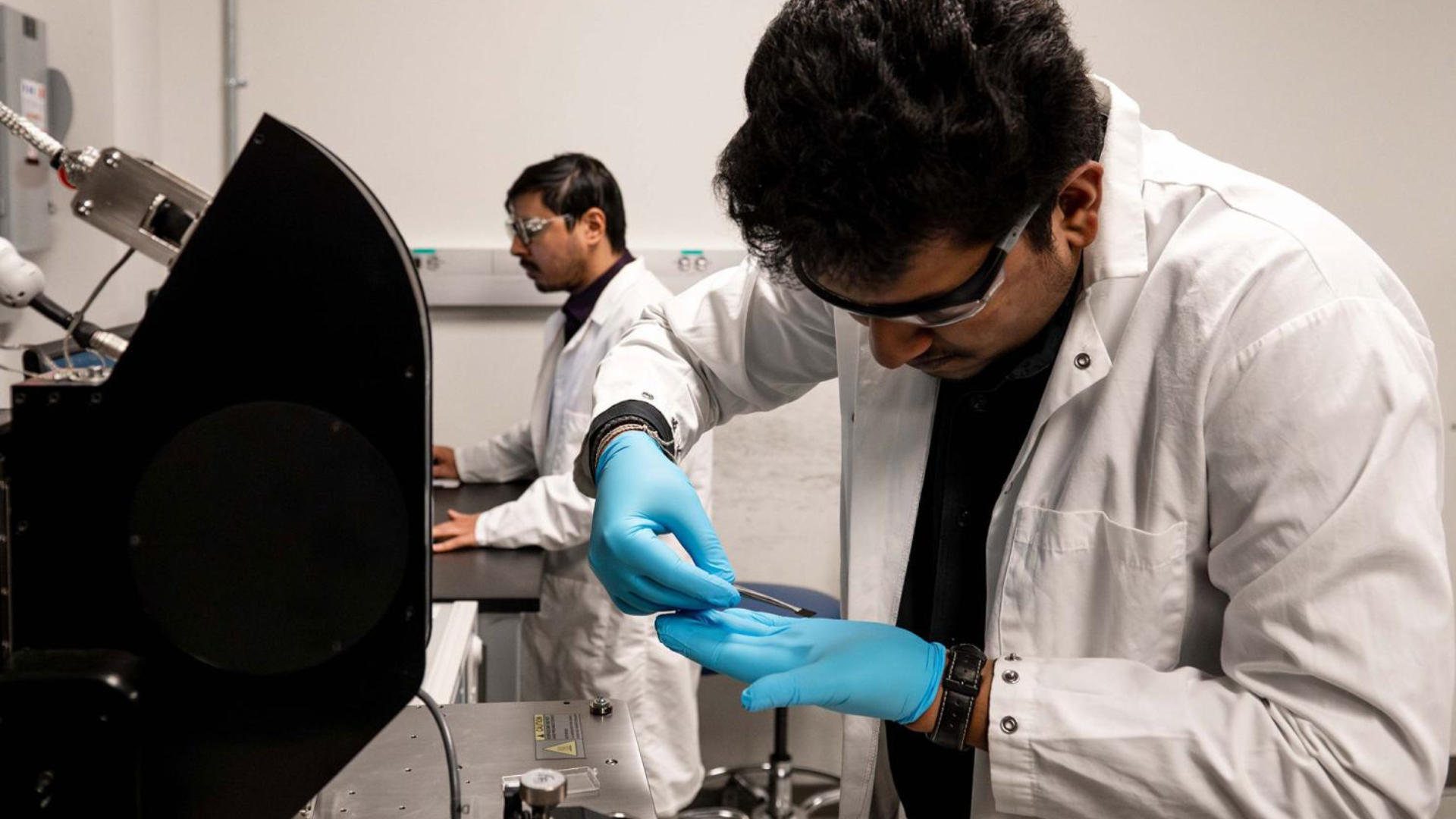
The 2D material sensors detect temperature changes in 100 nanoseconds and are over 100 times smaller than conventional designs.
When you purchase through links on our site, we may earn an affiliate commission. Here’s how it works .
Penn State researchers have developed what they’re calling microscopic temperature sensors that are small enough to embed directly into processor chips, according to a paper published March 6 in Nature Sensors . The sensors, built from a novel class of two-dimensional materials, can detect temperature changes in 100 nanoseconds — millions of times faster than the blink of an eye, Penn State’s press release reads — and pack down to just one square micrometer, a size so small that thousands can be placed on a single chip.
Processors currently rely on temperature sensors placed outside the chip die itself, which limits the speed and precision of thermal monitoring. That gap’s important because individual transistors can spike in temperature faster than external sensors can register, forcing chips to apply conservative thermal throttling across entire cores rather than responding to localized hotspots. Penn State's design addresses that by integrating sensing directly into the silicon, using the same electrical currents already running through the chip.
The sensors are built from bimetallic thiophosphates, a two-dimensional material not previously used in thermal sensing. The material's key property is that its ions continue moving freely even when exposed to an electrical current. That’s a behavior that chip engineers normally try to eliminate in transistors, but the Penn State team exploited it instead, coupling ion transport for temperature detection with electron transport for reading that thermal data. The result is a sensor that the researchers claim requires no extra circuitry or signal converters and draws up to 80 times less power than conventional silicon-based thermal sensors.
Shanghai scientists create computer chip in fiber thinner than a human hair, yet can withstand crushing force of 15.6 tons
Intel details progress on fabbing 2D transistors a few atoms thick in standard high volume fab production environment
Chinese researchers discover new salty cooling solution that can drop temperatures by more than 50 degrees Celsius in seconds
"What is generally unwanted by industry in transistors is actually great for thermal sensing, so we really tried to exploit that in our design," said Saptarshi Das, professor of engineering science and mechanics at Penn State and corresponding author on the paper. “Rather than try to remove these ions from this system, we use them to our advantage," he goes on to explain, adding that coupling the ions for temperature sensing and electrons for reading that thermal data allowed the team to build an extremely accurate but compact device.
Das was clear, however, that the work is a proof of concept. While the sensors have been manufactured and tested in the lab using Penn State's Materials Research Institute Nanofabrication Laboratory, the path to commercial chip integration would require chipmakers to validate the process at scale. Still, the demonstrated specs — a 100-nanosecond response time, one square micrometer footprint, and no need for additional circuitry — address some of the constraints that have kept on-die thermal monitoring out of production silicon.
Follow Tom's Hardware on Google News , or add us as a preferred source , to get our latest news, analysis, & reviews in your feeds.
Get Tom's Hardware's best news and in-depth reviews, straight to your inbox.
Key considerations
- Investor positioning can change fast
- Volatility remains possible near catalysts
- Macro rates and liquidity can dominate flows
Reference reading
- https://www.tomshardware.com/tech-industry/SPONSORED_LINK_URL
- https://www.tomshardware.com/tech-industry/penn-state-researchers-build-atom-thin-thermometers#main
- https://www.tomshardware.com
- Oracle reportedly set to axe thousands of jobs and freeze hiring as AI data center bets ignite financial perfect storm — cuts in cloud division to be backfilled
- Go beyond the review with Bench, the deepest consumer hardware benchmarking database on the internet — compare hundreds of products across a range of categories
- PC processors entered the Gigahertz era today in the year 2000 with AMD's Athlon — AMD hit marketing gold with its 1 GHz Athlon, beat Intel by a nose
- Car powered by 500 disposable vape batteries boasts 18-mile range, 35mph top speed, USB-C charging port — early 2000s Reva G.Wiz gets a makeover
- NVIDIA DGX Spark Powers Big Projects in Higher Education
Informational only. No financial advice. Do your own research.