
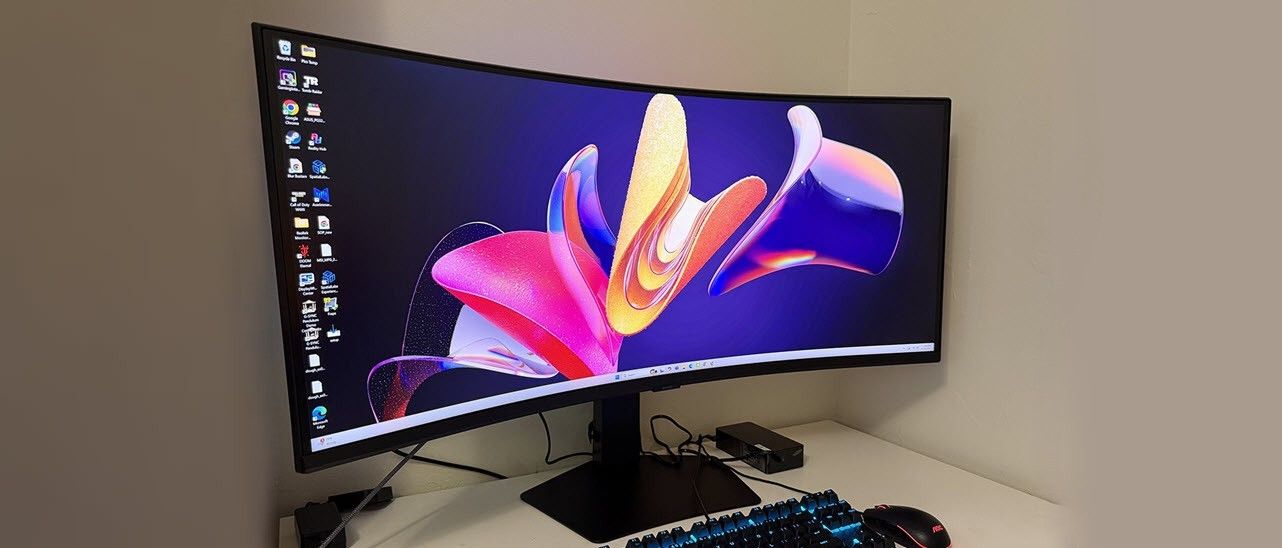
The Odyssey G7 comes in a coffin-like box with its contents protected by crumbly foam. The curvaceous panel is well secured in a large, molded block. The chance of damage is small. The solid metal base and stout upright snap together, then the panel hooks on for a toolless assembly. A large external power supply comes with right-angle plugs, and you get USB, DisplayPort and HDMI cables. A trim ring covers up the panel’s attachment point and is part of the lighting effect.
(Image credit: Samsung) (Image credit: Tom's Hardware) (Image credit: Samsung) (Image credit: Samsung) (Image credit: Samsung) The Odyssey G7 makes a bold statement with its extreme 1000R curve and three-foot width. You will need some space to accommodate that 40-inch screen. The base is relatively small but super solid and weighty as it’s made from a thick aluminum plate. The upright snaps on and offers a 4.7-inch height adjustment, 5/20 degrees tilt and 20 degrees swivel in either direction. Movements are firm and precise, the way a premium monitor should be.
The only branding in front is a super tiny “Samsung” screened onto an equally tiny bulge at the bottom center. This is where you’ll find the nav pad OSD control. It isn’t a joystick, but it works like one with four directional keys and a center selector. They’re rubberized and very easy to operate. They control all monitor functions.
The back is mostly smooth except for a ribbed band across the bottom. You can see that the inputs face back instead of down. Though it’s a little harder to hide cables, it’s a lot easier to make and change connections. You can manage the wiring with a small rubber band on the upright. In the photo, you can see the LED lighting that rings the fulcrum in different color and effects that are found in the OSD.
The top and side photos show just how extreme the Odyssey G7 is. It’s super curvy, but the image is rendered with minimal distortion. The 40-inch size and 1000R shape strike a good balance between immersion and clarity. The picture is super sharp with no visible pixel structure or grain from the anti-glare layer. 140ppi is nearly as dense as an Ultra HD monitor.
The inputs include two HDMI 2.1 and one DisplayPort 1.4. You also get USB 3.2 with one upstream and two downstream ports. A 3.5mm jack accommodates headphones or powered speakers. There are none inside.
The LEDs are called Infinity Core, and they come with multiple color and effect options. All the lighting is in a ring around the back that encircles the stand’s attachment point.
For HDR signals, you retain most of the picture adjustments and you can engage dynamic tone mapping, which is very effective. This is a rare feature that should be included on every HDR monitor. It goes beyond the static tone mapping found in HDR10 content and ensures that the display shows the full dynamic range of the material. It significantly improves the HDR experience.
A 21:9 monitor is perfect for PBP and PIP, so you can view two video sources at once. The Odyssey G7 has options for window position and aspect ratio, as well as audio source and sizing.
The Odyssey G7 can be enjoyed without calibration in its Eco mode. Despite the name, it does not limit brightness, and it’s fully adjustable. I tweaked the RGB sliders, which are very precise, and adjusted gamma, to get a tiny gain in quality. The main improvement was slightly more color saturation, which is certainly a good thing. My settings are shown below. For HDR content, I recommend turning on the Dynamic Tone Mapping and setting Local Dimming to High.
I have played games on every type of monitor, and no format has the in-your-face realism of an extremely curved ultra-wide. The wraparound effect is truly a thing, super effective. Not only was my peripheral vision completely covered, but the enemies were larger and more invasive of my personal space, virtually that is. Even 3D displays don’t impart that feeling. And comparing the Odyssey G7 to 34-inch screens is almost no comparison. Six inches doesn’t sound like much, but when you add in the 1000R curve, it is almost night and day.
The Odyssey G7 won’t give you the perfect motion resolution of an OLED, but its overdrive was excellent enough that I preferred it over Adaptive-Sync. You’ll need a fast video card to accomplish this since tear-free operation only comes when the frame rate is locked at maximum. A GeForce RTX 4090 provided enough juice to keep the action at 180fps. If you go slower, AS might be the better choice. This said, Samsung should make it possible to use overdrive and AS at the same time.
HDR was superb in every respect. Though you won’t find as much saturation as a QD-OLED here, the Odyssey G7 still makes a very colorful impression with accuracy that is plain to see. It looked great whether I calibrated or not, but I saw just a tiny bit more saturation after tweaking the RGB sliders. Check out my settings above if you want the best possible picture.
Functionally, the Odyssey G7 was a pleasure to use. The OSD is intuitive and easy to navigate using the pad-style buttons underneath. I also appreciated the rear-facing inputs. This is a small thing, but it really does make wiring easier. And it’s something Samsung almost always does, and almost everybody else doesn’t. The only other brand that commonly features rear-facing inputs is LG . I appreciated the inclusion of USB ports. A type B means you can make the Odyssey G7 a hub for two other peripheral devices. However, there’s no KVM functionality. I briefly missed the internal speakers (there aren’t any) until I plugged in a pair of headphones and remembered that even cheap cans sound better than nearly all monitor speakers.
The Odyssey G7 is very useful day to day thanks to its PBP capability. The 21:9 aspect ratio means you can have two rectangular windows showing two sources, which is great for a PC and a gaming console, for instance. Working on documents is best done in the center third of the screen. Placing windows on the sides shows a little distortion, though it was never a distraction.
Takeaway: The Odyssey G7 is a super cool monitor with excellent gaming performance and a vivid image. For well below the cost of an OLED, you get about 90% of the experience. Its tight curve creates an immersive effect that can’t be equaled by a less curved or flat screen. And its 40-inch size puts the game right in your lap, and, in your face. It’s one of the more addictive screens I’ve had the pleasure of playing and working on.
Current page: Features and Specifications
Key considerations
- Investor positioning can change fast
- Volatility remains possible near catalysts
- Macro rates and liquidity can dominate flows
Reference reading
- https://www.tomshardware.com/monitors/gaming-monitors/SPONSORED_LINK_URL
- https://www.tomshardware.com/monitors/gaming-monitors/samsung-odyssey-g7-s40fg75-40-inch-ultra-wide-curved-gaming-monitor-review#main
- https://www.tomshardware.com
- Intel drops plans to sell networking and communication division — says keeping NEX in-house will strengthen integration and customer offerings
- AI On: 3 Ways Specialized AI Agents Are Reshaping Businesses
- Nvidia lobbies White House and wins loosened AI GPU export control to China — U.S. lawmakers reportedly reject GAIN AI Act
- Zotac denies RTX 5070 Ti fan-related RMA and then offers to dispose of the GPU free of charge — the company claims 'irreversible' PCB damage and 'limited tools'
- Nvidia reinstates 32-bit PhysX support for RTX 50 series as part of its latest Game Ready driver rollout — 9 titles included in initial release
Informational only. No financial advice. Do your own research.