
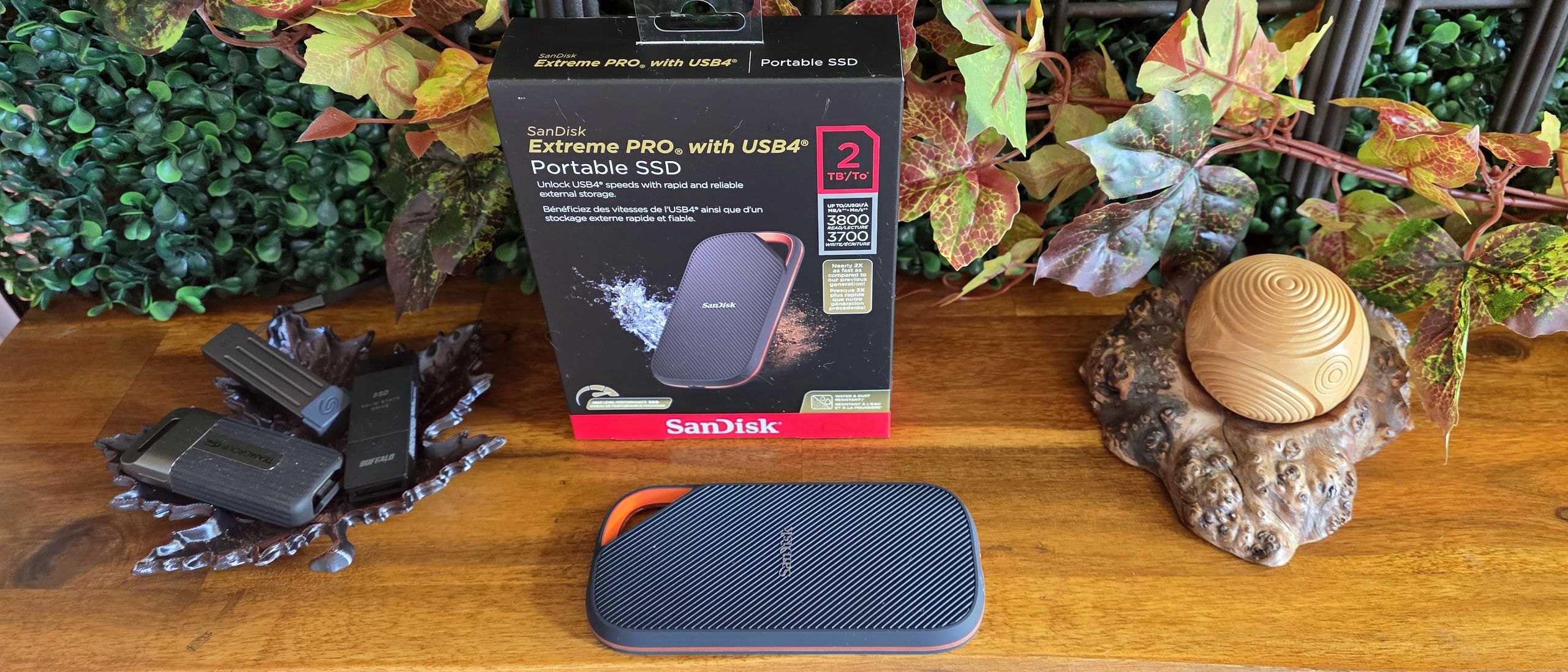
It’s not like the SanDisk drive is going to weigh your bag down or won’t fit in most pockets. But it is the largest external single-drive SSD I’ve reviewed or used in years.
In early 2025, we updated our external storage testbed to an AMD Ryzen 7600X-based PC with an Asus ROG Crosshair X870E Hero motherboard, installed in Lian Li’s Lancool 217 case . This was done in part because we needed a system with native USB4 support for upcoming drives (like this one).
All the drives in the charts below have been re-tested on the new X870E system, with the exception of the final Iometer sustained sequential test. That benchmark is less about top speed and more about how long a drive can write before depleting any fast cache onboard. We also updated to CrystalDiskMark 8, rather than the older (and non-comparable) version 7 we used on the previous testbed.
PCMark 10 is a trace-based benchmark that uses a wide-ranging set of real-world traces from popular applications and everyday tasks to measure the performance of storage devices.
In this first test, the LaCie SSD4 landed first, but SanDisk’s Extreme Pro USB4 wasn’t far behind, while Corsair’s USB4 drive was a distant third. But that’s not a dynamic that will hold for most of our tests, especially when it comes to write speed.
In this real-world file transfer test, SanDisk’s drive comes in first on reads, followed by LaCie’s USB4 drive, and then Corsair drive. But note that the Corsair EX400U nearly doubles the other two drives when it comes to writing files. This disparity was big enough that I ran the test on the SanDisk drive several times and, after achieving similar results, pulled out the Corsair and re-ran it on this test. Again, the results were effectively the same. At least in this real-world 50GB write test, the Corsair drive is significantly speedier.
CrystalDiskMark (CDM) is a free and easy-to-run storage benchmarking tool that SSD companies commonly use to assign product performance specifications. It gives us insight into how each device handles different file sizes. We run this test at its default settings.
Switching back to synthetic tests, the SanDisk drive drops to third when it comes to sequential reads, behind the Corsair and the LaCie. But the SanDisk drive nearly matched its first-place competitor on sequential writes.
Small file read performance sees SanDisk’s Extreme Pro USB4 on top in reads, with the LaCie Rugged SSD Pro4 slipping to fourth place. But again, the Corsair drive stands out in write performance here, with the SanDisk drive surprisingly in second-to-last place.
A drive's rated write specifications are only a piece of the performance picture. Most external SSDs (just like their internal counterparts) implement a write cache , or a fast area of flash, programmed to perform like faster SLC, that absorbs incoming data.
Sustained write speeds often suffer tremendously when the workload saturates the cache and slips into the "native" TLC or QLC flash. We use Iometer to hammer the SSD with sequential writes for 15 minutes to measure the size of the write cache and performance after the cache is saturated.
Immediately out of the gate, the SanDisk drive looks stunning, writing just below 3,500 MB/s, with only the LaCie Rugged SSD Pro4 getting close, starting just below 3,300 MB/s. But both drives’ performance falls off pretty quickly, with the LaCie dropping to the 1,600 MB/s range after less than 20 seconds. The SanDisk drive hung on at top speed for almost three minutes before dropping to a slower speed of around 1,100 MB/s for about five more minutes, then dropping again, to around 800 MB/s for the rest of our test.
The Corsair EX4000U, meanwhile, never managed to write above just 1,800 MB/s, and dropped to the 1,550-1,650 range after about 20 seconds – but it maintained that speed through the duration of our test (and even longer for a full 30 minutes), while the SanDisk drive was slower than the Corsair after just a few minutes of sustained writes.
In short, while the SanDisk drive is much faster at bursty and mainstream workloads, the Corsair drive is technically faster for big, drive-filling tasks that tend to fall into the “pro” category. That’s a shame from a marketing perspective, given that SanDisk has put Pro in its USB4 drive’s name, while Corsair has not.
SanDisk’s Extreme Pro USB4 drive is fast for mainstream tasks, and I’d argue it’s one of the nicest-looking (and feeling) drives I’ve tested in years. But it costs substantially more than both the Corsair and LaCie USB4 drives we’ve tested recently, while often falling behind them in real-world writes. That makes SanDisk’s USB4 drive hard to recommend, especially to the kind of “pro” users that SanDisk’s marketing is attempting to appeal to.
The Extreme Pro With USB4 is fine for carrying around and backing up files. But if you are often filling up your drive with high-resolution video or images and dumping them to local storage via USB4 or Thunderbolt, you’re better off looking elsewhere. Corsair’s competing EX400U remains our favorite USB4 SSD for most people – helped by the fact that it costs about $70 less at the same 2TB capacity.
Matt Safford After a rough start with the Mattel Aquarius as a child, Matt built his first PC in the late 1990s and ventured into mild PC modding in the early 2000s. He’s spent the last 15 years covering emerging technology for Smithsonian, Popular Science, and Consumer Reports, while testing components and PCs for Computer Shopper, PCMag and Digital Trends.
Key considerations
- Investor positioning can change fast
- Volatility remains possible near catalysts
- Macro rates and liquidity can dominate flows
Reference reading
- https://www.tomshardware.com/pc-components/external-ssds/SPONSORED_LINK_URL
- https://www.tomshardware.com/pc-components/external-ssds/sandisk-extreme-pro-with-usb4-2-tb-review#main
- https://www.tomshardware.com
- SanDisk Extreme Pro With USB4 (2TB) review: Bursty speed, but not great for pros
- NVIDIA Launches Omniverse DSX Blueprint, Enabling Global AI Infrastructure Ecosystem to Build Gigawatt-Scale AI Factories
- Fangs Out, Frames Up: ‘Vampire: The Masquerade — Bloodlines 2’ Leads a Killer GFN Thursday
- SanDisk Extreme Pro With USB4 (2TB) review: Bursty speed, but not great for pros
- Researchers create world's smallest pixel measuring just 300 nanometers across — could be used to create a 1080p display measuring 1mm across
Informational only. No financial advice. Do your own research.