
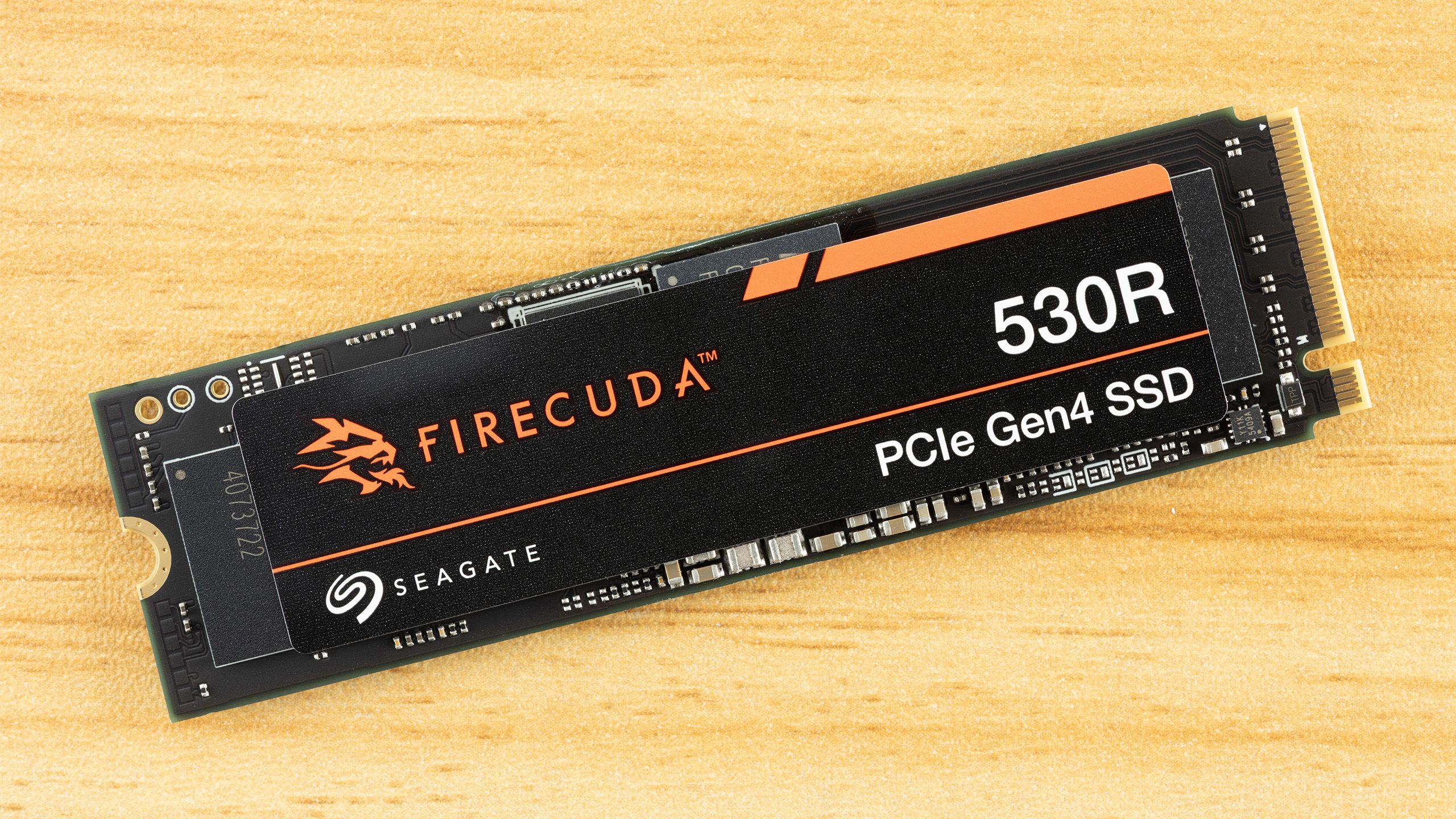
Looking for a good workstation SSD? Seagate apparently asked the same question of the market when it decided to design the FireCuda 530R. It’s a twist on the original FireCuda 530 , which uses the same controller, with a bigger emphasis on reliability. As it so turns out, the drive does deliver, and it’s no slouch for gaming or everyday tasks, either. It’s also fast enough to hold you over until the consumer SSD market recovers.
Seagate is no newcomer to reliable drives. The company has spent a lot of time working on its mechanical hard drives, offering three years of data recovery services for the best models. This also applies to some of its SSDs, and that list includes the 530R. It’s usually tough to recover data from a dead SSD, but if the data hasn’t been overwritten – and in most cases, drive failures happen in a way that doesn’t involve the flash or data directly – it’s possible it can be salvaged. That alone is a big selling point for this drive, but Seagate also offers exceptional TBW endurance limits at all capacities. The drive also works with the excellent SeaTools 5 diagnostic software. To put it simply, this drive is designed to last or at least give you perceived peace of mind.
There is a caveat or two with that, though. The drive’s controller – Phison’s E18 – had a string of bad luck with an alleged Microsoft Windows update gone wrong , which actually doesn’t apply to the 530R but might get attached in searches. This controller also had a stale data bug discovered late in the controller’s lifetime, a problem since many manufacturers decided not to patch the firmware. In both cases, these are Phison issues, and Seagate has generally been pretty alert about these things. It was one of the few manufacturers to work with Phison’s I/O+ DirectStorage-optimized firmware , so we know the company is proactive. We want to make sure to get out ahead of that in this review because, contrary to anything those events might suggest, this is actually a drive made for enthusiasts who value reliability and consistent performance.
The Seagate FireCuda 530R, not to be confused with the earlier FireCuda 530 , is available at 1TB, 2TB, and 4TB. It lacks the 8TB SKU of its predecessor. At the time of review, it’s priced at $175.74, $237.49, and $427.49. This makes it an exceptional deal at any capacity, as it has DRAM and its prices rival inferior DRAM-less options like the TeamGroup MP44 . It’s best at 2TB and 4TB, if you can find it, but even the price at 1TB is quite good.
This drive is rated for up to 7,400 / 7,000 MB/s for sequential reads and writes and up to 1,300K / 1,300K random read and write IOPS. These specifications are a little odd because write performance goes down with capacity, and the IOPS are identical for reads and writes across all SKUs. We would expect the 2TB SKU to provide peak performance. However, this doesn’t really matter much as the performance is good at any capacity.
The main thing that stands out is the IOPS, which are considerably higher than other drives with the Phison E18 controller, including Seagate’s older drives, which, along with the other performance specifications suggests this is an enthusiast or workstation drive. It’s worth emphasizing this because at first glance it’s easy to confuse this drive as some sort of FireCuda 530 successor when it’s more of a specialized variant. The IOPS rating makes this more apparent, but the specs across the entire capacity range reinforce that this isn’t a budget drive.
Also unusual is Seagate’s warranty for the drive. While the five-year duration is typical, the rated write endurance is not. The TBW endurance ranges from 1,100 to 1262.5 of data writes per TB of capacity, which is roughly double that of other drives. If you’re having flashbacks to the FireCuda 520 , which had very high TBW, you’re not alone. Seagate’s original FireCuda 530 also had high TBW, but we have to take the competition into consideration – that is, TBW is relative to other drives on the market. The 530R is in a good place here. Seagate also bundles a 3-year Rescue Services , or Rescue Data Recovery Services to be precise, warranty with the drive, which is exceptional for extra peace of mind.
Get Tom's Hardware's best news and in-depth reviews, straight to your inbox.
Key considerations
- Investor positioning can change fast
- Volatility remains possible near catalysts
- Macro rates and liquidity can dominate flows
Reference reading
- https://www.tomshardware.com/pc-components/ssds/SPONSORED_LINK_URL
- https://www.tomshardware.com/pc-components/ssds/seagate-firecuda-530r-2tb-ssd-review#main
- https://www.tomshardware.com
- Gigabyte X870 Aorus Stealth Motherboard Review: The gothy Goldilocks of rear-connect AM5 motherboards
- Intel Core Ultra 5 250K Plus review: The new best $200 CPU
- PC makers face shortages of Intel and AMD CPUs that stretch up to six months — lead time for orders jumps from just two weeks in the face of AI demand
- HP's new AI workstation can expand horizontally to add 15% more internal volume — alternate side panel also includes more active cooling.
- We need your opinions to shape Tom's Hardware Premium
Informational only. No financial advice. Do your own research.