
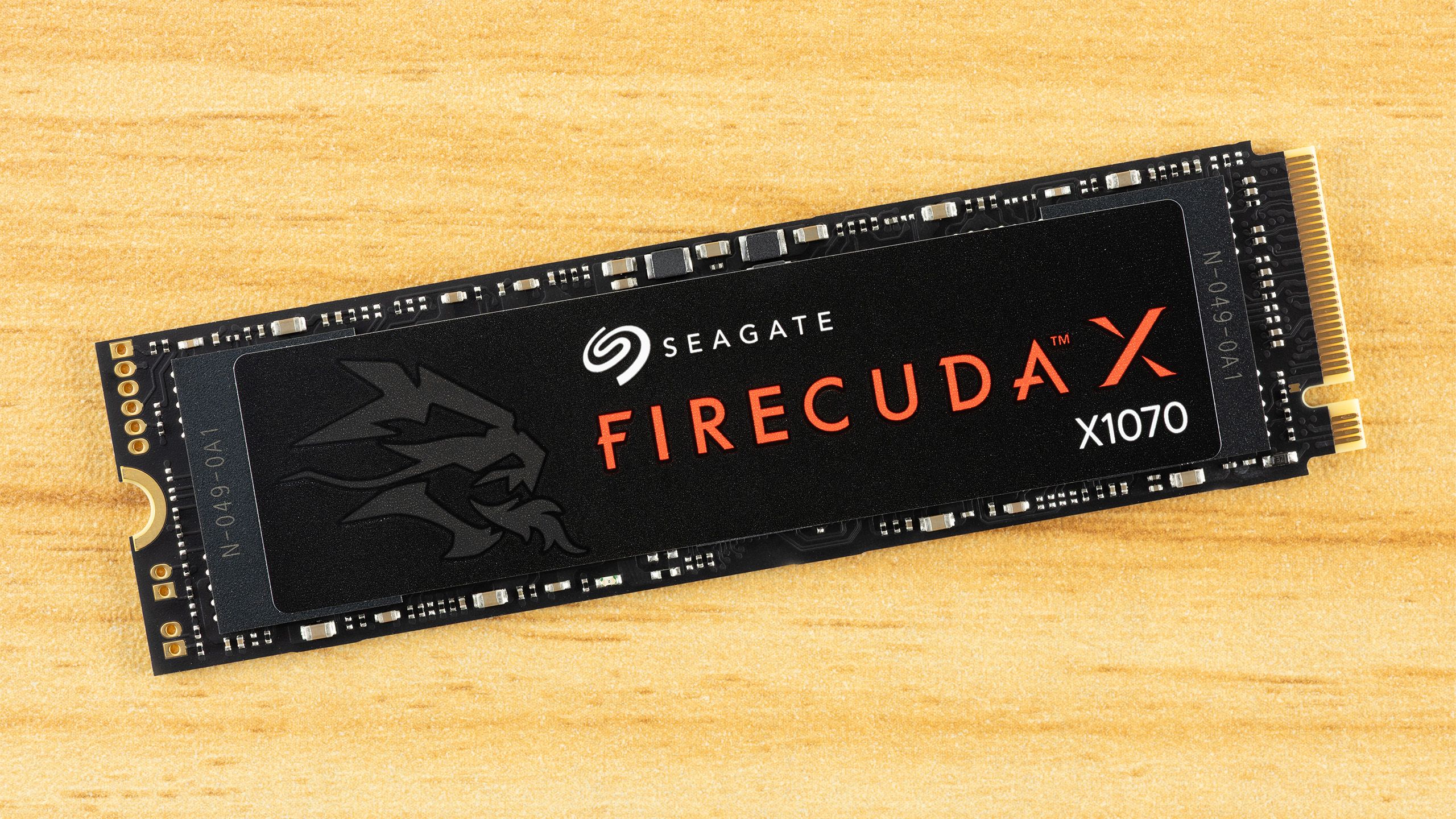
While Seagate has its hands full with the current memory situation , at least it’s nice enough to still give us some drives to explore. The FireCuda X1070 is the latest drive from the company, and it feels specialized in a way different from the FireCuda 530R, a drive we’ve also looked at recently. This is a budget drive with non-budget trappings that feels a little bit steadier than the ubiquitous Kingston NV3 . Its hardware is decidedly not the fastest out there, but with this level of support, Seagate is not treating it like a throwaway SKU either.
Memory has become the most expensive part of your build, whether it’s for main memory, video memory, or storage. However, SSDs tend to be a good place to skimp, as you can rotate games out and use mechanical HDDs or cloud storage to fill the gaps. Yet they are still an essential part of any build, and Seagate hopes to address this in part with the FireCuda X1070. While the FireCuda 530R feels more high-end and directed at enthusiasts, the FireCuda X1070 covers something closer to the entry-level market and can be good in laptops, desktops, and the PS5 . What helps the drive stand apart is its full five-year warranty – with three years of data recovery service – and decent TBW for a QLC-based drive. This is something that can get you through the memory price hump, as it were.
The Seagate FireCuda X1070 is available in the most popular capacities: 1TB, 2TB, and 4TB. Pricing shared with us at the time of review comes out to $239.99, $459.99, and $829.99 for the three SKUs. Manufacturers will set MSRPs like this, but even in the best of times, these are weak guidelines. Right now, fair prices for each SKU would be in the $150-$165, $265-$275, and $440-$460 ranges. This is using the Biwin NV7200 , the Kingston NV3 , the Patriot Viper VP4300 Lite , and the Silicon Power UD90 for baselining. These drives are roughly in the same class, recognizing that the latter two have seen changes in hardware over time. The FireCuda X1070’s flash will often put it ahead of variations found in the wild, but drives with comparable 232-layer flash, like the NV7200, directly compete. It likely has an edge over the average NV3, though.
Performance is respectable at up to 7,200 / 6,500 MB/s for sequential reads and writes and up to 900K / 1,000K random read and write IOPS. The 1TB model is the weakest, but its performance as a whole is more than adequate. Peak performance is at 2TB, and that’s also where the drive will be most efficient if performance is actually pushed. Seagate offers a full five-year warranty for the drive with three years of data recovery services included. The drive is also rated for 600TB of writes per TB, which is the standard amount for TLC-based drives. Given that this drive is using QLC flash, that’s actually high. Some users do look at TBW and, nine times out of ten, QLC will have around half the rated endurance of TLC, but that’s not the case here. For some, that’s enough to keep it in the running.
Seagate has a plethora of downloads available, but the most important are DiscWizard and SeaTools 5. DiscWizard is used to back up and secure your data, while SeaTools is an SSD toolbox-type application to help manage your drive’s health. This is standard in the industry, but Seagate does have some of the better software around. Seagate is also including one month of Xbox Ultimate Game Pass and two months of Adobe Creative Cloud Pro with this drive. The former is probably of more use for a budget drive like the FireCuda X1070.
(Image credit: Tom's Hardware) (Image credit: Tom's Hardware) The Seagate FireCuda X1070 is single-sided at all capacities, which makes sense for a drive of this caliber. Budget drives tend to pull less power and are suitable for laptops, the PS5, and other systems that might not have the cooling capacity of a high-end desktop. The drive is rated for 3.3V / 2.0A, which pegs it below 7W. Seagate itself lists the expected active power draw to average around 4.7W for the 2TB SKU. In SMART, the drive reports 5.5W for its non-idle modes. Our peak consumption is closer to the latter. This is less than half the power draw of the heaviest SSDs we’ve reviewed, and it should be fine in a laptop and can be installed without a heatsink.
(Image credit: Tom's Hardware) (Image credit: Tom's Hardware) (Image credit: Tom's Hardware) The 2TB model that we’re reviewing has a centerline SSD controller and two NAND flash packages. There is space for four flash packages if needed, potentially for the 4TB SKU. The controller is the TenaFe TC2201, which is a four-channel, DRAM-less solution. This is equivalent to Phison’s E27T, Silicon Motion’s SM2268XT2, or Maxio’s MAP1602, all DRAM-less solutions that can push the PCIe 4.0 interface. There is also a discrete PMIC with the Active-Semi logo, which is a Qorvo part, and we’ve seen these before on many older WD /SanDisk SSDs. This type of solution can help with PCB spacing, and this board is pretty clean. The flash is more of a mystery as the coding is unknown or internal, but we were able to get confirmation on it from Seagate right before publishing.
Get Tom's Hardware's best news and in-depth reviews, straight to your inbox.
Key considerations
- Investor positioning can change fast
- Volatility remains possible near catalysts
- Macro rates and liquidity can dominate flows
Reference reading
- https://www.tomshardware.com/pc-components/ssds/SPONSORED_LINK_URL
- https://www.tomshardware.com/pc-components/ssds/seagate-firecuda-x1070-2tb-ssd-review#main
- https://www.tomshardware.com
- Flabbergasted GPU repair wizard highlights dangers of liquid metal after leak kills entire RTX 5070 Ti — user-applied TIM spread to every crevice of the PCB, ph
- Nvidia demonstrates Rubin Ultra tray, the world's first AI GPU with 1TB of HBM4E memory — new chips will slot into Kyber racks
- March Into the Cloud With 15 New Games Coming to GeForce NOW
- STMicro to deploy humanoid robots to its legacy fabs in Europe — over 100 humanoid robots to be used for routine and physically demanding tasks in fight for eff
- Apple's MacBook Neo modded to a 1 TB SSD, breaking the firm's 512 GB barrier — base 256 GB model gets modded in expert NAND swap surgery
Informational only. No financial advice. Do your own research.