
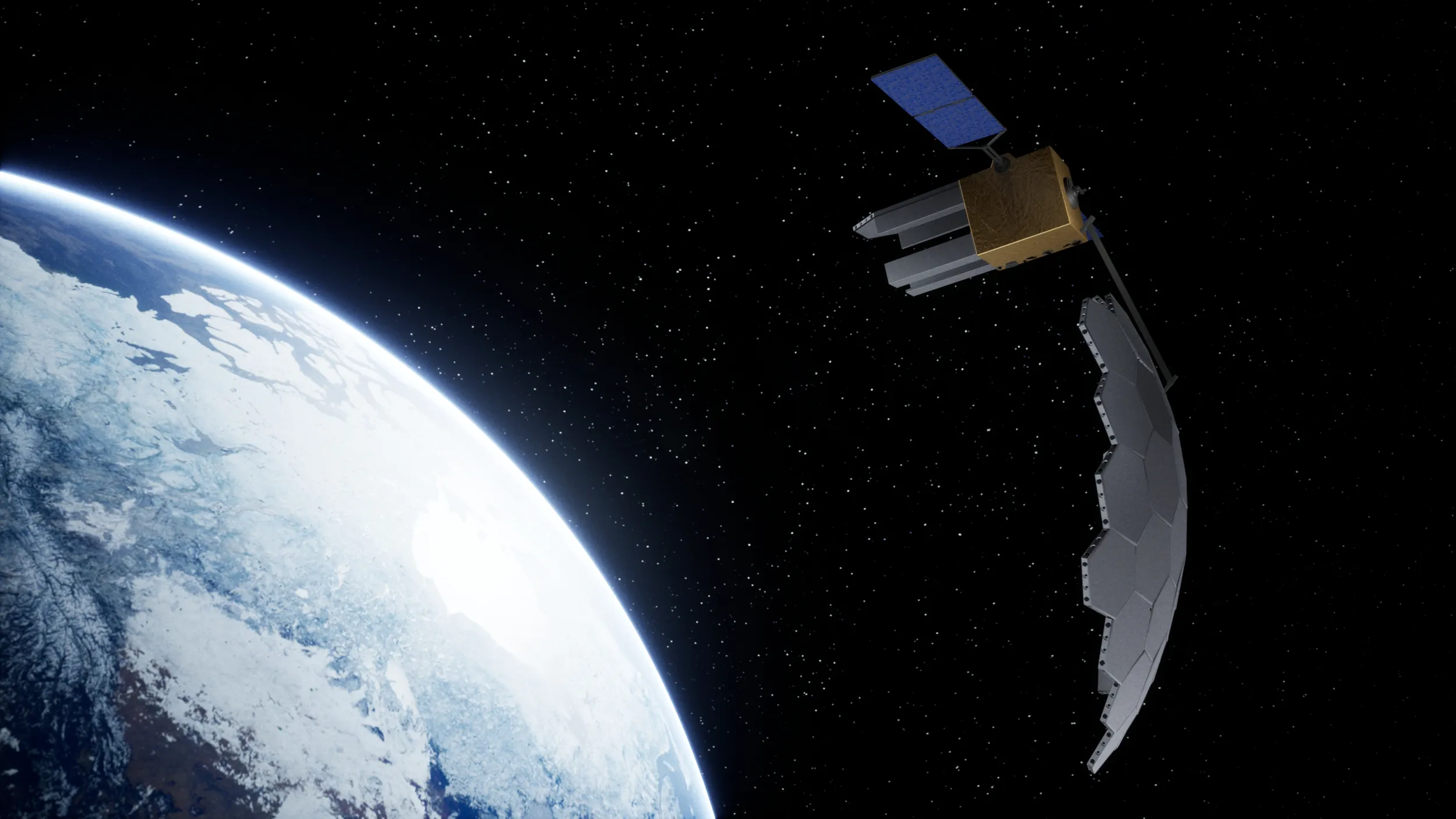
Simply scaling up Starlink V3 satellites, which have high speed laser links would work. SpaceX will be doing this. October 31, 2025
You can see Elon Musk's response to the original coverage above, claiming that Starlink's V3 satellites "will be doing this," and it seems to be relatively easy, too. The currently in-orbit V2 satellites cap out at a maximum data transmission rate of 100 Gbps, which the upcoming V3 satellites will increase to 1 Tbps. Through Starlink, SpaceX has already demonstrated it can deliver high-speed internet to even remote parts of the globe, so it's not entirely unprecedented that hyperscale data centers are on the world's richest person's mind. Unlike Starcloud and Rendezvous Robotics, though, we'll need more details here before speculating on what the future holds.
Follow Tom's Hardware on Google News , or add us as a preferred source , to get our latest news, analysis, & reviews in your feeds.
Hassam Nasir Social Links Navigation Contributing Writer Hassam Nasir is a die-hard hardware enthusiast with years of experience as a tech editor and writer, focusing on detailed CPU comparisons and general hardware news. When he’s not working, you’ll find him bending tubes for his ever-evolving custom water-loop gaming rig or benchmarking the latest CPUs and GPUs just for fun.
Tom791 The hard part isn’t the power production, it’s the heat dissipation. Pure convection is a terrible heat transfer method. Space is bad for heat transfer because it’s empty. Reply
Zaranthos We're not quite to Star Trek replicators yet, but we're getting close. You can 3D print food and all kinds of things now. It won't be long before you can inject a subdermal implant that will use an AI language model to universally translate language. Beam me up Scotty! Reply
Zaranthos Tom791 said: The hard part isn’t the power production, it’s the heat dissipation. Pure convection is a terrible heat transfer method. Space is bad for heat transfer because it’s empty. With a good enough power source or solar I'm sure there are creative ways to do this. Aside from basic simple things like conductive materials to external radiators you could use excess heat to generate a laser beam to transfer heat to space or even more distant objects. Reply
Notton Tom791 said: The hard part isn’t the power production, it’s the heat dissipation. Pure convection is a terrible heat transfer method. Space is bad for heat transfer because it’s empty. Here you go: https://en.wikipedia.org/wiki/Radiative_cooling With that said, radiative cooling works on earth too. That's the Yakhchal bit. Reply
Tom791 Zaranthos said: With a good enough power source or solar I'm sure there are creative ways to do this. Aside from basic simple things like conductive materials to external radiators you could use excess heat to generate a laser beam to transfer heat to space or even more distant objects. That’s not a current technology. Maybe someday. Reply
Tom791 Notton said: Here you go: https://en.wikipedia.org/wiki/Radiative_cooling With that said, radiative cooling works on earth too. That's the Yakhchal bit. Nobody said it didn’t work. It doesn’t work well. You can’t beat the heat transfer problem. That’s why astronauts working on EVAs have to have cooling suits to not pass out from accumulated body heat. They sweat like pigs. Reply
derekullo Next thing you know they will start putting data centers on the moon. Actually forget I said that! Reply
bit_user Zaranthos said: With a good enough power source or solar I'm sure there are creative ways to do this. Aside from basic simple things like conductive materials to external radiators you could use excess heat to generate a laser beam to transfer heat to space or even more distant objects. The only way you solve this by throwing power at it is via peltier (TEC) devices, which are very inefficient. They do not have excess amounts of power, either. I'm sure the 4×4 km array is sized strictly by necessity – and don't forget that every bit of it comes at enormous expense to launch up there. The idea of "creating a heat laser", as a cooling method, also seems to violate at least a couple laws of thermodynamics. The main concern I have about cooling is just how this "solar and cooling array" can do the cooling part in a modular way. The longest heat pipe would only be as big as one module, creating the need for thermal interfaces between each module. As we probably all know, each thermal interface acts as a barrier to heat transfer. Power distribution would seem to face similar problems, though perhaps not as severe. I'm also really curious how structurally robust it must be, in order to withstand stronger bursts of solar wind. Reply
usertests On SpaceX's end, scaling up Starlink satellites doesn't seem like the way to do it. Instead, leverage Starship to put a lot of mass (perhaps just Starships bolted together) into orbit, (relatively) cheaply increasing the volume and area available to dissipate heat from. I don't know if the Starcloud + Rendezvous Robotics approach can work, but I hope that NASA can contract them to build a giant telescope using their assembly techniques. Multi-kilometer aperture would be great. Reply
bit_user usertests said: leverage Starship to put a lot of mass (perhaps just Starships bolted together) into orbit, (relatively) cheaply increasing the volume and area available to dissipate heat from. To act as an effective heatsink, something needs to be specifically designed to do efficient heat transfer. I can imagine there are components in the propulsion system of a rocket that are designed that way, but rocket engine design is such a highly-constrained problem that I think it's asking too much for it to then do double-duty as a satellite heatsink. I don't think it would even be very area-efficient, compared to purpose-built radiators. However, I do wonder if there will come a point where we have essentially orbital recycling centers, rather than sending stuff to burn up in the atmosphere. For this datacenter project, specifically, I think a big issue with reusing other orbital objects is that the datacenter will probably be parked at the L1 Lagrange Point, in order to receive 24/7 sunlight. As you can see from this diagram, L1 is outside even the moon's orbit! So, it would take some probably non-trivial amount of extra fuel to get there. Earth and its Lagrange points L1, L2, L3, L4 & L5 usertests said: I don't know if the Starcloud + Rendezvous Robotics approach can work, but I hope that NASA can contract them to build a giant telescope using their assembly techniques. Multi-kilometer aperture would be great. Telescope optics need to be exceedingly precise. That requires a rigid structure. It took JWST like a couple months to do calibrations. I know not all of that was the optics, but you can just imagine how much havoc it'd cause if the structure was continuously deforming as you were trying to use it. For an even larger telescope, I think our best option might be to build telescope arrays on the moon. Incidentally, JWST is parked at L2. Reply
Key considerations
- Investor positioning can change fast
- Volatility remains possible near catalysts
- Macro rates and liquidity can dominate flows
Reference reading
- https://www.tomshardware.com/tech-industry/artificial-intelligence/SPONSORED_LINK_URL
- https://www.tomshardware.com/tech-industry/artificial-intelligence/self-assembling-data-centers-in-space-are-becoming-reality-as-rendezvous-robotics-partners-with-starcloud-elon-musk-chimes-in-that-spacex-will-be-doing-this#main
- https://www.tomshardware.com
- Acer Predator Triton 14 AI Review: Creative mobile gaming
- The Outer Worlds with ray tracing can't hit 60FPS at paltry 540p resolution with an RTX 5090 and 9800X3D – ray tracing 'performance' mirrors Borderlands 4 fiasc
- Trump says no Blackwell chips to be sold to China — Nvidia re-entry into Beijing nixed despite temporary trade truce
- The same ASRock B850 motherboard kills three Ryzen 7 9700X CPUs worth $1,000 one by one in South Korea — victim used updated BIOS and never overclocked, but sti
- Apple Mac Pro and Mac Mini clones launch with AMD Ryzen CPUs — perfect mini-PCs for those who love Apple's aesthetics but still need Windows or Linux
Informational only. No financial advice. Do your own research.