
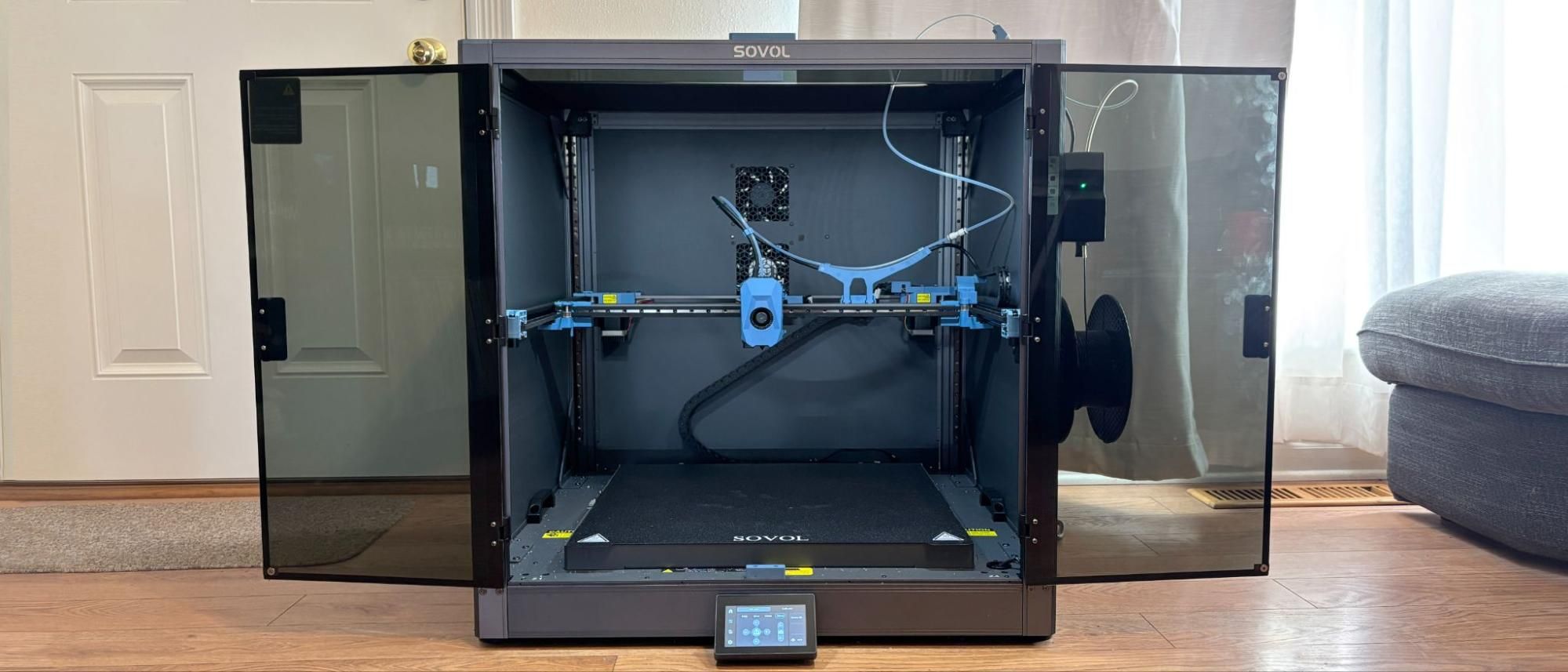
The SV08’s build volume of 500 x 500 x 500 mm is cut to 500 x 500 x 450 mm when you add the enclosure. This makes it among the largest consumer-grade 3D printers available, with only Elegoo’s OrangeStorm Giga being larger. With all that size comes some important considerations. This is the second printer I’ve reviewed that couldn’t fit on a table and had to sit on the living room floor. The SV08 Max, at almost 28 inches wide, is painfully close to the size of a standard 32-inch door frame in the USA. Given any obstruction, taking the door off its hinges may be required to get it out of the room. It’s 65 pounds without the enclosure, and close to 100 with it, making this a team lift or rolling dolly affair to move.
At first glance, what stands out the most is the auxiliary filament feeder mechanism and the swooping filament path with a little cradle to keep the long Bowden tube secure. The tool head extruder pushes filament well, but it takes nearly five feet of Bowden tube to reach the side-mounted spool, which is nearly five feet away. Sovol’s answer to this is an auxiliary feeder that seems just short of a multicolor system. It pushes the filament into a spring-loaded buffer on top of the feeder, which contracts and then refills as the extruder uses filament. The plastic guides and Bowden tubes keep the filament from kinking. The feeder also loads and unloads filament well, if a bit slowly. There are a few fittings between the feeder and the extruder where the filament can be accessed in case it breaks or jams. Occasionally, the filament will catch on these during loading, which is annoying.
The only real downside to this system is the way it handles filament runout. The filament runout sensor is in the auxiliary feeder, but it takes a while for the printer to stop and signal that it needs a refill. You need to fish the filament out of the Bowden tube, and either crank new filament into the extruder by hand or wait for the feeder to slowly inch the material toward the toolhead. There is no automated process, though the screen does walk you through the process. The first time the filament ran out, I didn’t scrunch down to see if the filament was flowing out of the hotend, and it restarted the job without plastic.
The Sovol SV08 Max shares a nozzle and much of its toolhead, including the eddy current sensor, with the tiny and speedy Sovol Zero.
Cooling is provided by a large blower fan mounted in the toolhead cover and another smaller blower motor mounted to the bottom of the toolhead. Together, these are more than adequate.
The SV08 has a good camera attached to the gantry for monitoring the printer and taking time-lapse video.
The Sovol SV08 Max enclosure kit turns an unusually large consumer-grade printer into a true unicorn, as it enables it to print finicky, higher-temp filaments. The enclosure consists of metal panels and a pair of swing-out glass doors. The top is half bolted-down metal and half removable glass. It comes with two fans in the back. The panels are some sort of non-ferrous metal that’s heavier than aluminum. The enclosure arrived a week after the printer was up and running, and thankfully, the sides went right into place. Sovol went to the trouble of cutting recesses in the side panels for the screws needed for the initial assembly, and the fan wiring was pre-installed.
The enclosure only had one flaw. The magnetic catches on the door are weak and set too far back, and do not touch the doors. When the SV08 Max is moving at speed, the doors rattle, making an amazing cacophony. I was able to solve this by adding a few button magnets to close the gap.
Speaking of cacophony, the Sovol SV08 Max is not a quiet printer, even when enclosed. I adore the sound of singing steppers motors, but maybe I’m a little weird. The constant fan noise when the printer is turned on is fairly loud, and even louder when it's running. The enclosure does nothing to dampen the racket.
The Sovol SV08 Max takes a fair amount of time to assemble. Including the enclosure, it took two solid hours. Sovol did try to make this as easy as possible. All of the parts were well marked, and the hardware needed was easy to identify. Everything was machined perfectly.
There are plastic shipping blocks that must be removed from the base unit before installing the four corner uprights. The uprights install on the base with five screws of three different types. The top frame attaches to the uprights with eight screws total. The gantry is tilted up to rest on its four mounts and secured by eight screws. The tool head mounts on the X-axis carriage with three screws, and the Bowden guide and wire guide clip on without tools. The top-mounted Bowden tube guide attaches with two screws, as do the auxiliary feeder and spool holder. The stiffening ribs or corner brackets are attached to the sides of the frame with four screws each.
The touch screen slots in the front of the printer. There are a bunch of electrical connections, which are all well labeled and thought out.
Installing the enclosure kit is straightforward, with the only head scratcher being the orientation of the fans, with one blowing and one sucking.
It also wasn’t super clear that the fan covers need to be split apart and the inner part installed with the fan. This was the only part of the build where I had to unscrew a part I’d mistakenly mounted incorrectly.
The Sovol SV08 Max has a very fast leveling routine, which produces a good bed mesh without fail. The printer uses an eddy current sensor to scan only the area of the bed that will be printed on without contacting the build plate. The process takes only seconds. Setting the Z offset takes longer and involves tapping the bed in each corner and the middle several times. I ran into problems several times with prints not sticking and eventually figured out that the Z-axis offset was too close to the bed.
Loading filament is as simple as pushing it into the auxiliary feeder, which will push it to the extruder. The loading routine will heat up the nozzle to 250 degrees Celsius and then load it, offering you the option to push more if it hasn’t gone all the way through. Unloading is as simple as well, with the auxiliary feeder spitting the filament all the way out. It's a good idea to be there to respool it as that happens.
One thing to note is that 250 degrees Celsius is fine to load and unload PLA, PETG, and TPU, but it isn’t hot enough to clear some high-temperature filaments. This loading temp can be changed in the printer configuration or filament can be loaded and unloaded manually for the printer’s screen.
The Sovol SV08 Max comes with a copy of Orca Slicer and a copy of the SV08 Max configuration file, along with instructions on how to add it.
My first prints on the Sovol SV08 Max covered a fairly large surface area and seemed to lay down fine. Later prints, especially the 20-foot, coiled, bone dragon, revealed bed adhesion issues caused by the Z-offset being too close. The nozzle ended up scraping small pieces right off the bed. This is the kind of problem that will terrorise those newer to 3D printing.
My first print was a 10-minute 45-second Benchy presliced by Sovol and printed in Creality Black PLA . It is not a great print until you look at the size of the printer. Usually, speed is the enemy of larger motion systems, but the Sovol seemed to handle this pretty well.
For my next print, I had to go bigger. The Meadowlark Performance Glider printed great at both 100% and 250% in translucent blue PETG from Bambu Lab . Printed with a .2mm layer height and run at a pedestrian speed of 100 mm/s, the print completed in 5 hours and 22 minutes. The print looks fantastic, with even the large bridged area of the nose printing well without supports. Now I just have to find a really big rubber band to launch it.
While I had the PETG loaded, I also ran this very cool dragon I found on Printables that lets you pick the number of links in the beast. I maxed out the printer with 522 links and scaled up to 102%, completely filling the bed with spiraling coils of dragon. The print was 12 feet long when completed.
This produced an acid test of the printer’s leveling and Z-offset, which it failed initially. The bed mesh was fine, but the Z-offset was off by a fair amount. It took several tries to find the right height, and I only needed to bump it up by .2 mm and let it heat soak for a good 20 minutes before printing. After 5 failures and a half spool of filament wasted on dialing the printer in, the print is perfect. This is printed in Bambu Lab translucent blue PETG with a .2mm layer height and limited to 100 mm/s the print took 2 days 8 hours and 17 minutes.
Kh4rj0’s Articulated Bone Dragon (Image credit: Tom's Hardware) Model: Articulated Bone Dragon Filament: PETG Translucent
Kh4rj0’s Articulated Bone Dragon (Image credit: Tom's Hardware) Model: Articulated Bone Dragon Filament: PETG Translucent
I was interested to see if the auxiliary feeder could help push TPU through the super-long Bowden path to the toolhead, and surprisingly, it did. This design is a remix of wafflecart’s 3D Printed Mesh Sheet. Printed in Inland 95A TPU , with a .2mm layer height at the blistering speed of 40 mm/s, the netting took a little over 8 hours to complete.
Despite a little bit of stringing, the print is very good. The vertical lines of the mesh in this print bridge over the horizontal lines perfectly.
My next print was an end table, and a cautionary tale. Using 2.5 spools of Prusament Galaxy Black PLA, this was not going to be a cheap print. Unfortunately, the filament ran out overnight, allowing the print to cool enough at the top that it developed a crack at that layer that stayed hidden until it completed.
The print is otherwise perfect, and I may use it as a table anyway. I used a .28 mm layer height, and the print speed averaged 140 mm/s over 2 days and 13 hours.
It should be noted that this print used the full 450 mm build height of the printer with the enclosure. At those top layers, the toolhead Bowden tube really scrapes against the top of the enclosure. If the glass panel is not in place, it will catch on the metal panel on the top. Also, it is not noted anywhere that you need to change the build height to 450 mm in the printer configuration. Otherwise, it will happily smash itself into the top as it doesn’t know any better.
Agustin Arroyo’s Arch Retro Coffee Table (Image credit: Tom's Hardware)
Key considerations
- Investor positioning can change fast
- Volatility remains possible near catalysts
- Macro rates and liquidity can dominate flows
Reference reading
- https://www.tomshardware.com/3d-printing/SPONSORED_LINK_URL
- https://www.tomshardware.com/3d-printing/sovol-sv08-max-review#main
- https://www.tomshardware.com
- Arm's $250 million deal with Malaysia probed by anti-corruption authorities — $1.27 million seized from safehouse of prominent politician, former army chief arr
- [Daily Due Diligence] NVDA NVDA
- M4 MacBook Air with 24GB of RAM plunges to lowest-ever price following M5 announcement — $300 off is a steal on Apple's highest-spec RAM configuration
- Go beyond the review with Bench, the deepest consumer hardware benchmarking database on the internet — compare hundreds of products across a range of categories
- DDR5 RAM kits skyrocket to an astonishing $4,000 on Newegg with wild price listings on multiple G.Skill and Corsair products — various speeds and capacities all
Informational only. No financial advice. Do your own research.