
When you purchase through links on our site, we may earn an affiliate commission. Here’s how it works .
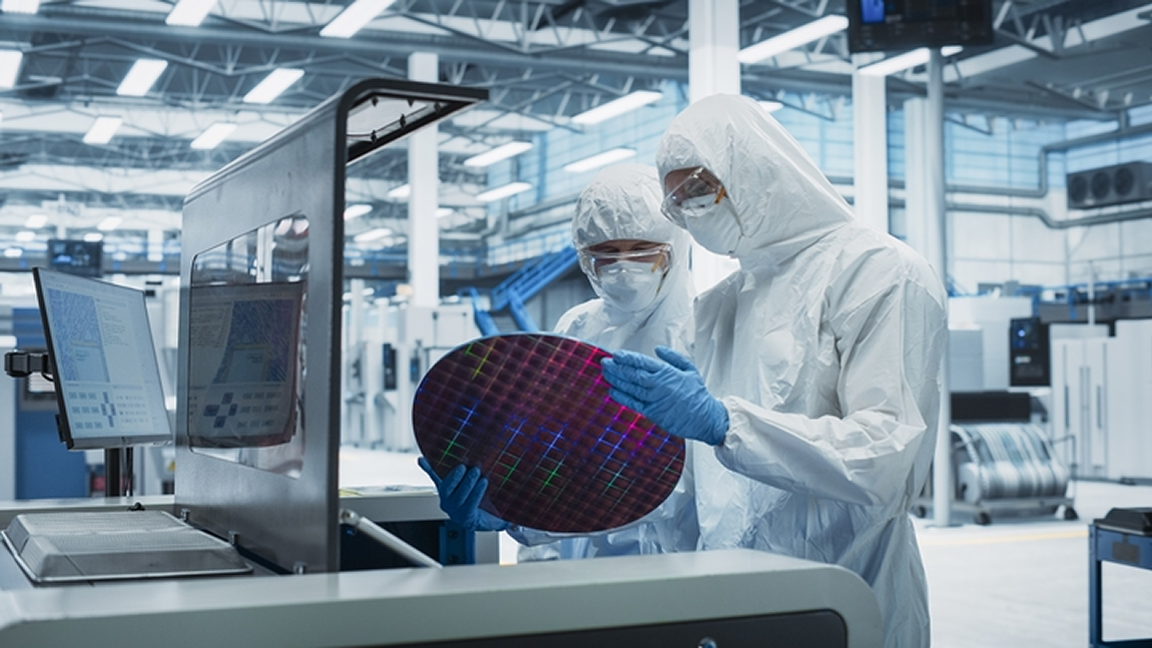
(Image credit: Shutterstock) The Substrate startup has been doing the rounds in the news lately, thanks to its proposition of making chips using particle accelerators and X-rays instead of conventional EUV lithography, claiming it can eventually have angstrom-sized features at only $10,000 per wafer—in U.S. fabs, no less. Those are bold claims, and an article by Fox Chapel Research (FCR) is seriously questioning whether they pay off.
The write-up is the first of two parts, and takes aim at not just the seemingly outlandish technological claims, but also at the track record of the venture's founders, as well as the overall messaging on Substrate's website. The start-up is backed by various investment funds, namely but not only Founders Fund, of whom Peter Thiel is part of.
The report says the founders are James and Oliver Proud, who reportedly have no experience in the semiconductor industry, nor do any of the investor funds. James' latest venture was apparently the Sense sleep tracker, a product that had its inception on Kickstarter to the tune of $2.5m, but didn't materialize until funding rounds raised over $50m. After release, the tracker was found to be borderline useless by reviewers and drew many comparisons to a scam.
The analyst says the iffy track record doesn't end there, as Substrate's registered business address appears to be the same as that of Delaware-incorporated DC Fusion LLC. We couldn't immediately find any information about this venture, though, as we could only track down a Maryland-based company focused on high-voltage DC power lines. The address for DC Fusion LLC appears to be a postbox.
FCR's text also takes potshots at Substrate's offering of extremely vague wording of its technologies and claims that are arguably outlandish. The writer has a point, seeing as once squeezed, there's not much juice in Substrate's website or the information it provided to Semiaccurate a short while back. We went over this information not too long ago and found that while the concept of using a particle accelerator for chipmaking is valid, it's not a new idea at all and is already under the proverbial microscope at a few laboratories.
The author compares the pictures to sample pictures provided by Substrate to those from ASML (the world's leading EUV machine maker), and finds Substrate's samples lacking substance, pointing out they're essentially starter-grade patterns rather than some highly advanced method. FCR also notes that Substrate didn't provide any numbers or concrete information other than a promise that its technology can theoretically create angstrom-sized patterns at low cost.
While on the topic of pictures, according to FCR, the available images of Substrate's lab space also don't quite appear to have any relation to what a chip-making laboratory would look like, void of any of the common machinery you'd expect in lithography, much less particle acceleration. The general feel of the website and data might be construed as that of a typical Silicon Valley startup, offering a grandiose idea in search of funding, with an expectation to "figure it out" later, if at all.
Get Tom's Hardware's best news and in-depth reviews, straight to your inbox.
Key considerations
- Investor positioning can change fast
- Volatility remains possible near catalysts
- Macro rates and liquidity can dominate flows
Reference reading
- https://www.tomshardware.com/tech-industry/semiconductors/SPONSORED_LINK_URL
- https://www.tomshardware.com/tech-industry/semiconductors/substrates-claims-about-revolutionary-asml-beating-chipmaking-technology-scrutinized-analyst-likens-the-venture-to-a-fraud-report-pokes-holes-in-the-startups-technology-messaging-and-leaders#main
- https://www.tomshardware.com
- Modern motherboard features explained: Connectors, headers, ports, and chipsets decoded
- Jensen Huang confirms there are no plans to ship Blackwell GPUs to China right now, chipmaker at Beijing's mercy — Nvidia CEO says shipments haven't been approv
- Gigabyte Aorus FO27Q5P 27-inch 500 Hz QD-OLED gaming monitor review: Superb in every respect
- OpenAI walks back statement it wants a government 'backstop' for its massive loans — company says government 'playing its part' critical for industrial AI capac
- Deutsche Telekom and NVIDIA Launch Industrial AI Cloud — a New Era for Germany’s Industrial Transformation
Informational only. No financial advice. Do your own research.