
When you purchase through links on our site, we may earn an affiliate commission. Here’s how it works .
Conventional thermal pads are used to cool all sorts of ICs across a number of devices, including phones. While the power envelope of our doomscrolling machines is nowhere near that of a computer, they still need effective management. In recent years, manufacturers have started to implement vapor chambers to improve thermal performance, and Xerendipity is now aiming to innovate in this space by combining both approaches into a single solution called the “ Vapor-Pad .”
According to SemiAccurate , which was on the showfloor at MWC 2026, Xerendipity calls this a "VC + Thermal Pad Hybrid," and it has a pretty simple mission statement. Thermal pads are cheap and convenient, but they don't have nearly as much conductivity as vapor chambers, which are custom-built for each device. Vapor chambers can be very efficient, but they're costlier and require more R&D to get right.
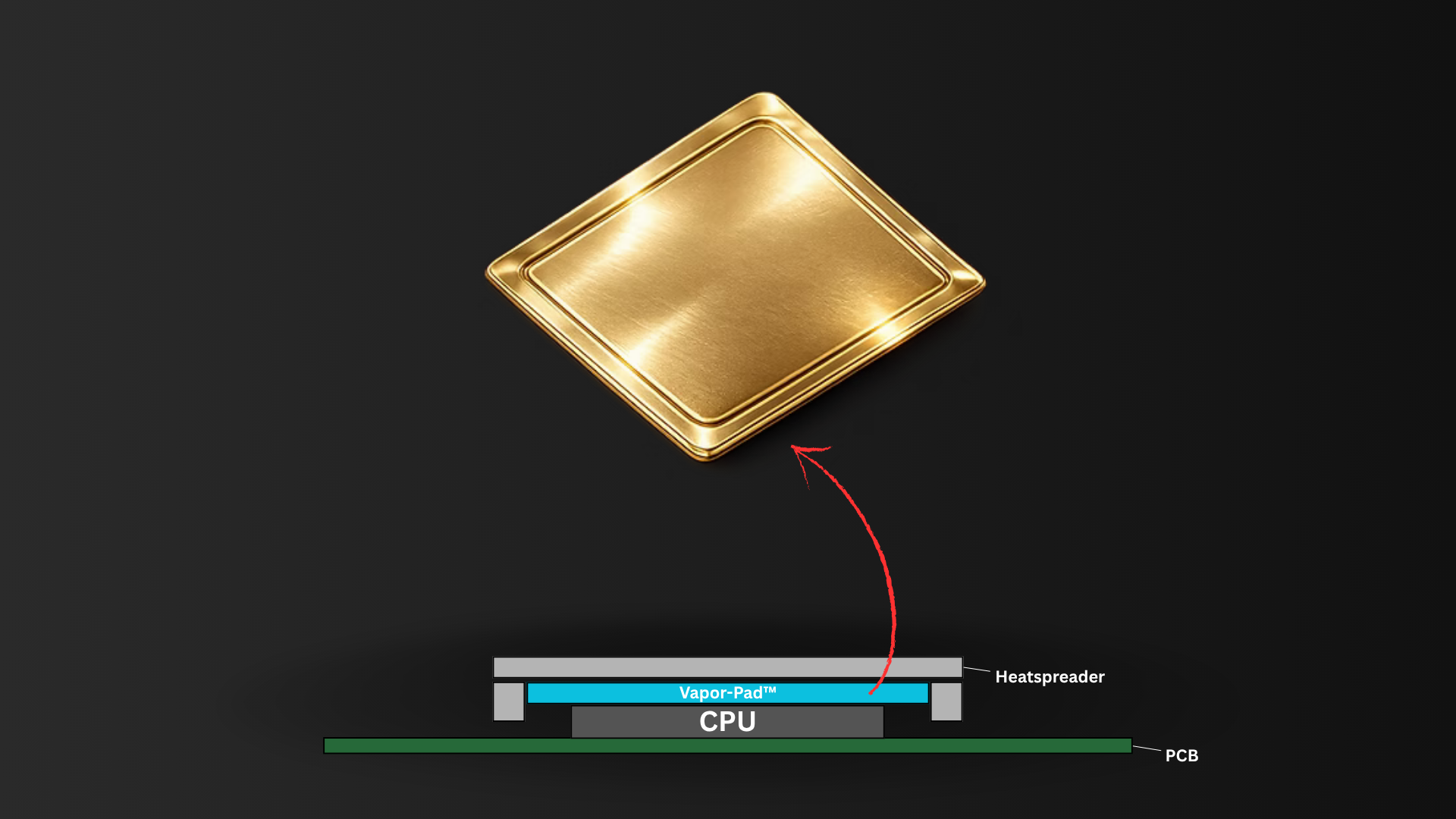
In comes the Vapor-Pad, which is essentially a sticker with a thin vapor chamber on it, giving you the best of both worlds. Xerendipity claims its product can dissipate between 800–1,200 W/m-K of heat versus the 15 W/m-K that traditional thermal pads are capable of. That's 50 to 80 times higher thermal conductivity in basically the same amount of space, all while being just as easy to apply as any regular thermal pad.
You may like Frore Systems' LiquidJet and AirJet Pak cooling systems in the flesh Plasma-powered solid-state laptop cooler to debut at CES Researchers build atom-thin 2D thermometers that can be embedded directly in processors Xerendipity showed that the Vapor-Pad is supposed to go between the CPU and its heatspreader, even replacing the solder TIM in some cases. It's supposed to come in direct contact with the silicon and the IHS in order to act as an optimal thermal buffer between the two. The diagram below shows how the Vapor-Pad would work, but there's another product included underneath it — so, what is that?
You're looking at Xerendipity's Non-Metal Vapor Champer , a self-explanatory solution to a problem you may not think exists, since metal already conducts heat the best. Like the Vapor-Pad, the NVMC is meant for phones, and its job is to cool the entire device without disrupting signals. Metal can easily block Wi-Fi and 5G cellular signals, which is why companies have to be extra careful with the internal design.
The antennae lines you see on the outside of pretty much every phone these days serve this purpose; it's meant to boost signals and ensure that if there's a vapor chamber inside, the signals almost have a way to go around it. With a non-metal vapor chamber, that problem is solved, and the entire phone can be packed with the NVMC for even more effective thermal management.
Not only that, but the lack of metal also means heat can't be dissipated through the surface of the device as well, which will reduce skin temperatures. Xerendipity claims its NVMC has 90% of the thermal conductivity of a regular vapor chamber and a 100% signal pass-through rate. It's also about 80% lighter than copper, so a bit of weight can be shaved off to perhaps accommodate a larger battery inside.
Get Tom's Hardware's best news and in-depth reviews, straight to your inbox.
Key considerations
- Investor positioning can change fast
- Volatility remains possible near catalysts
- Macro rates and liquidity can dominate flows
Reference reading
- https://www.tomshardware.com/phones/SPONSORED_LINK_URL
- https://www.tomshardware.com/phones/thermal-pads-with-in-built-vapor-chambers-claim-50-to-80-times-better-thermal-conductivity-than-normal-thermal-pads-1-200-w-m-k-vapor-pad-from-xerendipity-designed-to-replace-traditional-tim-in-a-cpu#main
- https://www.tomshardware.com
- Rogue OpenClaw AI wrote and published 'hit piece' on a Python developer who rejected its code — disgruntled bot accuses Matplotlib maintainer of discrimination
- GTC 2026: Ian Buck press Q&A transcript — VP of Hyperscale and HPC speaks out on shelving CPX and shipping LPU decode this year
- NVIDIA and ComfyUI Streamline Local AI Video Generation for Game Developers and Creators at GDC
- Micron predicts that cars will need 300GB of RAM — memory-laden vehicles could exacerbate shortages but create 'robust long-term growth in automotive memory dem
- Xbox Series X transformed into a gaming PC with 3D printed components, low-profile RTX 5060, and NUC 12 Extreme
Informational only. No financial advice. Do your own research.