
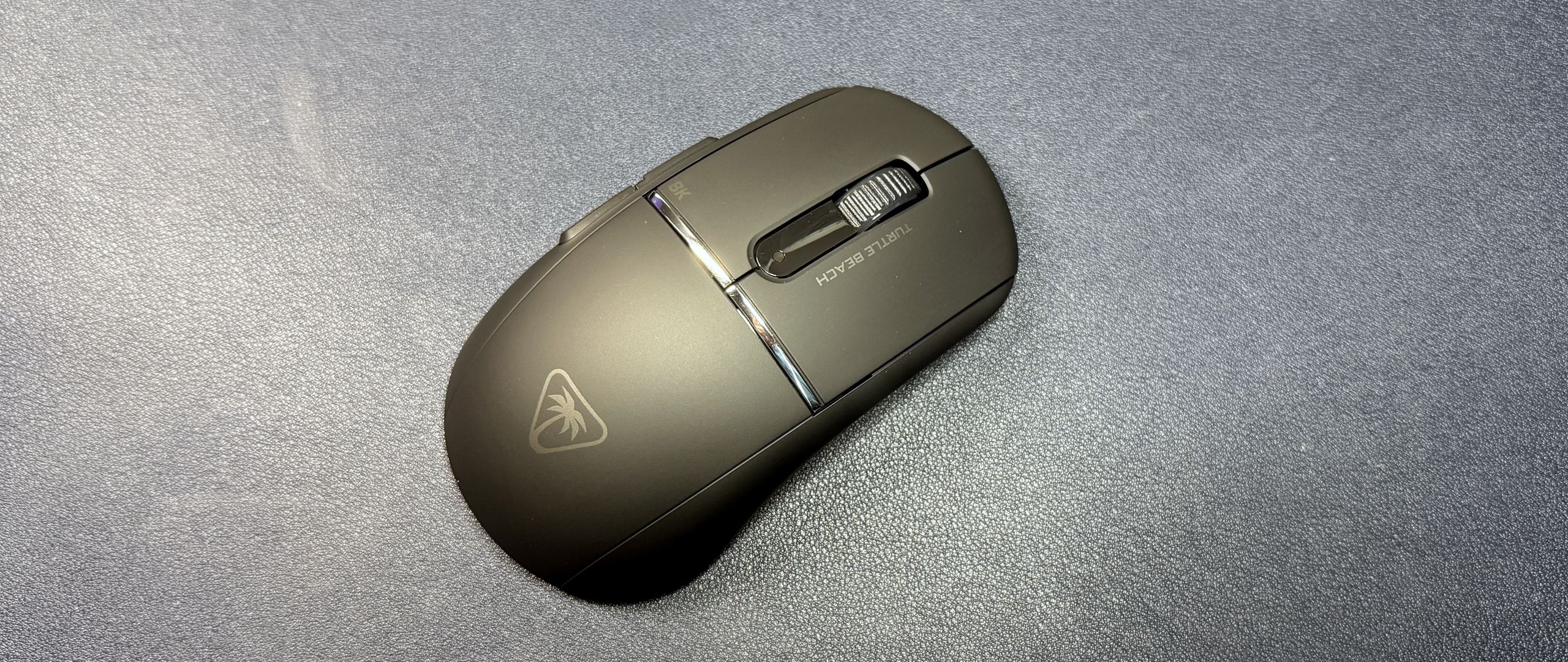
The Burst II Pro features Turtle Beach's latest Owl-Eye 30K optical sensor, which has a maximum sensitivity of 30,000 DPI and a maximum speed of 750 IPS, and can handle up to 70 Gs of force. According to the company, the sensor is optimized for "99.8% resolution accuracy on all surfaces including glass." This probably doesn't mean you can use it on a freshly-cleaned, fully-transparent glass windowpane, but it should still work almost perfectly on glass tables, desks, and mouse pads.
And it did work perfectly on all of the surfaces I tested it on, which included a variety of mouse pads (hard, soft, hybrid, glass) and different tabletops (wood, laminate, and frosted glass). In all of my tests, the sensor was smooth, speedy, and very accurate — even over uneven surfaces. Of course, most will probably be using this mouse in a pretty standard gaming environment, so accuracy shouldn't ever be an issue.
The Burst II Pro sports Turtle Beach's Titan optical switches, which are rated for up to 100 million clicks. The switches have a firm, stable click with a solidly tactile feel; they are on the louder side, though I've personally never found loud mouse switches to be a problem. The side buttons also have fairly clicky (and fairly loud) switches. This may not be the mouse for you if you're planning on gaming in the dead of night and hoping to stay relatively silent while doing so.
Like many other ultra-light modern gaming mice, the Burst II Pro features up to an 8,000 Hz (0.125ms latency) polling rate. I maintain the opinion that almost nobody will actually benefit from an 8,000 Hz polling rate in any peripheral — but if there was a peripheral in which it would make a difference, it would be a gaming mouse. You can adjust the mouse's polling rate in Turtle Beach's Swarm II peripheral software.
The Burst II Pro works with Turtle Beach's Swarm II software. The mouse works fine out of the box, but you'll need the software to download and install firmware updates, change various settings such as DPI steps, lift-off distance, and polling rate (1,000 Hz by default), and to remap buttons.
(Image credit: Tom's Hardware) (Image credit: Tom's Hardware) (Image credit: Tom's Hardware) The mouse has eight programmable inputs: the left/right primary buttons, the two side thumb buttons, the DPI switch, the center scroll wheel click, and the scroll wheel's up/down scroll. While you probably won't remap the main input for most of these buttons, you can also activate Easy Shift, which gives you a second layer of programmable inputs.
The Burst II Pro has three forms of connectivity: 2.4GHz wireless, Bluetooth, and wired (via USB-C). Its default polling rate is the standard 1,000 Hz, but the included 8K wireless dongle and the 8K USB-C to USB-A cable allow for up to 8,000 Hz polling rates over both wireless and wired connections.
Turtle Beach rates the Burst II Pro's battery life at 150 hours (with a 1,000 Hz polling rate), which is very good — on par with similarly lightweight mice, such as the Razer DeathAdder V4 Pro . Of course, switching to an 8,000 Hz polling rate drops this number down to just 40 hours (as you might expect). Still, that's not too bad — you should still be able to go a few days without charging.
The Turtle Beach Burst II Pro is a comfortable, ultra-lightweight gaming mouse with 8K wired and wireless polling rates — and it's quite a bit cheaper than flagship standouts such as the Razer DeathAdder V4 Pro . Still, it's not the cheapest ultra-lightweight 8K polling wireless mouse — you can find similar mice for less than the Burst II Pro's $139.99 retail price, such as the Glorious Series 2 Pro Wireless — and it's not a very exciting mouse otherwise. I did like the location of its DPI switch (though I don't find myself switching DPI… ever, basically), but it's placed a little too far forward to be remapped as anything else.
The Burst II Pro is… fine — it's not doing much to differentiate itself from its competitors, aside from having noticeably creaky sides, and it's a solid mouse if you're looking for wireless 8K polling — it's just not a standout in this increasingly crowded field.
Sarah Jacobsson Purewal Social Links Navigation Senior Editor, Peripherals Sarah Jacobsson Purewal is a senior editor at Tom's Hardware covering peripherals, software, and custom builds. You can find more of her work in PCWorld, Macworld, TechHive, CNET, Gizmodo, Tom's Guide, PC Gamer, Men's Health, Men's Fitness, SHAPE, Cosmopolitan, and just about everywhere else.
Key considerations
- Investor positioning can change fast
- Volatility remains possible near catalysts
- Macro rates and liquidity can dominate flows
Reference reading
- https://www.tomshardware.com/peripherals/gaming-mice/SPONSORED_LINK_URL
- https://www.tomshardware.com/peripherals/gaming-mice/turtle-beach-burst-ii-pro-review-ultra-light-8k-polling-and-a-little-creaky#main
- https://www.tomshardware.com
- PC Fan Faceoff: Can Arctic's $7 P12 Pro compete with the $40 Noctua NF-A12x25 G2?
- Ride Into Adventure With Capcom’s ‘Monster Hunter Stories’ Series in the Cloud
- GeForce NOW Rings In 2026 With 14 New Games in January
- MSI teases new power supplies with 'instant protection' against melting RTX 5090 cables — promises to solve 12V-2×6 connector woes by monitoring individual wire
- Intel Arc B570 GPU kicks off new year at just $199 — save $30 on one of the best budget GPUs around
Informational only. No financial advice. Do your own research.