
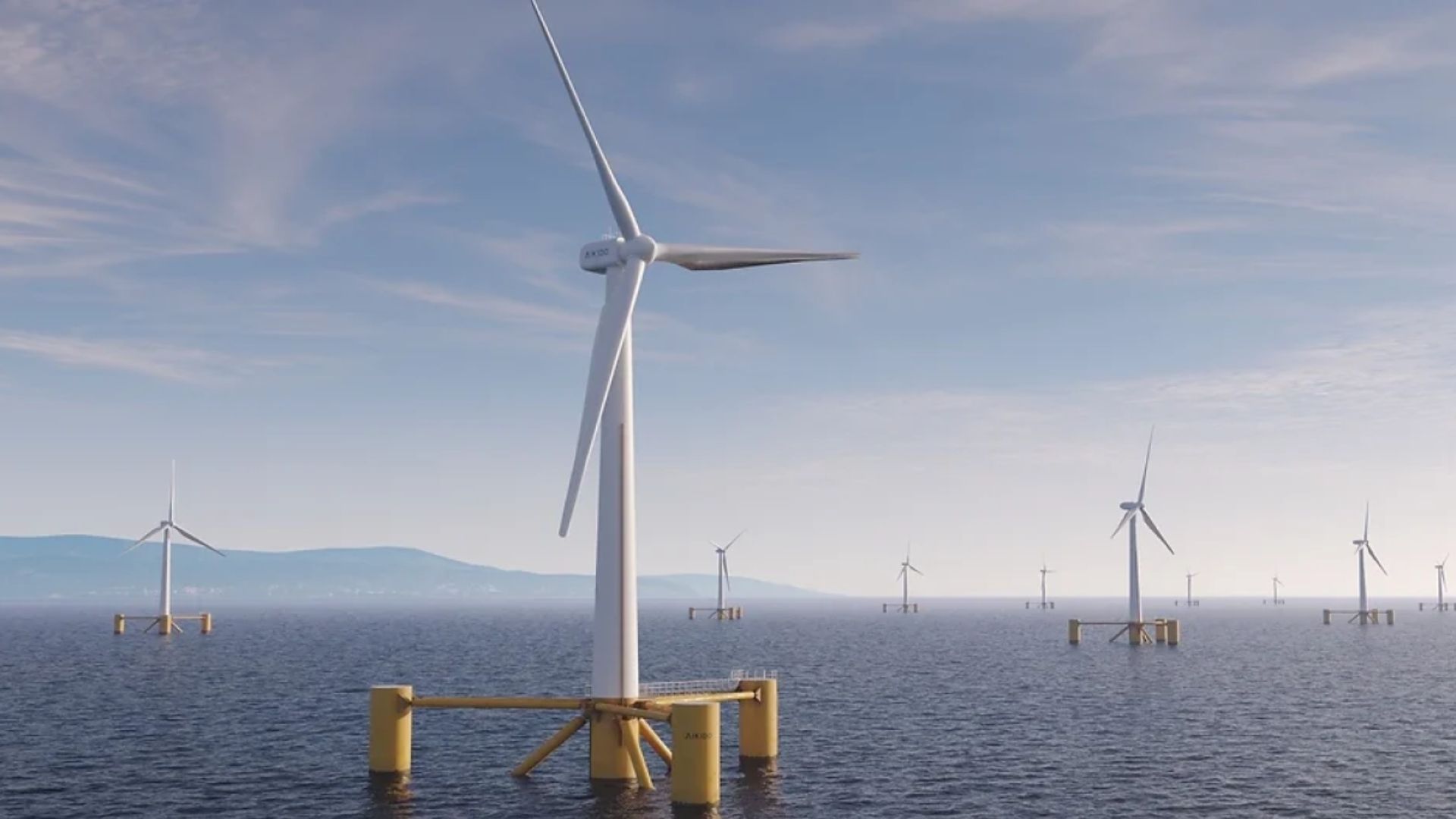
Aikido is using a semi-submersible design for its offshore wind turbines, similar to what many oil and gas companies use when drilling in high seas. This design comes with three ballast-filled legs, filled with fresh water to help maintain buoyancy and stay upright. From there, it’s secured to the seabed via chains and anchors, ensuring that it will remain in the general area, even as the wind and ocean batter it.
The firm says that it can add up to a 3- to 4-MW data hall in the upper part of each leg, meaning each wind turbine can potentially become a 9- to 12-MW data center. The fresh-water ballast is still stored in the lower part of each leg, which is then pumped towards the AI chips for cooling. The warm water is then pumped back into the ballast, with the chilly waters of the North Sea cooling it down. It also added an air-conditioner to manage the temperature of other components that aren’t part of the water-cooling loop.
You may like Data center developers building private natural gas 'Shadow Grid' power plants to sidestep strained grids U.S. electricity grid stretches thin as data centers rush to turn on onsite generators Nvidia-backed trial shows AI data centers can flexibly adjust power use in near real time, with global implications for energy consumption “We have this power from the wind. We have free cooling. We think we can be quite cost competitive compared to conventional data-center solutions,” Aikido CEO Sam Kanner told IEEE Spectrum . “This crunch in the next five years is an opportunity for us to prove this out and supply AI compute where it’s needed.”
However, building a wind-powered offshore data center is not without its challenges. First off, wind power isn’t exactly consistent throughout the year, so each 'data center' will have batteries for storing excess energy and delivering it in times of low production. If the lean season extends far longer than anticipated, it’s also connected to the grid, allowing it to use power from other sources. Aside from this, the sea can be quite unforgiving, and salt water is particularly corrosive, possibly leading to higher maintenance costs.
Nevertheless, experiments like this can potentially solve the power and space problems that most land-based data centers face at the moment. In fact, China has thought of a similar approach, with a wind-powered underwater data center prototype launched in Shanghai in October last year. Although this might seem like an ambitious project, it’s still far more feasible than Elon Musk’s plan of launching a million data center satellites orbiting around the earth.
Follow Tom's Hardware on Google News , or add us as a preferred source , to get our latest news, analysis, & reviews in your feeds.
Get Tom's Hardware's best news and in-depth reviews, straight to your inbox.
Key considerations
- Investor positioning can change fast
- Volatility remains possible near catalysts
- Macro rates and liquidity can dominate flows
Reference reading
- https://www.tomshardware.com/desktops/servers/SPONSORED_LINK_URL
- https://www.tomshardware.com/desktops/servers/us-startup-plans-to-build-data-centers-inside-ocean-based-wind-turbines-servers-water-cooled-via-chilly-north-sea-each-leg-houses-a-data-center-firm-set-to-launch-three-legged-prototype-in-norways-north-sea-this-year#main
- https://www.tomshardware.com/subscription
- NVIDIA and Partners Show That Software-Defined AI-RAN Is the Next Wireless Generation
- Jensen Huang set to receive $4 million bonus from Nvidia, 0.002% of his $164 billion net worth — a small incentive for one of the richest people on earth
- Motherboard buying advice for the PC building apocalypse — Our benchmarks, and years of testing, show you where to save and when to spend
- How AI Is Driving Revenue, Cutting Costs and Boosting Productivity for Every Industry in 2026
- AMD VP uses AI to create Radeon Linux userland driver in Python — senior AI engineer says he "didn't open the editor once"
Informational only. No financial advice. Do your own research.