
Valve's 256GB LCD Steam Deck is an incredible 20% off — big price drop just in time for the Steam Autumn Sale
The CPU is paired with 16GB of DDR5. And while the company is using traditional SODIMMs, it's a bit more complicated to reach them with the heatsink in the way. Technically, you can upgrade it, but with some RF shielding and an attempt to keep the memory as close as possible to the CPU for signal integrity, it might be a bit of work.
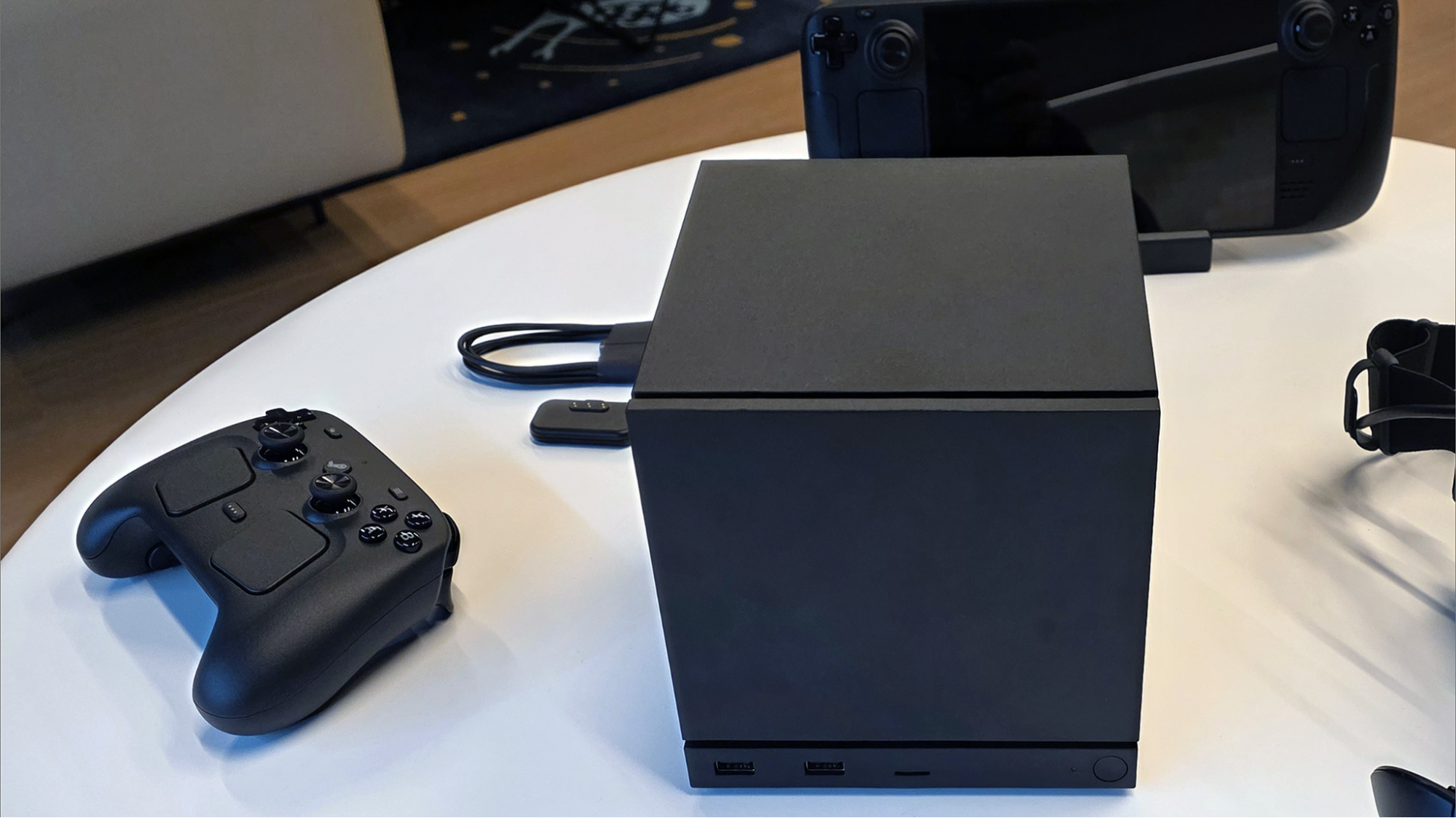
(Image credit: Tom's Hardware) (Image credit: Tom's Hardware) There's an integrated 300W power supply. Valve says the GPU uses 110W (though one Valve rep gave a range of 110W – 130W, stating that "we're still kind of fine-tuning that") while the CPU goes up to 30 watts. The CPU peaks at 4.8 GHz.
Valve will sell two configurations of the Steam Machine, and the only difference will be storage. You can get either a 512GB SSD or a 2TB SSD. Either way, Valve is using an M.2 2230 SSD in the system, though there is room to support an M.2 2280 if you decide to upgrade or replace the drive.
There is another way to expand storage. Just like on the Steam Deck, you can use a microSD card. If you remove the microSD card and place it in a Steam Deck or a Stream Frame, your library will come with you, ready to go in other devices.
"For most people, you never have to be seeing [the SSD] at all," said Valve hardware engineer Yazan Aldehayyat. "[An] SD card is your best way to expand your storage, but if you really want to, you can. It's your device."
In addition, there are distinct Wi-Fi and Bluetooth antennas to help prevent signal issues. If you're using Valve's new Steam Controller, a connection puck is built into the device, allowing for up to four Steam Controllers with no loss in Bluetooth performance. (You are, of course, welcome to connect a mouse and keyboard or use other controllers).
The system supports two displays via HDMI and DisplayPort on the rear. If you add a DisplayPort hub to the rear or use daisy-chaining, the system should be able to support more monitors. While Valve says the HDMI port supports 4K at 120 Hz, it's labeled as HDMI 2.0, not HDMI 2.1, because it doesn't currently use some software features of HDMI 2.1, such as like DSC and ALLM, which Valve says "we are currently working on and hope to rectify in the future."
With the new computer, Valve also has a new controller, the Steam Controller. This will be sold in an optional bundle with the Steam Machine, as well as on its own. Beyond the Steam Machine, the Controller works with anything that runs Steam, including Windows, Mac and Linux PCs, PC gaming handhelds , the Steam Frame, and Steam Deck. If you use Steam Link, iOS and Android devices should work, too.
"They're clocked and canted, and that is just because based on a ton of experimentation, and probably 30 different orientations of these trackpads, we found that this angle is the most comfortable for the most users when they're playing," Valve’s Steve Cardinali said.
The joysticks are using TMR (Tunneling Magnetoresistance) joysticks, which should help reduce stick drift. Valve also said that because these joysticks are so responsive, it could reduce the deadzone on the controllers by more than half.
(Image credit: Tom's Hardware) (Image credit: Tom's Hardware) There are also standard L/R triggers and L/R bumpers, along with four assignable grip buttons, just like on the Steam Deck. Effectively, this whole controller is the Steam Deck controls in a console-style controller.
The other inputs, though, are more unique. There's a 6-axis gyroscope and what Valve calls "Capacitive grip sense," which means the controller can tell that you're holding it. We demoed the Controller in Balatro , lifting fingers off of the controller to activate the gyroscope, making moves, and then placing our fingers back down.
There are four motors in the controller: two in the grips and another two specifically for the trackpads.
You can connect the Steam Controller to devices in three different ways. The primary option is the Steam Controller Puck, which comes pre-paired with the controller. (If you're using a Steam Machine, there's an internal puck inside). The Puck, which plugs into a USB port, uses a proprietary wireless connection that Valve claims is more stable than Bluetooth, and can connect to four controllers. Of course, standard Bluetooth is also an option, as is directly attaching to a computer with a USB cable.
The Steam Controller Puck can also charge the controller. There are pogo pins on the puck that you can connect to the Controller in order to charge it when you're not playing games. You can also charge the device over USB.
Valve estimates that you'll get 35 hours or more of playtime on the Steam Controller's rechargeable battery.
Tom's Hardware Managing editor Matt Safford said that the controller felt comfortable in his brief demo time, though he spent more time cycling through the various modes than settling on a specific one. Quickly using the gyroscope to move the cursor after removing a couple of fingers from the grip did instantly feel intuitive. More time, he said, will tell how he feels about the touchpads, given his muscle memory and proclivity for the FPS genre is based on a keyboard and mouse.
The controller didn't feel overly bulky, nor heavy or light. The plastic used in the construction generally felt fine, neither overly cheap or particularly premium. It feels similar to a Steam Deck.
Valve hasn't provided pricing or an exact release date for the Steam Machine or Steam Controller just yet, though we were told to expect the hardware early next year. Some of that uncertainty is because of a volatile market for computer components.
"The market is kind of weird right now," a Valve rep told us. "You know, memory prices are going up like right as we speak. Right now, depending on who you ask, they might tell you the GDDR we're using is not a thing next year, right? So, like, there's a lot of things that we're still trying to figure it out. But, uh, of course, our goal is to be ready, and we think we're doing a pretty good job of that.”
That being said, we were told that the company is aiming for a "great value" on "the entry level side of things." But Valve's developers also mentioned that the Steam Machine, being packed with features, makes pricing a bit of a "balancing act" in an attempt to find a sweet spot. But we won't find out pricing until closer to launch.
The Steam Machine moniker does come with some baggage. That was also the name of a series of small desktop computers released in 2015 running on a previous version of the Linux-based SteamOS. At the time, SteamOS only ran games that worked natively on Linux. And the Steam Machines, which were made by companies like Alienware, Zotac, and Origin, didn't perform as well as Windows-based competitors with similar hardware. At the time, Valve chose not to make its own computer , though it did make a controller .
That controller, also dubbed the Steam Controller, featured a single touchpad in lieu of the right control stick. While some praised it for its flexibility across game genres, the controller eventually went on a firesale in 2019, with Valve selling them at $5 a pop to clear inventory.
Valve's hardware developers told us they've learned from the original Steam Machines, and that they don't want game developers to have to do work to get their games working for the device unless it's additive to take advantage of SteamOS or Steam Machine features.
With newer hardware, better game compatibility, and the Steam Deck as a strong proof of concept, it sure seems from a brief hands-on that the Steam Machine has a better chance this time around.
Andrew E. Freedman Social Links Navigation Andrew E. Freedman is a senior editor at Tom's Hardware focusing on laptops, desktops and gaming. He also keeps up with the latest news. A lover of all things gaming and tech, his previous work has shown up in Tom's Guide, Laptop Mag, Kotaku, PCMag and Complex, among others. Follow him on Threads @FreedmanAE and BlueSky @andrewfreedman.net . You can send him tips on Signal: andrewfreedman.01
LordVile Claiming 4K60 with 8GB of VRAM is a bit dangerous. Especially with upscaling. I doubt it can do it too it’s effectively an overclocked RX 7400 Though depending on the price I’d be tempted to replace my XSX with it. Reply
Branpanman OMG Valve, just take my money!!! Reply
Key considerations
- Investor positioning can change fast
- Volatility remains possible near catalysts
- Macro rates and liquidity can dominate flows
Reference reading
- https://www.tomshardware.com/video-games/console-gaming/SPONSORED_LINK_URL
- https://www.tomshardware.com/video-games/console-gaming/valve-brings-back-steam-machine-and-steam-controller-hands-on-with-valves-new-amd-based-living-room-gaming-hardware#main
- https://www.tomshardware.com
- Tape keeps kicking, 'breakthrough' 40TB native spec announced — LTO-10 tapes claim up to 100TB compressed data capacity, hold 2.2X more data than previous spec
- N64 cartridge-playing Analogue 3D finally gets a shipping date – FPGA-powered Nintendo 64 remake with 4K, VRR to roll out starting November 18
- IBM unveils new 'Quantum Nighthawk' 120-qubit processor and software stack — company on track for 2029 fault-tolerance milestone
- Centauri Carbon 2 spotted in the wild ahead of Q1 2026 release – multi-material 3D printer's details listed in first official spec page
- Automotive officials warn of 'devastating' chip storage as Nexperia halts China-bound wafer shipments — companies working 'around the clock' to find alternative
Informational only. No financial advice. Do your own research.