
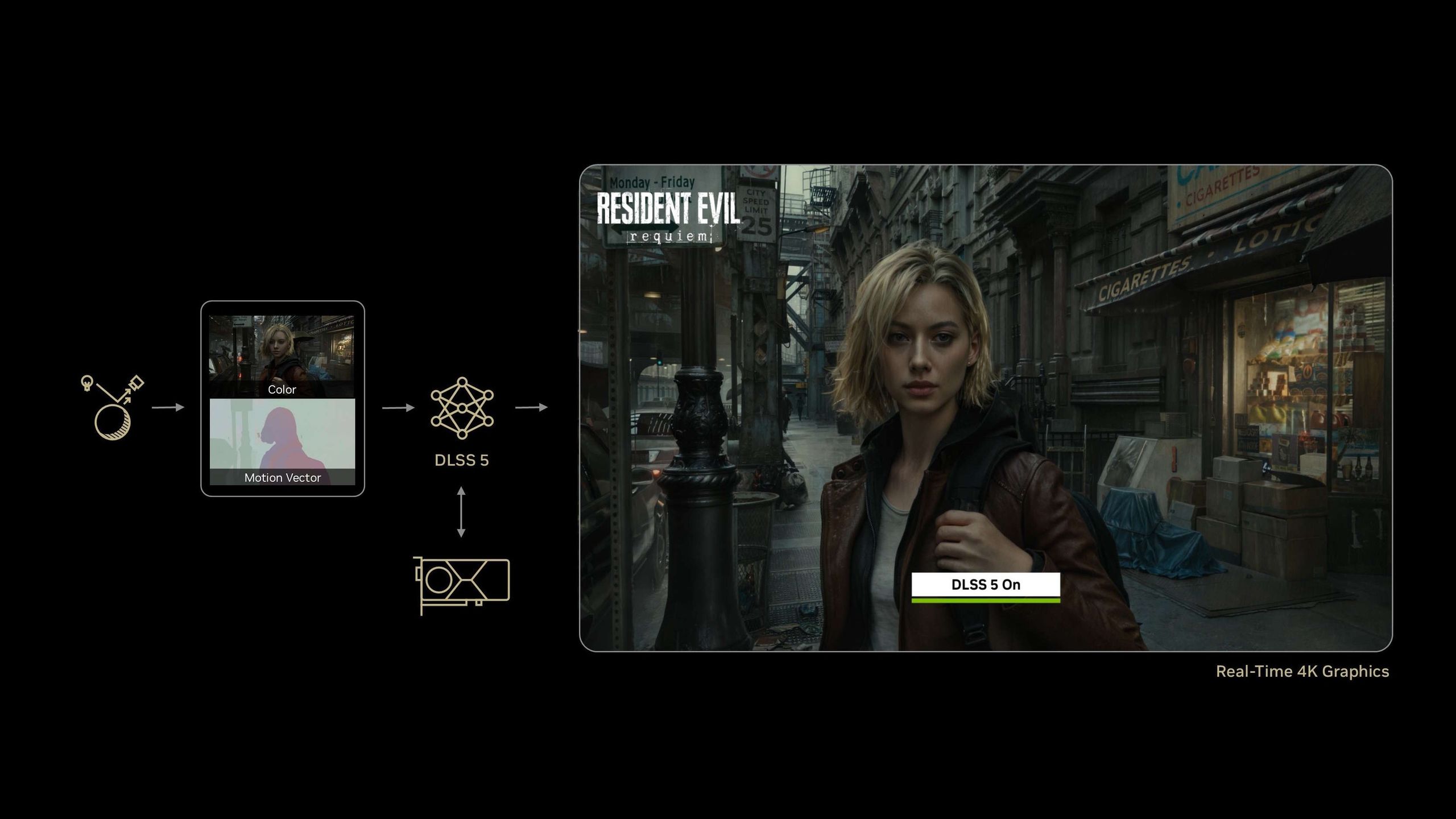
Watch On Nvidia says that we’re not used to seeing faces of this fidelity in real-time rendering, and sometimes, the effect is breathtaking. The visages of the characters in Nvidia’s Zorah demo went from looking like “a good video game” to “incredibly lifelike.” And the flatly lit and (frankly) dead-eyed characters of Starfield practically come alive with DLSS 5 enabled, transforming into something resembling actual humans rather than aliens wearing human skin suits.
But in Oblivion Remastered , which uses character models that still exhibit some of the awkwardness of the 2006 original, the results are more mixed. It’s incredible that DLSS 5 can simply infer that flowing hair should create shadows that the game’s native lighting model completely fails to cast, but when that same character’s facial features are comically exaggerated, rendering their skin and hair with cinematic detail and precision can be more off-putting than immersive. The uncanny valley becomes the uncanny Grand Canyon.
And that’s where the advent of DLSS 5 and its reception moves into the realm of the philosophical rather than the purely technical. Real-time graphics as a field has relentlessly pursued more photorealistic rendering ever since the advent of the first GPUs, and working in the wide gap between real life and the capabilities of our tech to reproduce it has required considerable artistic skill, taste, and judgment to partially bridge those limitations.
If DLSS 5 is going to drastically narrow that gap, carelessly applying it has the potential to produce results that aren’t consistent with a game’s creative direction, and the inflamed community response to the results of some of Nvidia’s demos so far suggests that the company and its game dev partners will need to tread carefully to avoid those pitfalls. Assuming a developer includes DLSS 5 in a title using the existing Streamline SDK, Nvidia says that the model offers controls for color grading, intensity, and masking to fine-tune its overall effect on a game's appearance.
Of course, DLSS 5 will be toggle-able just like upscaling and frame gen, so if you’re not a fan of its implementation in a particular game, you can just leave it off entirely. And although the company acknowledges that the model could certainly be shoehorned into games by enterprising modders, the results thereafter are purely those folks’ responsibility, not devs' or Nvidia's.
The final open question for DLSS 5 regards its hardware requirements. The demos we saw were all running on a PC featuring dual RTX 5090s, one to run the game itself and one dedicated to accelerating the model. That’s a massive amount of compute, but the company said it hasn’t begun performance optimizations on the model yet, so we’ll have to withhold judgment on its hardware requirements until later. Nvidia also didn’t offer any indication of which of its RTX GPU architectures would be best compatible with DLSS 5, either.
All told, this remains an early look, but even at this stage, we’re excited and cautiously optimistic for the changes that expanded uses of neural rendering holds for gaming graphics. The fact that DLSS 5 is an AI model means that it can be continually fine-tuned and improved, just as DLSS upscaling has progressed in its capabilities over time.
Given that fact, Nvidia will doubtless continue to work internally and with game studios to refine DLSS 5’s outputs and requirements as the tech continues to be developed ahead of its launch this fall. The company claims over a dozen games will support DLSS 5 at launch so far, and given the widespread adoption of DLSS tech generally, that number is sure to grow by leaps and bounds. From what we’ve seen so far, we can’t wait to get our hands on it and give it a spin in a wider range of titles.
Follow Tom's Hardware on Google News , or add us as a preferred source , to get our latest news, analysis, & reviews in your feeds.
As the Senior Analyst, Graphics at Tom's Hardware, Jeff Kampman covers everything to do with GPUs, gaming performance, and more. From integrated graphics processors to discrete graphics cards to the hyperscale installations powering our AI future, if it's got a GPU in it, Jeff is on it.\u00a0 ","collapsible":{"enabled":true,"maxHeight":250,"readMoreText":"Read more","readLessText":"Read less"}}), "https://slice.vanilla.futurecdn.net/13-4-18/js/authorBio.js"); } else { console.error('%c FTE ','background: #9306F9; color: #ffffff','no lazy slice hydration function available'); } Jeffrey Kampman Senior Analyst, Graphics As the Senior Analyst, Graphics at Tom's Hardware, Jeff Kampman covers everything to do with GPUs, gaming performance, and more. From integrated graphics processors to discrete graphics cards to the hyperscale installations powering our AI future, if it's got a GPU in it, Jeff is on it.
Bolboa I am not thrilled at all despite the "visual uplift". I’m concerned about inconsistencies between frames, exaggerated colors and lighting, the pretension for the gpu of acting as an art director, generative models that are slow to download or limited to online usage, and the complete shift in the nature of DLSS, which no longer aims to enhance performance while preserving pre-rendered data. Worse, I don't even think NVIDIA is prepared for potential legal action over the anti-competitive practices that this feature introduces. Developers will put less effort into the final product, and this will be offset by proprietary technology that forces players to turn to NVIDIA to experience the game as the developers intended. Do developers even own the generated result and are allowed to show it in a trailer as part of their creation? Reply
bigdragon DLSS 5 looks like it can jump that gap between polygons and real media. This tech is genuinely impressive to see and really elevates graphics to a whole new level! There's just one teeny, tiny, little problem: this level of graphical fidelity will only be wielded by the AAA studios that have been pushing out live service flop after flop. All of the games I've been enjoying with friends since the pandemic have been stylized or otherwise not focused on photorealism. I think the industry is continuing to focus excessively on graphics at the expense of gameplay. Let's also not forget the elephant in the room: the RTX 5090. You know, everyone's favorite oppressively overpriced fire-starter. How much longer until we get Nvidia cards that are advertised as LAI (Light AI Inference) similar to the LHR (Light Hash Rate) cards from several years ago? Reply
waltc3 Going all the way back to nVidia's original G-sync advertising, when nVidia posted screen grabs with "Gsync-off" or "RTX Off", I noticed years ago that my ATi/AMD GPUs never rendered as poorly as I see in nVidia's "XXX-off" screen ads. In fact, the "On" frames were much closer to my normal rendering fidelity! I see nothing here to change my mind. Come on–two 5090s required for DLSS 5, which isn't close to being ready for prime time. Seriously, who is going to lay out $4k+ for his gaming GPUs that will be lucky to support 1-2 games at most that nVidia will have to pay for because devs aren't going to jump on this with enthusiasm…;) It simply isn't necessary or desirable, imo. Seems like nVidia is grasping here for something to show…;) Reply
User of Computers Meh. AI slop in MY video games? no thanks! Reply
Key considerations
- Investor positioning can change fast
- Volatility remains possible near catalysts
- Macro rates and liquidity can dominate flows
Reference reading
- https://www.tomshardware.com/pc-components/gpus/SPONSORED_LINK_URL
- https://www.tomshardware.com/pc-components/gpus/we-got-a-first-look-at-nvidias-dlss-5-and-the-future-of-neural-rendering-at-gtc-the-results-can-be-impressive-but-theres-work-to-do#main
- https://www.tomshardware.com/subscription
- Nvidia's Nemotron coalition brings eight AI labs together to build open frontier models
- NVIDIA DSX Air Boosts Time to Token With Accelerated Simulation for AI Factories
- AMD's upcoming RDNA 5 GPUs might improve dual-issue execution & use shader units more efficiently — LLVM patch adds new FMA instruction to ease compiling
- Grab 32GB of Corsair DDR5 RAM for just $111 in this epic Newegg combo with the 9850X3D — $1,020 bundle for an AMD gaming PC build includes an Asus X870E-E mothe
- Into the Omniverse: How Industrial AI and Digital Twins Accelerate Design, Engineering and Manufacturing Across Industries
Informational only. No financial advice. Do your own research.