
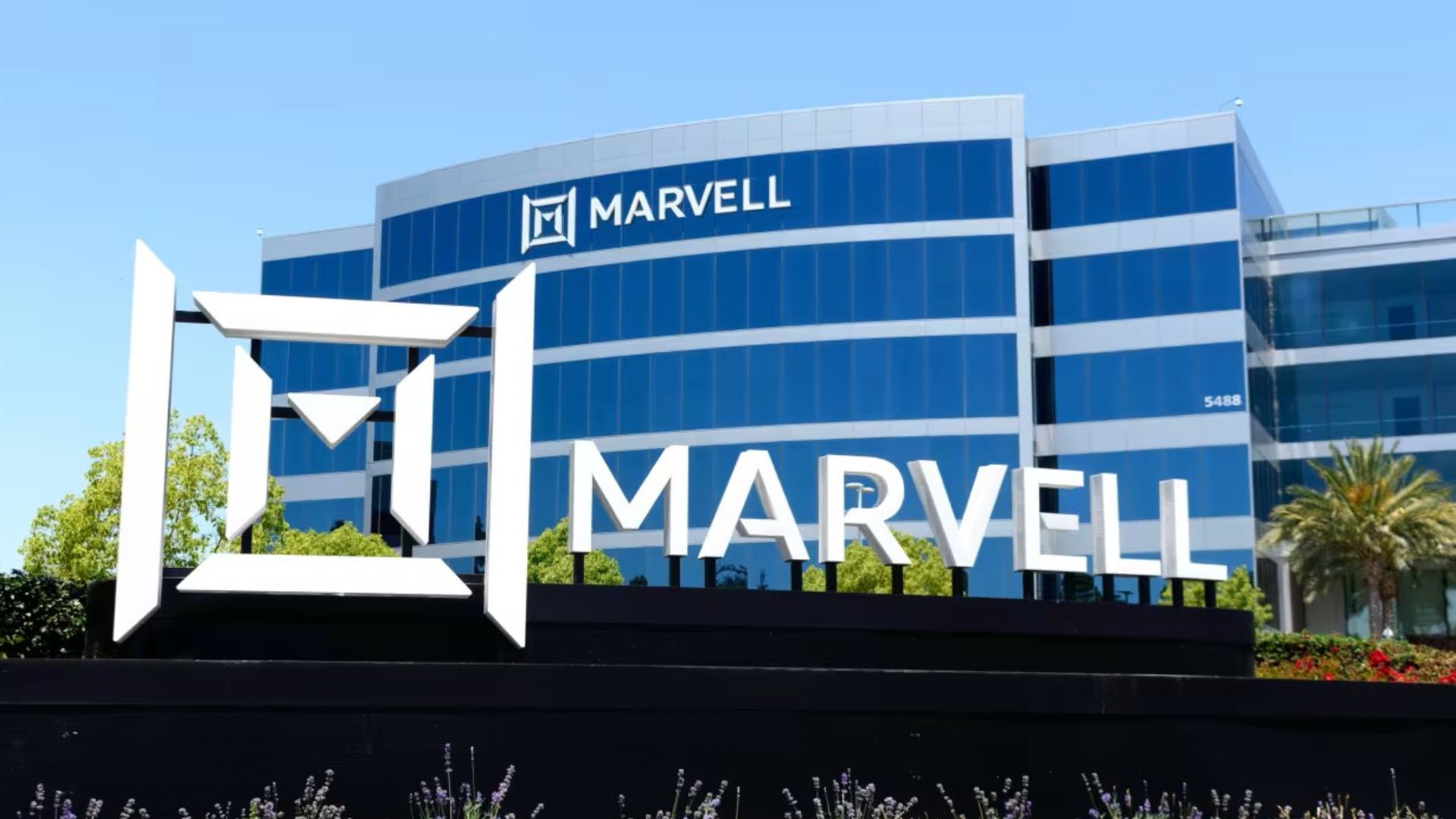
The Marvell deal is the second $2 billion investment Nvidia has made in 2026. The first, announced in January, went to AI cloud provider CoreWeave , which rents access to Nvidia CPUs. This was widely described as an example of the circular financing arrangements that have lifted AI company valuations: Nvidia invests capital in a customer, and that customer uses it to buy more Nvidia hardware . Nvidia already held a 7% stake in CoreWeave and has committed to buying more than $6 billion in its services through 2032.
That’s pretty different from the deal just struck with Marvell. CoreWeave focuses on the demand-side of things — fund a customer to buy more GPUs. Marvell focuses on the supply side, co-opting the company designing the alternative silicon itself. Instead of fighting the custom ASIC trend, Nvidia is absorbing it into its own infrastructure.
The Marvell deal is the latest in a series of NVLink Fusion expansions. Samsung Foundry joined in October to offer design-to-manufacturing support for NVLink-compatible custom chips on its 3nm and 2nm nodes, giving Nvidia a second major foundry partner after TSMC. Then Arm entered the program in November , enabling its licensees to build CPUs with native NVLink connectivity, which opens the door for hyperscalers like Google, Meta, and Microsoft to integrate NVLink directly into their own Arm-based SoCs. SiFive joined in January 2026, bringing RISC-V into the ecosystem. Fujitsu, Qualcomm, MediaTek, Alchip, Astera Labs, Synopsys, and Cadence were among the original partners announced at Computex .
On the other side sit AMD, Intel, and Broadcom, all of which are backing the Ultra Accelerator Link (UALink) consortium as an open industry-standard alternative to NVLink. UALink's 1.0 specification supports up to 1,024 GPUs with 200 GT/s bandwidth, but the standard has yet to ship in production hardware, while NVLink is already deployed at scale in Blackwell NVL72 racks.
Broadcom's absence from NVLink Fusion is pretty interesting, given it’s the other half of the custom ASIC duopoly. Broadcom has been Google's TPU design partner for over a decade, spanning six generations of the chip, and also works with Meta on its MTIA accelerator and reportedly with OpenAI on a custom ASIC. If Broadcom's clients eventually face pressure to deploy their custom chips in NVLink-compatible racks, the current dividing line between the NVLink Fusion camp and the UALink camp could shift.
The partnership also covers two secondary but just-as-significant areas. Marvell acquired Celestial AI in early 2026 for $3.25 billion, adding photonic fabric technology to its portfolio. Optical interconnects are becoming critical as AI clusters scale beyond the distances where electrical signals maintain their integrity, and Marvell's optical DSP products are already widely used in pluggable modules for data center networking. The company's fiscal year 2027 revenue target for data center switches is above $600 million, roughly double its fiscal year 2026 figure.
Meanwhile, the AI-RAN part of the Nvidia-Marvell collab will target the transformation of telecomm infrastructure into AI-capable networks using Nvidia's Aerial platform for 5G and 6G. This is a smaller market today, but both companies are positioning for a buildout that would embed AI processing directly into the radio access network.
"The inference inflection has arrived. Token generation demand is surging, and the world is racing to build AI factories," said Jensen Huang on the investment. Whatever the use-case may be, Nvidia wants to be a critical part of AI infrastructure. And by opening the gates and partnering with Marvell, his company is broadening the size of its walled garden.
Luke James is a freelance writer and journalist.\u00a0 Although his background is in legal, he has a personal interest in all things tech, especially hardware and microelectronics, and anything regulatory.\u00a0 ","collapsible":{"enabled":true,"maxHeight":250,"readMoreText":"Read more","readLessText":"Read less"}}), "https://slice.vanilla.futurecdn.net/13-4-19/js/authorBio.js"); } else { console.error('%c FTE ','background: #9306F9; color: #ffffff','no lazy slice hydration function available'); } Luke James Social Links Navigation Contributor Luke James is a freelance writer and journalist. Although his background is in legal, he has a personal interest in all things tech, especially hardware and microelectronics, and anything regulatory.
Key considerations
- Investor positioning can change fast
- Volatility remains possible near catalysts
- Macro rates and liquidity can dominate flows
Reference reading
- https://www.tomshardware.com/tech-industry/SPONSORED_LINK_URL
- https://www.tomshardware.com/tech-industry/nvidia-invests-2-billion-in-marvell-whose-biggest-clients-are-trying-to-replace-nvidia-chips#main
- https://www.tomshardware.com
- Into the Omniverse: NVIDIA GTC Showcases Virtual Worlds Powering the Physical AI Era
- The Future of AI Is Open and Proprietary
- Bitcoin network has its first quarterly hashrate drop since 2020 — Iran conflict spurs Bitcoin mining operators to accelerate pivot to AI infrastructure
- NVIDIA, Telecom Leaders Build AI Grids to Optimize Inference on Distributed Networks
- Revolut Bank ordered to hand over details of more than 300 Sky TV subscribers connected to piracy operation — TV provider expected to pursue subscribers who pai
Informational only. No financial advice. Do your own research.