
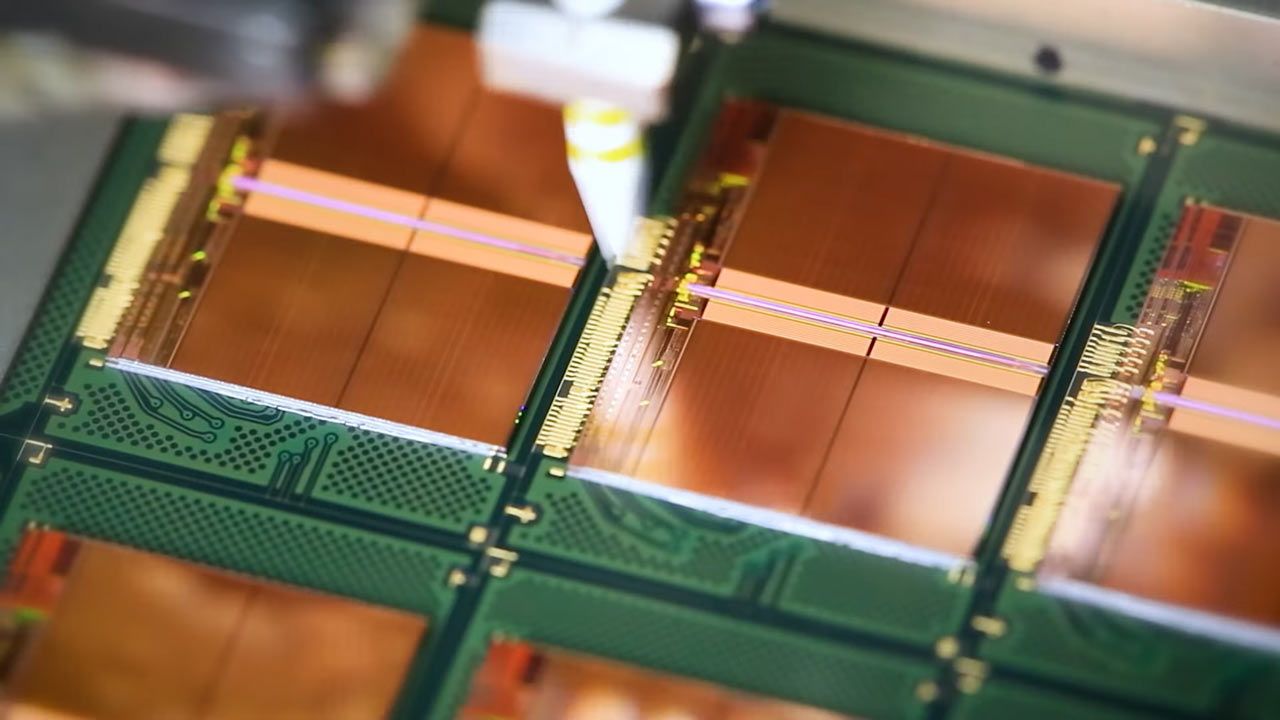
Various reports suggest that YMTC’s Fab 2 has been operating with domestic workarounds and modified legacy tools , relying in part on procurement from third-party intermediaries to secure essential chemicals and maintenance components. However, these workarounds are slow and painful.
One potential candidate is SMEE’s immersion lithography equipment, but this has yet to deliver consistent yields beyond 28nm logic equivalents , far from the sub-20nm half-pitch necessary for leading-edge NAND stacking. Still, YMTC’s new fab suggests confidence that by 2027, domestic toolchains will be capable enough to support high-volume NAND production if not at the bleeding edge, then at commercial scale.
The report by Nikkei Asia suggests that the timing of this announcement also aligns with China’s broader recalibration toward AI infrastructure resilience. With U.S. export restrictions locking out Chinese firms from Nvidia H100 and A100-class GPUs, Beijing has redirected its subsidies and engineering talent toward local accelerator design, sovereign foundation models, and the underlying memory and packaging stacks that make them viable.
In that context, NAND flash is arguably foundational. While DRAM remains the performance bottleneck in AI inference, NAND underpins persistent storage for massive model checkpoints, training data lakes, and parameter weights for retrieval-augmented generation. YMTC’s success here is thus critical not because its chips are the fastest, but because they’re Chinese.
That imperative is reflected in the composition of China’s "Little Giants" initiative, which is understood to support key industrial chains and strategic emerging industries such as semiconductors and advanced manufacturing in the upstream value chain. YMTC, though technically a commercial entity under Tsinghua Unigroup, functions effectively as a state-backed lynchpin for this ecosystem.
It’s also worth noting that YMTC’s return to expansion mirrors Beijing’s new appetite for high-risk, high-capex investment in areas where U.S. export controls bite hardest, but enforcement remains inconsistent. In that grey area, YMTC might be betting that Washington’s resolve may soften over time, or that domestic tooling will catch up just enough to justify the investment.
From a business standpoint, YMTC’s decision to break ground on a third fab lands during one of the tightest NAND cycles in recent memory. According to Phison CEO K.S. Pua, the price of a 1Tb TLC NAND die has more than doubled in the past six months, climbing from $4.80 to $10.70 , with virtually all 2026 production capacity already sold out. NAND flash pricing is expected to remain elevated into 2027, as AI datacenter deployments and enterprise SSD demand continue to outpace wafer output across the major suppliers.
China's premier memory-maker YMTC struggles amid chokehold of US sanctions
Key considerations
- Investor positioning can change fast
- Volatility remains possible near catalysts
- Macro rates and liquidity can dominate flows
Reference reading
- https://www.tomshardware.com/tech-industry/semiconductors/SPONSORED_LINK_URL
- https://www.tomshardware.com/tech-industry/semiconductors/ymtc-moves-ahead-with-third-fab-in-wuhan-despite-us-sanctions#main
- https://www.tomshardware.com
- 'Bitcoin Queen' who laundered $5.6 billion in illicit funds through crypto gets nearly 12 years in prison — UK court hands down sentence
- Vintage 3dfx Voodoo 2 cards may inevitably fail due to pyroelectric capacitors — retrocomputing channel investigates and recommends preventive maintenance
- After six years of promises and no shipping silicon, Tachyum revises Prodigy processor specs to 1,024 cores with 1,600W of power consumption — likely another 5-
- AMD's FSR Redstone officially debuts in Call of Duty: Black Ops 7 — AMD's answer to Nvidia's Ray Reconstruction
- Deutsche Telekom and NVIDIA Launch Industrial AI Cloud — a New Era for Germany’s Industrial Transformation
Informational only. No financial advice. Do your own research.