
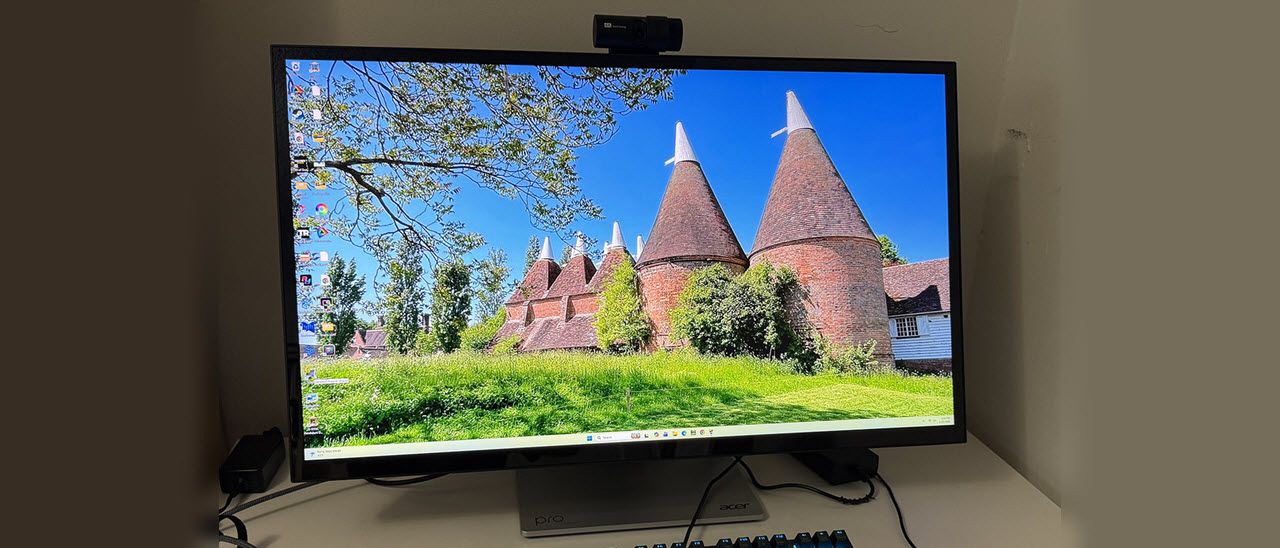
The PE320QXT is a different kind of professional display. It maintains color reference but is squarely aimed at designers and collaborators. At $1,900, it’s a decent value when you consider its unique abilities, extreme pixel density, and included extras.
The PE320QXT ships in fully recyclable packaging with molded pulp protecting the contents. The panel, upright, and base assemble without tools into a solid package. More on that unique stand in a moment. The webcam is permanently attached to the top of the panel. The pen comes in its own box with a USB charging cable for its Type-C port. Bundled cables include HDMI and USB, plus an external power supply brick.
(Image credit: Acer) (Image credit: Acer) (Image credit: Acer) (Image credit: Tom's Hardware) (Image credit: Tom's Hardware) Image 1 of 5 View Original
From the front, the PE320QXT looks like any other monitor, though it sits lower than most. That’s due to the oleo stand, which provides 60 degrees of tilt so you can angle the panel up like a tablet. The tilt extends five degrees forward as well. The height range is almost 10 inches, but if you want the panel to sit vertically in front of you, you’ll need a pedestal. You also get 360 degrees of swivel, with the base moving on a smooth bearing concealed within it. All movements are smooth and precise and befit a premium display.
The webcam sits atop the panel and is permanently attached. It has a little lens cover for security that slides left and right. You can roll a dial to angle the lens and tilt it completely backwards. The pen I received stows on the bottom of the screen magnetically and is compatible with Windows’ touchscreen protocols.
The screen’s front layer is very slick and shiny, perfect for drawing but not as good at preventing light reflection. You’ll need to be conscious of ambient light sources, especially when tilting the PE320QXT upwards. The image is very sharp and clear when no light hits it.
The ports are around the back and face rearwards. You get three USB ports, one upstream and two downstream. Video includes two HDMI 2.1 and a DisplayPort 1.4 plus a USB-C (DP Alt) port that supports 90 watts of power. There’s a 3.5mm headphone jack, and there are a decent pair of internal speakers, five watts each.
(Image credit: Tom's hardware) (Image credit: Tom's hardware) (Image credit: Tom's hardware) (Image credit: Tom's hardware) (Image credit: Tom's hardware) (Image credit: Tom's hardware) (Image credit: Tom's hardware) (Image credit: Tom's hardware) Image 1 of 8 View Original
The OSD is Acer ProDesigner standard and starts with basic image controls. The HDR option includes Off, Auto, and HDR600. I found that even on Auto, I had to manually select the HDR mode for HDR10 content. You’ll also want to turn on the Max Brightness option to get, you know…
Gaming’s single option is a two-level overdrive. It’s reasonably effective on its Normal setting, but there’s only so much it can do with a 60Hz refresh rate and no Adaptive-Sync.
In Save Settings to, four memory slots let the user assign configurations to four of the 10 picture modes.
For gaming and productivity, I stuck with the General color space and User mode with my calibration in place. I’ll deliver the spoiler first: the PE320QXT is not a monitor for fast-paced shooters. There is significant motion blur at 60 FPS to where aiming becomes difficult if you’re accustomed to faster screens. And there’s no Adaptive-Sync, though this wasn’t a significant issue since the frame rate never varied from 60. There is an overdrive option which reduces blur a little and works without ghosting on its Normal setting.
If your games are more like Myst, then you can have a spectacular time playing on the PE320QXT. The color is stunning with rich hues and bright primaries. The image is also razor sharp. 219ppi is a benefit you can plainly see when compared to the 140ppi of the same-sized Ultra HD monitor. You won’t be able to see the dot structure without a serious magnifying glass.
With a resolution like 6K, you must consider the original content. Nothing is mastered in 6K, so unless you’re playing a rendered game, there will be some upscaling. Watching 4K video was a good experience with clean rendering, but the frame rate is locked at 60Hz. There is no support for 24 or 50p cadences.
Rendered graphics are the PE320QXT’s strongest ability. I look forward to the day that 8K is a thing because 6K is so realistic already. Moving through a virtual environment suspends disbelief far more effectively than lower resolutions. Looking at CAD drawings and conceptual renderings is also much more useful with this much pixel density.
Color-critical work is also a good experience, but I wished for more flexibility in the PE320QXT’s OSD. You’ll see in the tests later that color and gamma are close to the mark, but grayscale tracking has errors that are just visible. This manifests more in neutral tones like clouds or snow. And black and white material has a slight color cast as well.
The touchscreen function is something I haven’t seen before in such a large monitor. To activate it, just make a USB connection between the PE320QXT and the PC. I could use my finger or the included stylus to act as a pointing and drawing device. It was handy to store the stylus on its magnetic strip across the bottom of the screen. The webcam was also very cool. It rotates enough that you can keep your face centered in the frame regardless of the panel’s position. With 60 degrees of tilt, it can almost lie flat, which is great for use while standing. The stand is super solid and flexible and lets you put the monitor in almost any position. 360 degrees of swivel means that you’re only limited by cables when swinging the monitor about.
Takeaway: The PE320QXT acquits itself well as a collaboration and design tool. It isn’t quite a reference display for video postproduction or photography, though it supports those color spaces correctly to the point where you could use it for presentation. Gaming isn’t its forte with a 60Hz limit, but the overdrive was effective at reducing motion blur. The tablet feature and flexible stand are its most usable assets since you can work in a group while standing or sitting. The webcam also makes collaboration easy.
Current page: Features and Specifications
Key considerations
- Investor positioning can change fast
- Volatility remains possible near catalysts
- Macro rates and liquidity can dominate flows
Reference reading
- https://www.tomshardware.com/monitors/gaming-monitors/SPONSORED_LINK_URL
- https://www.tomshardware.com/monitors/gaming-monitors/acer-prodesigner-pe320qxt-professional-monitor-review#main
- https://futureplc.com/privacy-policy/
- Minecraft system requirements raised for the first time in 17 years — Microsoft now recommends 16GB of RAM and a 2020s or newer CPU to run the Java Edition
- HP OmniBook X Flip 14 Review: Premium design, middling performance
- Nvidia weighs $250 billion guarantee so OpenAI can lease SoftBank's 10-gigawatt Ohio campus, report claims — Nvidia also said to be discussing $350 billion deal
- Built for Vera Rubin, NVIDIA Spectrum-6 Arrives in Gigascale AI Factories
- AI enthusiast adds Nvidia Tesla V100 as loud as a lawnmower to gaming PC for $266 — 32GB of VRAM rig can run 27 billion parameter model at 32 tokens per second
Informational only. No financial advice. Do your own research.