
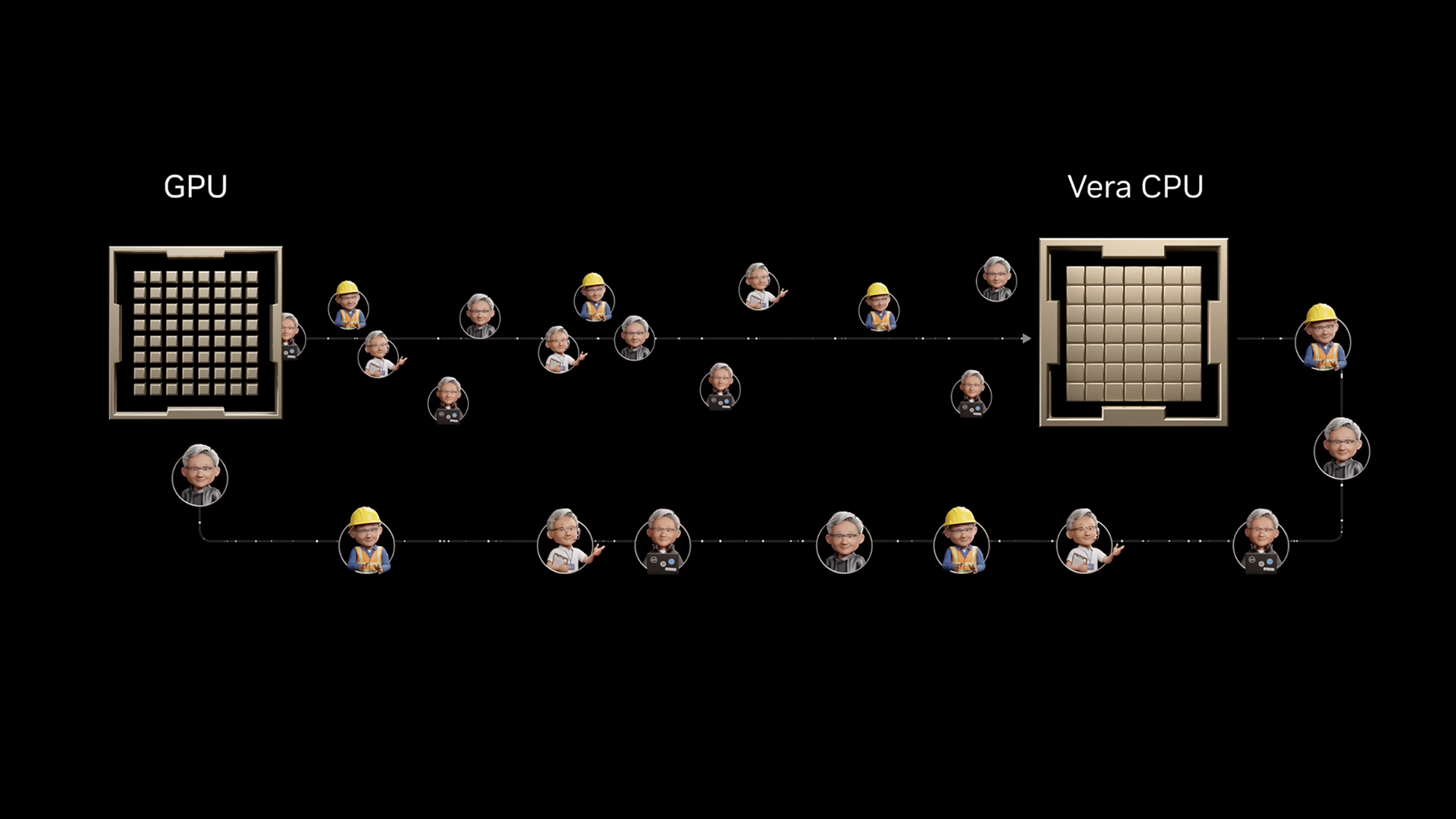
A n AI agent doesn’t stop running after a single request. It acts in a loop. The model reasons about the next step. The CPU executes the work around the model. The result comes back. The model decides what to do next. Then the loop runs again.
That pattern creates a demand profile for which conventional CPUs were not optimized. Traditional CPU work is intermittent and user-driven, made up of short interactions triggered by people. Agentic work is persistent and parallel: swarms of agents running continuously, each advancing through a chain of steps where each step depends on the result of the one before it.
More cores in a CPU means more agent tasks per CPU, and data center CPUs need lots of cores to maximize throughput of tasks.
However, adding more cores to a CPU cannot shorten the time for each step inside a single agent loop. More cores can’t make any one task run faster. In fact, CPUs designed to maximize core count can even slow down the performance of each core as they contend for resources.
Individual per-core performance matters to drive the speed of each step’s completion. The throughput of additional cores is useful but insufficient. And since each action is dependent on the previous result, per-core speed determines how fast the loop advances.
In the end, the best agentic CPU needs the best single-threaded performance per core, and every core needs to deliver that performance without compromise. The world counts in seconds. Agents count in nanoseconds. NVIDIA Vera is built for this new category — and speed — of work.
NVIDIA Vera is a max single-threaded CPU at scale, designed from the ground up for the agent loop: the work that happens between model calls as agents use tools, process data, run code and check results.
At the core of Vera is Olympus, NVIDIA’s custom CPU core, which delivers 50% higher instructions per cycle than NVIDIA Grace. That matters because many agent steps are sequential. A tool call, code execution, test run or data-processing step must finish before the next model call can use the result. Faster cores move each loop forward faster.
Vera pairs those faster cores with up to 1.2TB/s of LPDDR5X memory bandwidth at less than 40 watts of memory power, plus a monolithic compute die that helps active cores stay fed and keeps data movement predictable with 3.4TB/s of core-to-core bandwidth, 3x greater than any other data center CPU. This enables all 88 cores with the full memory performance of the CPU without creating bottlenecks that slows down every core.
The result is faster agent loops. In loaded CPU workloads that represent agentic execution, Vera delivers 1.8x the sustained per-core performance of x86.
Those gains compound across tool calls, code executions, data-processing steps and verification passes, helping AI factories complete more agent work with the GPUs they already operate.
Perplexity tested Vera on the agentic work it runs every day. Running a real coding workflow — cloning a repository and running its test suite in sandboxes — Vera completed the job about 1.5x faster than x86, and started concurrent sandboxes up to 1.9x faster. Perplexity is now looking to deploy Vera in its upcoming production system.
Agents also depend on data. They query, retrieve, filter and move information constantly, and Vera runs those CPU-side data workloads faster. Partners have measured 3x faster large-scale SQL analytics with Starburst and up to 6x lower latency on real-time streaming with Redpanda, both against leading x86 server CPUs.
Agent work isn’t one workload. An agent runs tools and sandboxes, processes data, serves requests and trains the next model with reinforcement learning — and all of it leans on the same strengths.
One Vera handles the whole range, rather than requiring a different CPU for each kind of work. And because Vera is the same CPU that hosts the GPUs in NVIDIA Vera Rubin and powers the NVIDIA BlueField-4 STX storage processor, the whole AI factory runs on one architecture and one toolchain.
And NVIDIA’s not done. NVIDIA’s next-generation Rosa CPU with the Rigel core will continue the company’s CPU roadmap for the agentic AI era. Rigel is NVIDIA’s next-generation Arm v9.2 CPU core, delivering higher per-core performance than Olympus while keeping the same silicon footprint. Key improvements include better instruction delivery, a larger L2 cache and more efficient memory handling.
In the agentic AI era, there will be billions of agents, and every one of them will turn to a CPU to act, check, retrieve, execute and verify. In this new market, completed agent work is the product. Faster agent loops help every GPU spend more time generating revenue producing work and less time waiting.
NVIDIA Vera is the CPU built for that future.
Key considerations
- Investor positioning can change fast
- Volatility remains possible near catalysts
- Macro rates and liquidity can dominate flows
Reference reading
- https://blogs.nvidia.com/blog/nvidia-vera-max-single-threaded-cpu-at-scale/#primary
- https://blogs.nvidia.com/blog/author/ian-buck/
- https://blogs.nvidia.com/blog/nvidia-vera-max-single-threaded-cpu-at-scale/#disqus_thread
- China’s Huawei to enter South Korean AI chip market with new Atlas SuperPods, clusters pack 8,192 Ascend 950 accelerators per deployment — reportedly challenges
- Hands-on with Corsair's 2800X RS-R ARGB Micro-ATX PC Case – smaller footprint, roomy internals, includes three fans
- Nvidia and Intel tout homegrown American chip supply chain prowess as country bolsters local production, but gaps remain — crucial Blackwell packaging steps rem
- Reviewer tests 'RTX 4080M' desktop graphics card powered by salvaged laptop silicon — performs worse than slightly more expensive RX 9070 GRE but draws only 100
- NVIDIA and AWS Collaborate to Bring AI to Production at Scale
Informational only. No financial advice. Do your own research.