
When you purchase through links on our site, we may earn an affiliate commission. Here’s how it works .
Alibaba describes the Zhenwu V900 as an AI training and inference processor with 216 GB of GPU memory and 1,200 GB/s of inter-chip bandwidth. Aside from performance being multiples of the last generation, the chip can scale out to a supernode cluster “comprising up to 500,000 cards.” The AI accelerator is due for mass production and commercial release in the first quarter of 2027, Alibaba says.
The company’s May roadmap placed the V900 in the third quarter of 2027, so the timeline has moved up. As of May, Alibaba chip arm T-Head had shipped more than 560,000 Zhenwu chips to over 400 external customers, a count Alibaba now puts above 650, with a Zhenwu refresh expected annually.
The technical specifications do not include FLOPS, a process node, foundry, power figures, or memory bandwidth claims. The prior M890 had 144GB of memory with 800GB/s of inter-chip bandwidth. The M890 could work in a supernode of 128 chips, while T-Head says more than 1,000 V900 chips can work as a single system.
For comparison, Huawei’s Ascend 960PR , due in the third quarter of 2027, is slated for 192GB of memory capacity, 2.4TB/s of memory bandwidth, and a 2.2TB/s scale-up interconnect. Alibaba’s most-powerful and three-times claims currently rest on no absolute figure for compute, but maximum achievable FLOPS are often far below calculated figures to begin with, so delivered performance will be the ultimate judge.
Z.ai powers up a 1-gigawatt AI data center built entirely on Chinese chips, report claims
Huawei details AI accelerator roadmap, pulls in next-generation Ascend NPUs by several quarters
China's 2.8 trillion-parameter Kimi K3 beats Claude Fable 5 in Frontend Code Arena
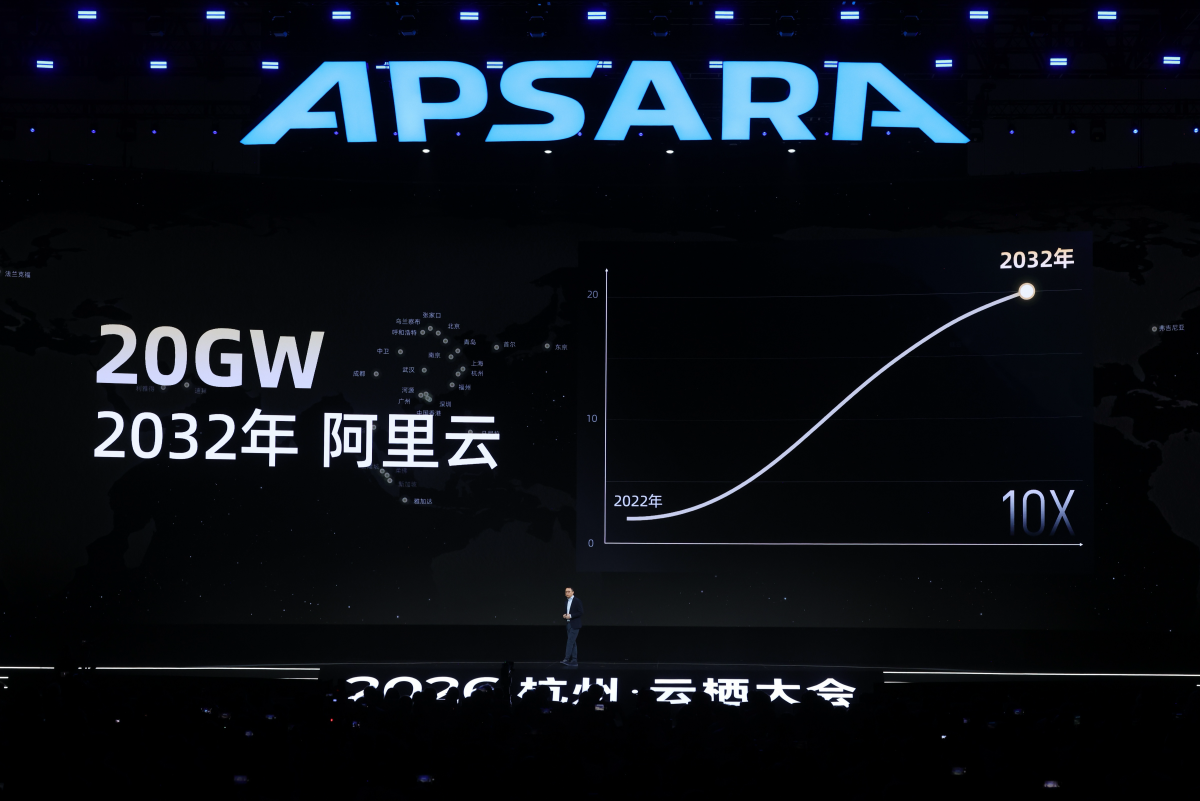
Alibaba Cloud’s greater goal is to reach a data center capacity of “more than 20 gigawatts” by 2032, the company said. However, global shortages in the AI supply chain “are currently limiting the speed at which we can scale our compute infrastructure,” Wu said. Alibaba also anticipates significant growth in its own annual AI chip shipments. Domestic demand remains high as Huawei had to shelve its global Ascend rollout . The report compared these goals to SpaceX, which has around 1.4GW of AI compute with a target of more than 10GW in 2027.
On the model side, Qwen 4 is “currently in training,” Alibaba said, and the Qwen 4.5 and 5 families will scale up further on the roadmap. As far as the achievements of its current models go, the company claims that Qwen3.8-Max ran “33 iterative cycles” over a month of automated runs to produce an Artificial Analysis score gain from 40 to 45. Meanwhile, a separate chip-design experiment with more than 10,000 EDA tool calls over more than 60 hours of test time showed an area cut of 42% without performance loss.
Get Tom's Hardware's best news and in-depth reviews, straight to your inbox.
Key considerations
- Investor positioning can change fast
- Volatility remains possible near catalysts
- Macro rates and liquidity can dominate flows
Reference reading
- https://www.tomshardware.com/tech-industry/artificial-intelligence/SPONSORED_LINK_URL
- https://www.tomshardware.com/tech-industry/artificial-intelligence/alibaba-unveils-zhenwu-v900-ai-accelerator-claims-its-the-most-powerful-ai-chip-in-china-accelerator-supports-500-000-chip-supercluster-with-a-10t-parameter-qwen-model-on-the-roadmap#main
- https://www.tomshardware.com/membership
- $14,000 gaming PC features 70 handcrafted titanium cherry blossoms which unfurl as temperatures rise
- ‘We’ll be the first to mine Bitcoin in space’ says Nvidia-backed startup
- iPhone 18 Pro Max storage can drop lower than a hard drive at 1.1 MB/s during heavy writes
- Meta's new transoceanic undersea cable boasts a whopping petabit of bandwidth
- Raspberry Pi locks boards to factory RAM capacities in firmware
Informational only. No financial advice. Do your own research.