
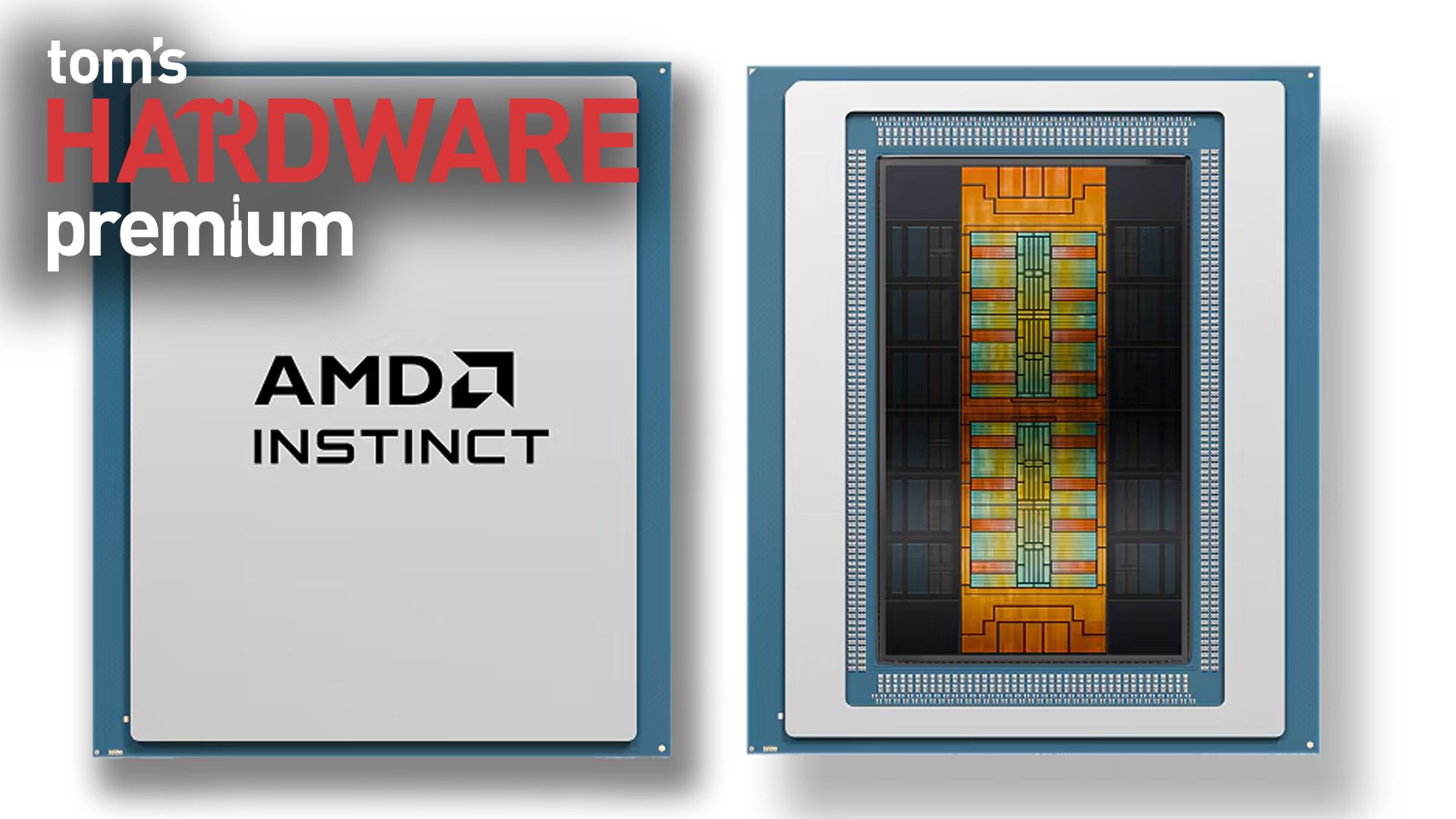
AMD says Ozaki FP64 emulation is no replacement for the real thing when it's needed.
a]:text-inherit [&>a]:underline">
When you purchase through links on our site, we may earn an affiliate commission. Here’s how it works .
Over the past few years, Nvidia has reallocated die area on its data center GPUs to favor the lower-precision matrix math that boosts the operations needed for much of modern AI inference. That reallocation only makes business sense, as the total addressable market for AI compute has exploded while the demand for double-precision math in large supercomputing installations has remained flat by comparison.
To make up for the lack of native FP64 support, Nvidia has turned to techniques that allow it to emulate FP64 operations using methods like the Ozaki schemes. But AMD claims this kind of emulation is nowhere close to a replacement for native double-precision processing for a few reasons—hence continued development of specialized products like the MI430X.
For one, AMD notes that Ozaki emulation assumes that the workload in question resembles a dense general matrix multiply (GEMM). In its own application profiling, the company says "less than 10%" of HPC workloads perform dense GEMM operations, so this emulation is a good replacement for native compute. Dense linear algebra is the one common workload for which AMD says Ozaki emulation is a natural fit.
For workloads like sparse iterative linear algebra, stencils and hydrodynamics, high-order finite element analysis, Monte Carlo and particle transport, and classical molecular dynamics, AMD says developers still need strong FP64 vector performance for the best results.
Researchers ‘recognize that AI will never replace HPC,’ says AMD executive — high-precision workloads will ‘exist for a very long time’ even as AI usage expands
AMD grabs over 40% of new TOP500 list for supercomputers, up 14% since last year
Nvidia announces Rubin HPC GPU with 'record number of CUDA cores' at Supercomputing 2026
Furthermore, even for workloads that map well onto GEMM operations, AMD says matrix sizes must be large in order to achieve the best performance, and that might also not be a given for every operation. The operands of those matrices also have to be sized well to the hardware, as incorrectly scaled operands can reduce performance. The FP64 vector math capabilities of the MI430X are insensitive to those operand sizing issues.
Beyond those stumbling blocks, AMD also notes that using Ozaki emulation methods can cause the memory footprint of an application to balloon, requiring up to three times more capacity than native FP64 would.
Since HBM capacity is directly tied to GPUs in modern supercomputing installations, fitting a workload to a machine that can only emulate FP64 operations could have cascading effects on the number of GPUs and compute nodes required, causing knock-on challenges for the floor area, power, and cooling required to support the system.
AMD says the high 432GB of HBM4 memory capacity per MI430X node allows its customers to provision fewer GPUs and compute nodes in a system, saving on networking, power, and floor space.
In addition to its FP64 HPC performance, AMD positions an MI430X-powered supercomputer as an AI inference platform for developing workloads that utilize those models as part of the research process. But there are some key differences between those systems and the Helios rack-scale accelerator powered by MI455X GPUs from the same CDNA 5 architectural family.
AMD targets Nvidia with first official benchmarks for EPYC 'Venice' CPUs
Key considerations
- Investor positioning can change fast
- Volatility remains possible near catalysts
- Macro rates and liquidity can dominate flows
Reference reading
- https://www.tomshardware.com/pc-components/gpus/SPONSORED_LINK_URL
- https://www.tomshardware.com/pc-components/gpus/amd-attacks-nvidias-fp64-emulation-at-sc26-touts-native-double-precision-on-instinct-mi430x-says-ozaki-schemes-fit-less-than-10-percent-of-hpc-workloads-and-triple-memory-use-and-emulated-fp64-is-a-poor-fit-for-many-hpc-workloads#main
- https://www.tomshardware.com/my-account
- NVIDIA Announces Rubin HPC — A New GPU to Accelerate Agents for Science, Engineering and Analytics
- Razer's lightweight DeathAdder V3 Pro price is slashed 57% at Amazon
- NVIDIA Announces Rubin HPC — A New GPU to Accelerate Agents for Science, Engineering and Analytics
- NVIDIA DGX Spark Developer Kit Turns a Desk Into a Supercomputing Lab
- NVIDIA Announces New Planned Investments in Korean Startups at the MSIT-NVIDIA AI Startup Partnership Forum
Informational only. No financial advice. Do your own research.