
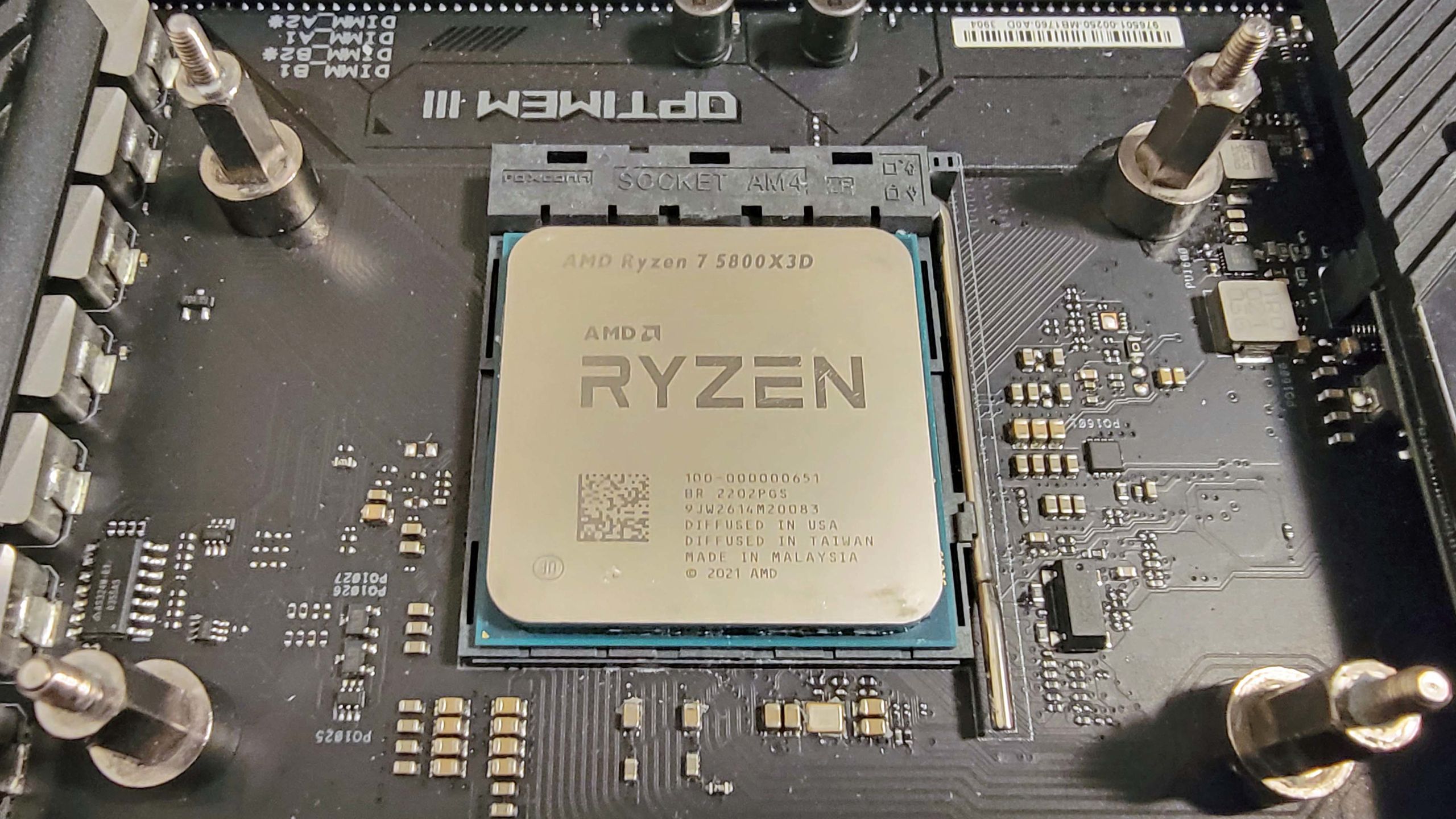
You can read more about second-gen SoIC in our SoIC roadmap on Tom’s Hardware Premium , though it has far more implications for the data center (at least currently) than for consumer chips. Regardless, AMD couldn’t simply reintroduce the Ryzen 7 5800X3D; instead reworking the chip to work with TSMC’s second-generation stacking process. McAfee says it ended up being “a labor of love” for the engineers to work on this part again, as the company went through testing and validation for a re-release.
Follow Tom's Hardware on Google News , or add us as a preferred source , to get our latest news, analysis, & reviews in your feeds.
Jake Roach is the Senior CPU Analyst at Tom\u2019s Hardware, writing reviews, news, and features about the latest consumer and workstation processors. ","collapsible":{"enabled":true,"maxHeight":250,"readMoreText":"Read more","readLessText":"Read less"}}), "https://slice.vanilla.futurecdn.net/13-4-24/js/authorBio.js"); } else { console.error('%c FTE ','background: #9306F9; color: #ffffff','no lazy slice hydration function available'); } Jake Roach Social Links Navigation Senior Analyst, CPUs Jake Roach is the Senior CPU Analyst at Tom’s Hardware, writing reviews, news, and features about the latest consumer and workstation processors.
MG1103 I'd be interested to see a few benchmarks between the original 5800X3D and the re-engineered one to see if there's any performance differences. (including thermals) Reply
usertests MG1103 said: I'd be interested to see a few benchmarks between the original 5800X3D and the re-engineered one to see if there's any performance differences. (including thermals) https://www.tomshardware.com/news/amd-shares-new-second-gen-3d-v-cache-chiplet-details-up-to-25-tbs AMD has finally answered a few of our follow-up questions and shared important new details, including that the chiplet remains on the 7nm process and now has a peak bandwidth of up to 2.5 TB/s, whereas the first-gen 3D V-Cache peaked at 2 TB/s (among lots of other new info). Second-gen 3D V-Cache in 7800X3D and friends has 25% higher peak bandwidth than first-gen. So if that has carried over to the 5800X3D Anniversary Edition, it may improve performance slightly on its own, independently of thermals. Reply
umeng2002_2 I think it would only change the thermal or voltage characteristics, which should really only affect the boosting behavior. Will be interested in the reviews. Reply
Pegaroo usertests said: https://www.tomshardware.com/news/amd-shares-new-second-gen-3d-v-cache-chiplet-details-up-to-25-tbs Second-gen 3D V-Cache in 7800X3D and friends has 25% higher peak bandwidth than first-gen. So if that has carried over to the 5800X3D Anniversary Edition, it may improve performance slightly on its own, independently of thermals. I think you are getting mixed up between gen 2 3d v cache and TSMCs 2nd gen stacking process. I could be wrong but I don't think the 2 are necessarily the same thing Reply
abufrejoval From what I understand, they had to build some new machinery to obtain the same product: they built new facilities to do the V-cache+CCD bonding part of the production process, they didn't change the specification of the product itself, nor the three major components: IOD, CCD and V-cache chiplets. With that in mind, the resulting product should be near indistinguishable, in fact that's what their aim would be. Now they might be cheaper to produce, they might produce a larger percentage of perfect bins, resulting in a statistical bias towards better chips, but eggregious success beyond that would be failing the mission. And from personal and thus only anectdotal experience, bin spread in 5800 CCDs was significant. I counted myself lucky to get an 8-core 5800X on launch night and was quite happy with it most of the time, but I couldn't help noticing that it was running so hot (and maxing out those 110 Watts of energy budget), that I couldn't quite imagine how they'd be able to run the 16-core variant with two such CCDs and only 30 extra Watts of power (140). Especially since I didn't overclock it, just ran PBO and a hefty Noctua air cooler. A few years later those 16-core variants became cheap enough and I got both a few 5800X3D chips and a single 5950X. Both of those were very different beasts in terms of power consumption from the first 5800X. The 5800X3D were obviously heat and clock constrained, but clock-for-clock they seemed to make do with much less power than the original 5800X: they certainly never felt slower, even if some synthetic load results were a tad lower. Essentially the 5800X3D felt like a true 5800X replacement with V-cache benefits where those applied and generally much lower power consumption. Even more extreme was the 5950X, which not only clocked higher, but seemed to use half as much power per CCD than the 5800X did: it's quite a beast yet stays relatively cool with that same cooler. It outperformed the 5800X on any task using 1-8 cores, being able to use higher clocks, and then it still had 1-8 cores to go and power budget to make them useful. I guess it had to, so the 2nd CCD had any chance to let its cores run: a dual CCD chip using bins like the original 5800X would have wound up close to 200 Watts, just adding up those HWinfo number, which of course aren't exactly precise. My take from that was that dual CCD cpus (like the better EPYCs) got much better quality bins and most likely the 5800X3D did as well, but that 6-core or even 4-core CCD were an unfortunate and hard to avoid side effect more of voltage bins than outright defects. How wide those bins spread in those early days and if TSMC manages to hit the top notches much better today, nobody will tell you. But it's the only area where I can imagine significant progress and a bit of motivation on AMD's side: their ability to sell lesser bins or even 5xxx CPUs without the V-cache, may have dropped off a cliff ten years in: way too much competition there and no money to be made. Reply
Smb2886 It sounds like a justification for the high price of a CPU released in 2022. They claim they had to rebuild from scratch and pass the cost on to consumers. However, in all honesty, it still doesn’t justify the high cost of an outdated CPU unless you’re taking advantage of people who can’t upgrade to AM5 right now due to the AI boom driving up prices. Instead of exploiting your consumers, you could have still made a profit. Now, you have to look like the bad guy and lower the price in a few months. Why do you always have to be greedy? Reply
usertests Pegaroo said: I think you are getting mixed up between gen 2 3d v cache and TSMCs 2nd gen stacking process. I could be wrong but I don't think the 2 are necessarily the same thing It's made on the same node so I'm not sure why it wouldn't all happen together. Guess we'll find out. Smb2886 said: Now, you have to look like the bad guy and lower the price in a few months. Why do you always have to be greedy? Supply and demand. I'm not convinced that they will make enough of these to avoid selling out at full price. What are they going to do, make 1 million "Anniversary Editions"? Reply
Key considerations
- Investor positioning can change fast
- Volatility remains possible near catalysts
- Macro rates and liquidity can dominate flows
Reference reading
- https://www.tomshardware.com/pc-components/cpus/SPONSORED_LINK_URL
- https://www.tomshardware.com/pc-components/cpus/amd-had-to-re-engineer-the-ryzen-7-5800x3d-for-a-re-release-10th-anniversary-edition-chip-had-a-whole-body-of-engineering-work-put-into-it#main
- https://www.tomshardware.com/subscription
- Microsoft announces Majorana 2 quantum computing chip — claims a practical machine will come in 2029
- AMD is considering a potential Ryzen 5 9600X3D — company says six-core Zen 5 X3D chip 'maybe something we look at doing… later this year'
- Tom's Hardware Unfiltered: Computex 2026, Day 2 — Interviews, roundtables, and the first day at the Nanggang Exhibition Center
- Corsair shows off gaming mouse with dedicated Stream Deck launch button — wireless mouse also gets almost 50 hours of 8K battery life
- NVIDIA AI Cloud Ecosystem Expands Worldwide to Meet Global AI Compute Demand
Informational only. No financial advice. Do your own research.