
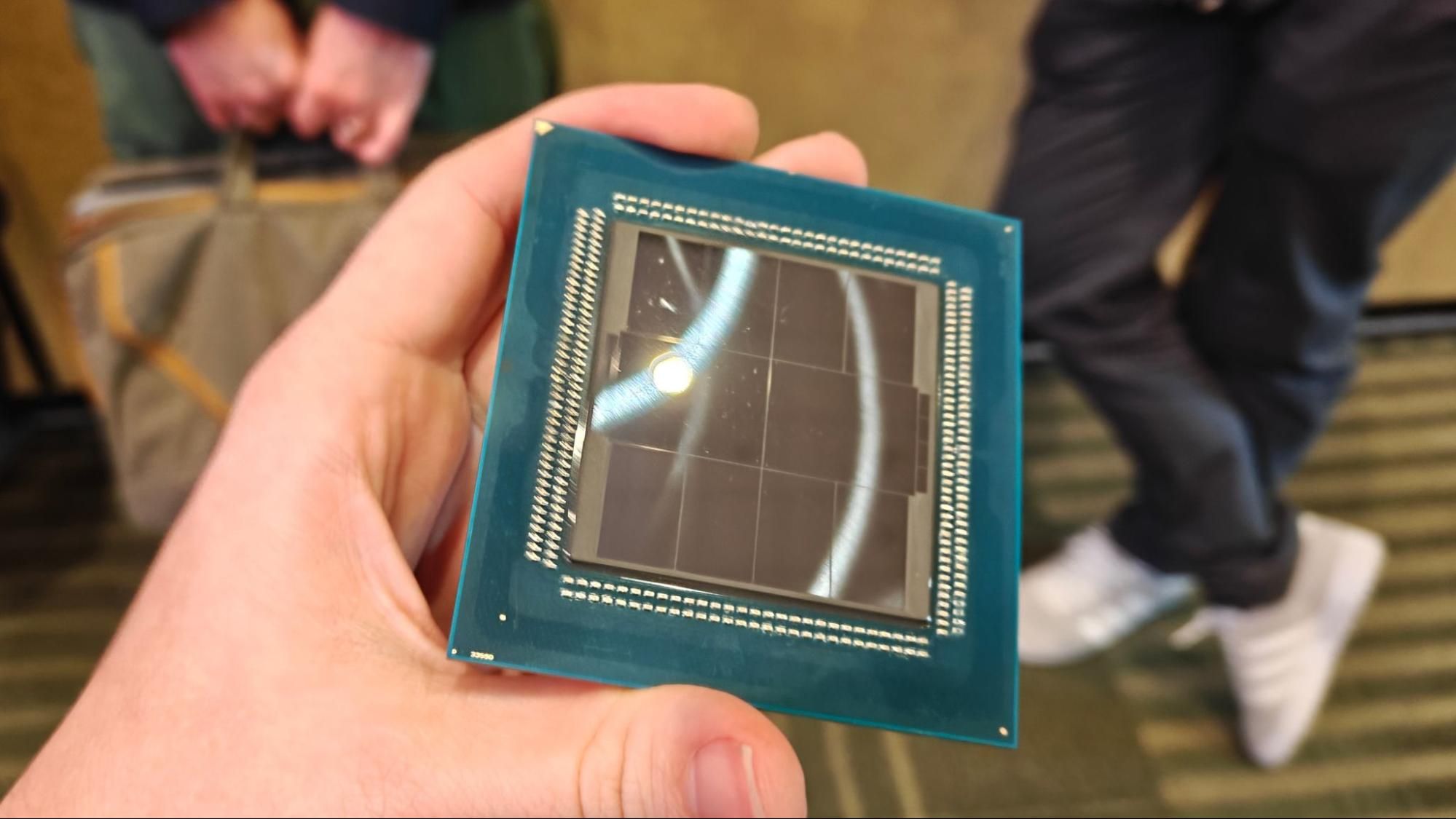
Although AMD has focused a lot of its teases on the 256-core Venice, the initial SP7 offerings will also hold a 96-core, high-frequency model that can clock up to 5 GHz.
(Image credit: AMD) (Image credit: AMD) (Image credit: AMD) (Image credit: AMD) (Image credit: AMD) (Image credit: AMD) Image 1 of 6 View Original
Unlike the extrapolated performance AMD shared a few weeks back, we have some concrete benchmarks for the Epyc 9996 now. AMD has, unsurprisingly, focused the workloads around agentic AI. However, many of the workloads applicable for agentic AI are applicable elsewhere, as well, including high-concurrency networking tasks, code compilation, and media processing.
Note that AMD includes just the Epyc 9965 as a gen-on-gen comparison point in the charts above. This is a “dense” Zen 5 design with 192 cores. Results for the 128-core 9755 are included in the tables below.
Starting with front-end operations, AMD claims a 1.2x gen-on-gen improvement and a 2.8x improvement compared to Intel Xeon 6980P, with an NGINX web server using the WRK load generator. Unlike most of these competitive performance figures, AMD included the actual numbers for the benchmarks it ran in the footnotes, which you can see in the table below.
In data-heavy workloads that are common among AI agents, AMD claims a 1.7x improvement over Turn, and a massive 3.4x over the Xeon 6980P. AMD used the TPCx-AI benchmark to gather these results. The primary metric for this test is AI use cases per minute (AIUCpm), for which AMD shared the median result2. If you’re interested in more about the reporting of this benchmark, Dell has published an extensive breakdown .
For its “enterprise tools” benchmarks, AMD ran several tests, including TPC-H, TPC-C, and Redis, and it reports the results as “geomean throughput.” We have actual numbers here, but they’re a geomean representing several different tests rather than a single benchmark. Broadly, however, AMD claims a 1.6x gen-on-gen improvement in these workloads, and a 2.6x improvement compared to Intel.
A lot of agentic workloads are applicable outside of agents, but AMD also tested a few agents directly. It replayed five different agent personas across the chips and, once again, gathered a throughput geomean. We don’t have the metrics here, nor for the previous benchmark, so it’s possible there’s an angle of performance that we’re not seeing with the data provided by AMD.
Regardless, the company claims a 1.5x gen-on-gen improvement in this test, and a 2.5x improvement compared to the 6980P.
AMD ran these tests earlier in the month. But just a few days ago, Nvidia published its first SPEC CPU 2026 results for Vera . AMD ran some tests of its own using the same compiler for a comparison between Vera and Venice. AMD’s Kuppuswamy says, “everything is apples-to-apples comparison, same compiler.” That’s GNU 15.2, if you’re curious.
In throughput, AMD claims a 2.2x improvement in the SPECrate integer suite, compared to Vera using the dense Venice design with 256 Zen 6c cores. More importantly, AMD claims a 1.2x improvement in per-core performance when comparing Vera to a 96-core “High Frequency” Venice chip. AMD says it used Nvidia’s results as the basis for comparison. With both Venice designs, AMD used a 600W TDP.
In SPEC CPU 2017 (again using SPECrate with integer workloads), AMD has data comparing Venice to Intel’s 6980P and Arm’s new AGI , showing 2x throughput compared to Intel, and 1.3x per-core performance. Note the core counts here for AMD. SPECrate is a throughput test, and AMD stepping down to a 128-core model suggests that performance will likely drop off as the core count increases.
(Image credit: AMD) (Image credit: AMD) Image 1 of 2 View Original
Key considerations
- Investor positioning can change fast
- Volatility remains possible near catalysts
- Macro rates and liquidity can dominate flows
Reference reading
- https://www.tomshardware.com/pc-components/cpus/SPONSORED_LINK_URL
- https://www.tomshardware.com/pc-components/cpus/amds-256-core-epyc-9996-venice-claims-up-to-a-3-4x-jump-over-intel-xeon-competition-20-percent-over-nvidia-vera-zen-6-comes-with-up-to-1024mb-of-l3-16-channel-memory-and-5ghz-clock-speeds#main
- https://www.tomshardware.com/subscription
- Nvidia and SK Group enter $500 billion AI partnership — plan to supercharge AI infrastructure with next-gen memory and massive AI factories
- 45% off: Slashed to just $1,099, this bargain RTX 5060-powered gaming laptop is discounted by $900 at HP — near half-price HyperX Omen 16 is the perfect gaming
- Save 10% on the brand-new Creality Pika 3D scanner — easily scan models and textures for $629
- 'When will the EA greed end': Fans vent their fury as company announces $150 version of FC 27 — annual game release comes in three editions, but top-tier option
- NVIDIA Vera Rubin Driving Performance Per Watt, Lowest Token Cost for Partners Worldwide
Informational only. No financial advice. Do your own research.