
Micron details ambitious DRAM and NAND roadmap — 3D NAND, High-NA EUV, new materials, and custom silicon makes a comeback
CXMT president says company’s first 4F² DRAM will be a server DDR5 RDIMM due by year-end
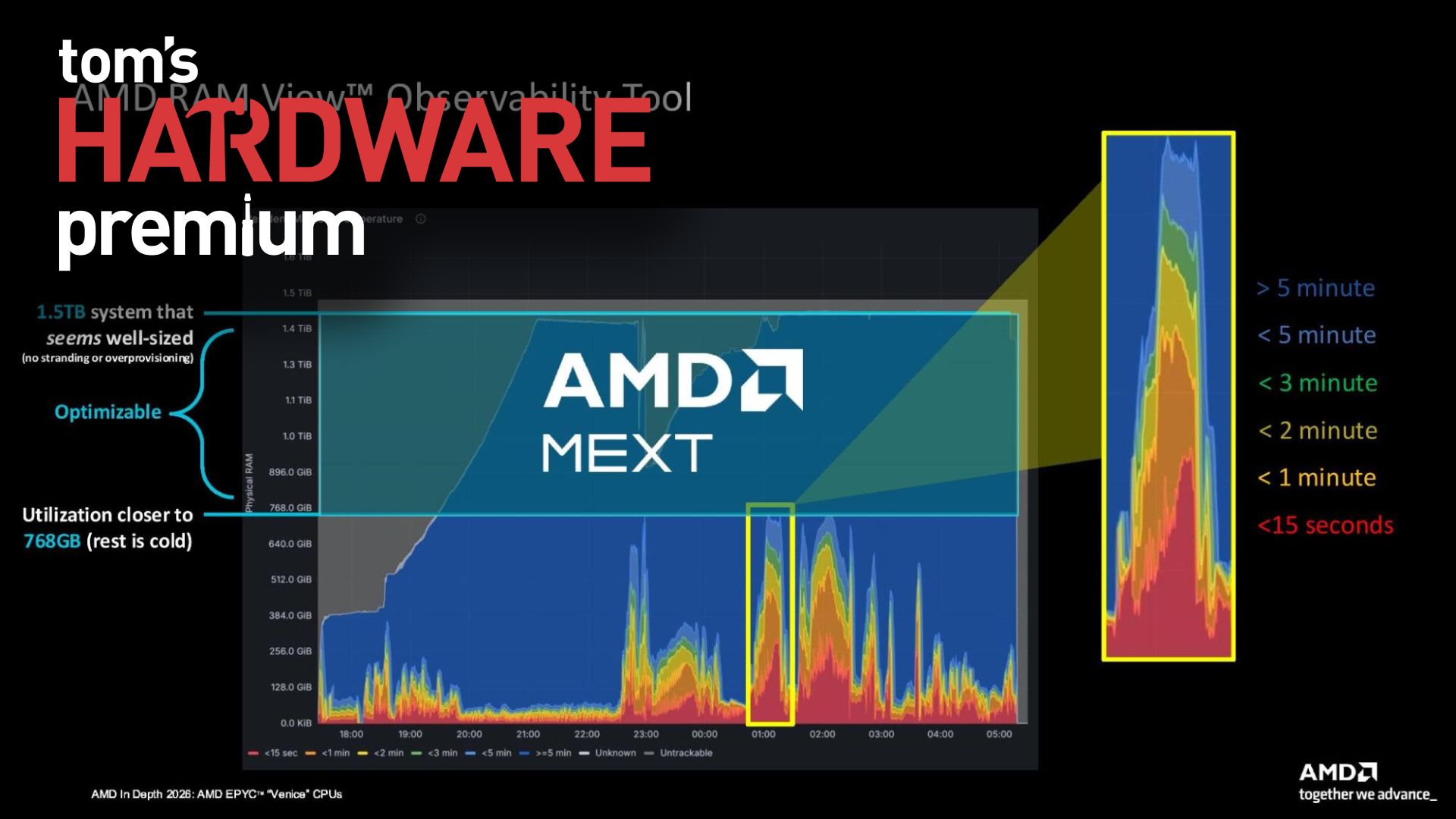
In order to understand the application of MEXT to different workloads, AMD has developed RAM View to go alongside the tech. It’s a memory utilization tool that shows which pages are hot and which have gone cold. As you can see from the example above, a system with 1.5 TB of memory shows near-full utilization across the full workload, but around half of the pages stored in memory haven’t been touched in five minutes or more at any given time.
AMD provided this generalized example and didn’t clarify what workload it was testing. That’s very important, as the utilization breakdown will look vastly different depending on the application(s) running on the server. Initially, AMD is applying MEXT to critical EDA applications it uses internally, such as Synopsys PrimeTime, but the company says it has focused on optimizing agentic AI, database, and media and entertainment workloads as well.
This is important not only because memory access patterns change between applications, but also because performance in those applications reacts differently when a system doesn’t have enough memory. The “memory wall,” as AMD calls it, should be a familiar concept regardless of whether you’ve ever touched a server. With MEXT, AMD says it’s trying to extend this memory wall, which may look different for different applications.
For instance, the company is confident that many workloads can reduce capacity by around 20% to 25%. As the reduction increases, however, the applications become more specialized, and the performance delta becomes greater.
AMD has shared some internal MEXT results, which look impressive, though as usual, it’s always smart to handle first-party benchmarks like this with skepticism. Starting with PrimeTime, where AMD has focused much of its attention on MEXT up to this point, it says servers running at 50% capacity retain 95% of the performance of a full server, and going down to as little as 25% capacity still maintains 80% of the application’s performance.
PrimeTime demands a lot of memory for large designs. There are some applications where performance is nearly identical, according to AMD. In a 3-node cluster running in Azure with 5th-gen EPYC CPUs, AMD says MEXT offers 99% of the performance of the full cluster while running at 50% DRAM capacity with the Spark SQL workload from the TPC-DS benchmark. SQL databases try to cache as much data as possible in memory to prevent I/O bottlenecks, creating a golden opportunity for tech like MEXT that wants to free cold pages.
Perhaps the most applicable workload at the current moment, however, is agentic AI, and AMD says MEXT has similar applications there. Across a five-agent concurrent geomean, AMD claims 99% of the performance of a full server with 50% memory capacity, and 85% of the performance with 25% capacity. With a “memory-hungry” agent, AMD claims 90% and 88% performance for 50% and 25% capacity, respectively.
The slide you can see above has footnote tags. However, AMD has not shared the footnotes with us yet, so we don’t have a view into how these tests were run. Naturally, we assume AMD has, at minimum, represented the performance of MEXT in the best light possible. We can’t do a full analysis without knowing how the tests were run, however.
What is interesting is AMD’s cautious approach to rolling out MEXT. It’s an EPYC-exclusive feature right now, though AMD left the door open for support on future products (consumer devices, such as Strix Halo ) far down the road. It will be sold as a license, bundled with the RAM View software, but we don’t have a timeline on when that will happen. And, despite a partnership with HPE to push out “MEXT Ready” servers, we still don’t know when MEXT itself will be ready for deployment beyond AMD’s walls.
Given that conservative approach, there are likely pitfalls to MEXT that we’re not seeing yet, and it’s hard to imagine it will be broadly applicable to every server, at least at the 50% and 25% DRAM capacity levels that AMD showed off with its benchmarks.
However, even being able to trim 25% of a server’s DRAM capacity represents a massive cost savings in the current supply-constrained environment. If some workloads can push that to 50% capacity, that’s even better. Of course, we’ll need to see how MEXT holds up once it’s available broadly, but if AMD’s claims hold water, it could become a defining technology in data centers that can’t seem to get enough memory.
Jake Roach Social Links Navigation Senior Analyst, CPUs Jake Roach is the Senior CPU Analyst at Tom’s Hardware, writing reviews, news, and features about the latest consumer and workstation processors.
Key considerations
- Investor positioning can change fast
- Volatility remains possible near catalysts
- Macro rates and liquidity can dominate flows
Reference reading
- https://www.tomshardware.com/pc-components/cpus/SPONSORED_LINK_URL
- https://www.tomshardware.com/pc-components/cpus/amd-shares-how-it-can-retain-95-percent-of-server-performance-with-just-half-the-dram-sidestepping-memory-shortages-with-mext-tech-powers-over-100-servers-already-running-with-plans-to-expand-to-2-000-servers-in-2027#main
- https://www.tomshardware.com/my-account
- Nintendo unleashes DMCA takedown wave against open-source Switch modchip firmware, 144 tools disabled
- Grab this GameSir Super Nova wireless controller at a record-low Amazon price, now under $40
- Bizarre AI chip demo uses butter to highlight how new chip runs 40 degrees cooler than the competition
- How NVIDIA Open Source Tools Are Helping Researchers Build Next-Generation 6G Networks
- Nvidia cracks down on overseas cloud AI GPU rentals for China
Informational only. No financial advice. Do your own research.