
3. Take the included mounting bars and place them on top of the standoffs, and then secrure them with a screwdriver and the included screws.
4. Apply the included Arctic MX-6 thermal paste to your CPU. If you aren’t sure how to do this properly, please refer to our handy guide on how to apply thermal paste .
5. Press the pump block on top of the CPU, and secure the built-in screws using a screwdriver.
6. Once complete, connect the cabling to the CPU block’s head. For the purposes of testing, I chose the option with individual PWM control for the fans, pump, and VRM fan. However, some may prefer the simplicity of the all-in-one cable. Connect the cables, place the VRM fan on top of the CPU block, and installation is complete.
The 9950X3D setup that we started testing coolers with last year has suffered an unfortunate death. As such, we’ve begun to test coolers on a system with AMD’s 9950X.
There are some differences in how the 9950X and 9950X3D CPUs are impacted by thermal events: while the heat output of the CCDs of AMD’s 9950X3D are relatively balanced, the 9950X I’m using has one CCD that runs much hotter than the other, with a difference of over 10 degrees C in some scenarios, shown below.
The benchmark results shared in these reviews may differ from others because I emphasize results that are comparable to real-world use.
This means that I generally test CPU coolers inside of a closed desktop case, which increases cooling difficulty compared to other testing methods. Open benches have lowered ambient temperatures, which in turn makes weak coolers appear stronger than they really are. Some have used generic thermal plates to test cooling solutions. I reject both of these methods, because they don’t accurately reflect the real-world conditions where a CPU cooler is used.
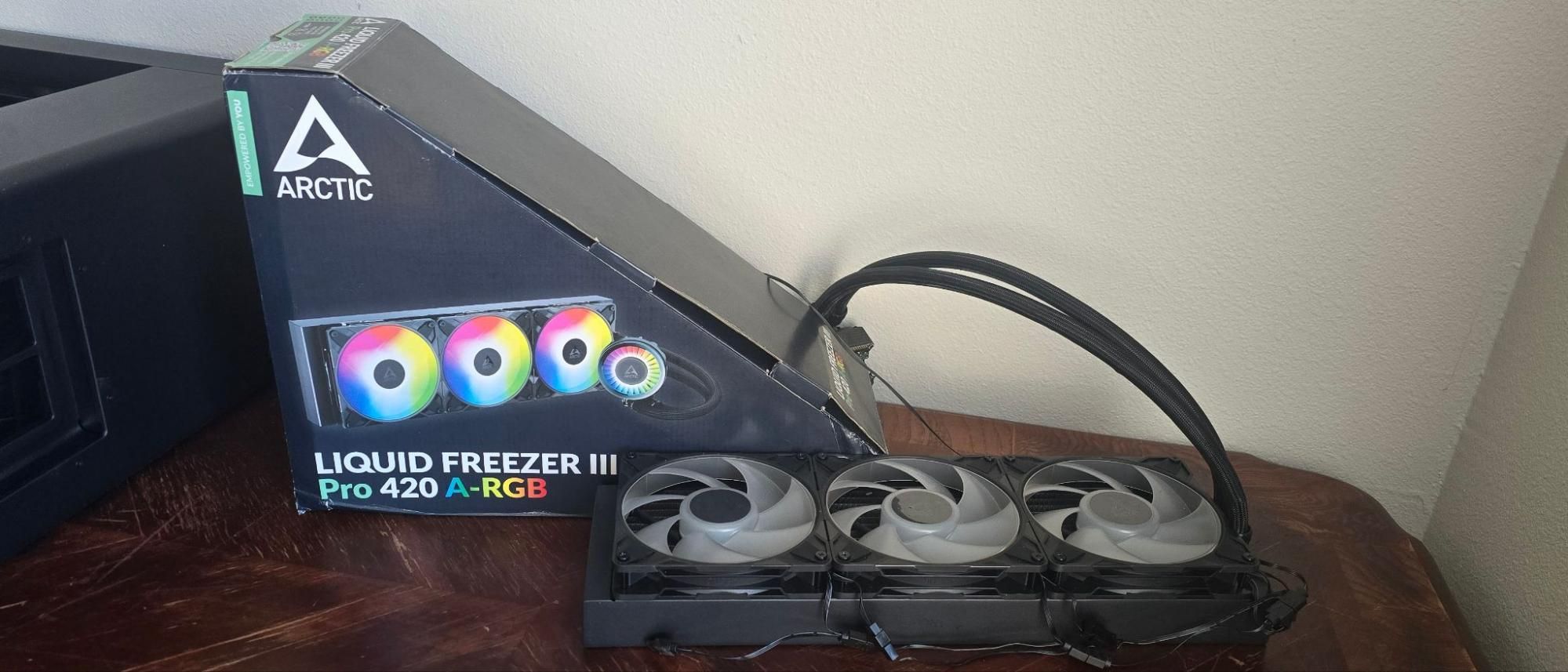
That said, this review bends this rule a little: The MSI Pano 100R PZ case that we use for cooler testing doesn’t technically support 420mm radiators. So I had to place it on top of the case to make it fit. This likely affects thermals and acoustics at least somewhat, but short of re-testing all our coolers in a different case, we didn’t have a better option. We tested Be Quiet’s competing Silent Loop 3 420 in this same way for comparison, while the smaller 360mm coolers were tested in a typical fashion, with the radiator and fans inside the case. If there is heavy interest in large 420mm cooler testing, we will revisit these results in a larger case later this year.
Current page: Features and Specifications
Key considerations
- Investor positioning can change fast
- Volatility remains possible near catalysts
- Macro rates and liquidity can dominate flows
Reference reading
- https://www.tomshardware.com/pc-components/liquid-cooling/SPONSORED_LINK_URL
- https://www.tomshardware.com/pc-components/liquid-cooling/arctic-liquid-freezer-iii-pro-420-review#main
- https://www.tomshardware.com
- NVIDIA Brings GeForce RTX Gaming to More Devices With New GeForce NOW Apps for Linux PC and Amazon Fire TV
- Acer Predator OLED 26.5-inch gaming monitor plummets to $429, hitting record-low price — $120 saving nets you 1440p QD-OLED panel, boasting a snappy 240Hz refre
- AMD FSR Redstone press roundtable CES 2026 transcript — company speaks out on why AI 400 lacks RDNA 4 GPU
- KTC H27E6 27-inch 320 Hz QHD gaming monitor review: Super quick and a great value
- Acer Predator OLED 26.5-inch gaming monitor plummets to $429, hitting record-low price — $120 saving nets you 1440p QD-OLED panel, boasting a snappy 240Hz refre
Informational only. No financial advice. Do your own research.