
Josh Hort (AMD): Now, [as for] when? I can't say when. Obviously, we try to be as open as we possibly can without giving away the farm. Because we want proliferation of the technology, right? There's partners who come out of the woodwork that could be competitors of ours, who also want to be partners on things like this because it's just good for the ecosystem. FSR was picked up by Microsoft for their AutoSR implementation, for instance, and the main reason why they picked it is because it was open. Open source is good for everybody. [Note: this is incorrect as far as we know; AutoSR is ML-based and uses a custom CNN.]
Journalist 8: You made a comment that we've made a lot of progress with ISVs […] if your team was in charge of this, was there like a change in strategy, or more of a focus? How did you get from point A to point B, where you got like 200 games in a couple months?
Josh Hort (AMD): I think I kind of hinted at it, right? I think putting it out on GPUOpen, we hit critical mass. I think it was a flywheel where the game publishers saw "OK, this tech actually works pretty well," and the Digital Foundry review came out, they did the pixel peeping and were like, "Wow! This is pretty fantastic." It was a glowing review, which was great for us, right? But it puts us on the map where like, OK, the technology's at a point where it's mature, it's ready to go, and my team put in a lot of effort in the ISV enabling portion, but also like I said, putting it on GPUOpen so that anybody can pick it up I think also really helped propel us way faster than we could do with just the people power that we have.
Journalist 8: Following up on the change in strategies, when you're approaching ISVs for integration, particularly in games, outside of budget and time constraints, do you hear anything else from developers concerning their hesitation for adding features, especially the latest and greatest features?
Josh Hort (AMD): It depends on what piece of technology is getting inserted into the pipeline and where. If you look at things like super resolution, and frame generation, those are both post-processing steps at the end of the pipeline, so it's very easy to integrate them. Now, denoising, the ray regeneration portion, that can be more tricky, because some game engines have a fused denoiser where they want the denoise and the super-res step to happen at the same time; others want them completely separated because they're at different parts of the pipeline.
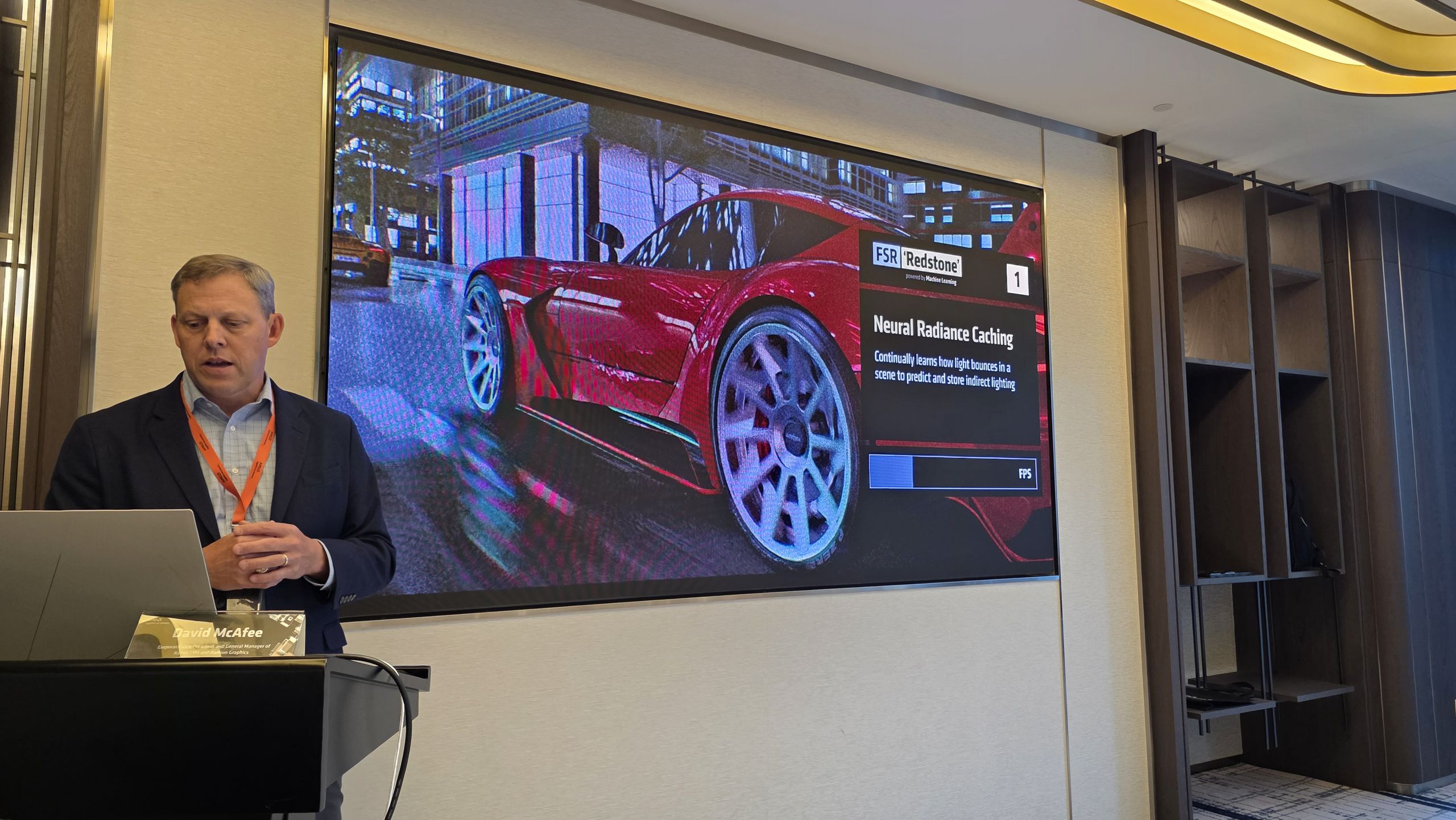
So when you have a fused denoiser, it provides performance, but it can't be used by all game engines, just because of the way they are written. On something like the neural radiance caching, that one is even more complex, because it needs a lot of different input information into the model to get the output, and the information might not be readily available in the format that's required by the model in order for it operate. It's also kind of intrusive into the pipeline. Long story short, it's harder to integrate.
Journalist 8: So, especially for those features, you're looking to engage developers before release as much as you can?
Josh Hort (AMD): Yeah, so like we did a lot of work with Fatshark, because they can move really fast, and they were embracing the technology; not necessarily "building the plane as we're flying it," but super cutting-edge, rapid iteration, super close, deep technical partnership. The amount of work we did in a small amount of time is phenomenal. But we have more work to do, and that's going to be a focus in 2026, is getting that Neural Radiance Caching feature — not only getting it into more titles, but also improving on the integration, the API and whatnot, so as we get more feedback from our ISV partners, we'll be improving it across the way in 2026 and beyond.
Journalist 1: How's Redstone been with VR? Any issues with ghosting, or?
Key considerations
- Investor positioning can change fast
- Volatility remains possible near catalysts
- Macro rates and liquidity can dominate flows
Reference reading
- https://www.tomshardware.com/pc-components/gpus/SPONSORED_LINK_URL
- https://www.tomshardware.com/pc-components/gpus/amd-fsr-redstone-press-roundtable-ces-2026#main
- https://www.tomshardware.com
- KTC H27E6 27-inch 320 Hz QHD gaming monitor review: Super quick and a great value
- Acer Predator OLED 26.5-inch gaming monitor plummets to $429, hitting record-low price — $120 saving nets you 1440p QD-OLED panel, boasting a snappy 240Hz refre
- Nvidia's Arm-based N1X-equipped gaming laptops are reportedly set to debut this quarter, with N2 series chips planned for 2027 — new roadmap leak finally hints
- Developer patches Wine to make Photoshop 2021 & 2025 run on Linux — Adobe Creative Cloud installers finally work thanks to HTML, JavaScript and XML fixes
- Developer patches Wine to make Photoshop 2021 & 2025 run on Linux — Adobe Creative Cloud installers finally work thanks to HTML, JavaScript and XML fixes
Informational only. No financial advice. Do your own research.