
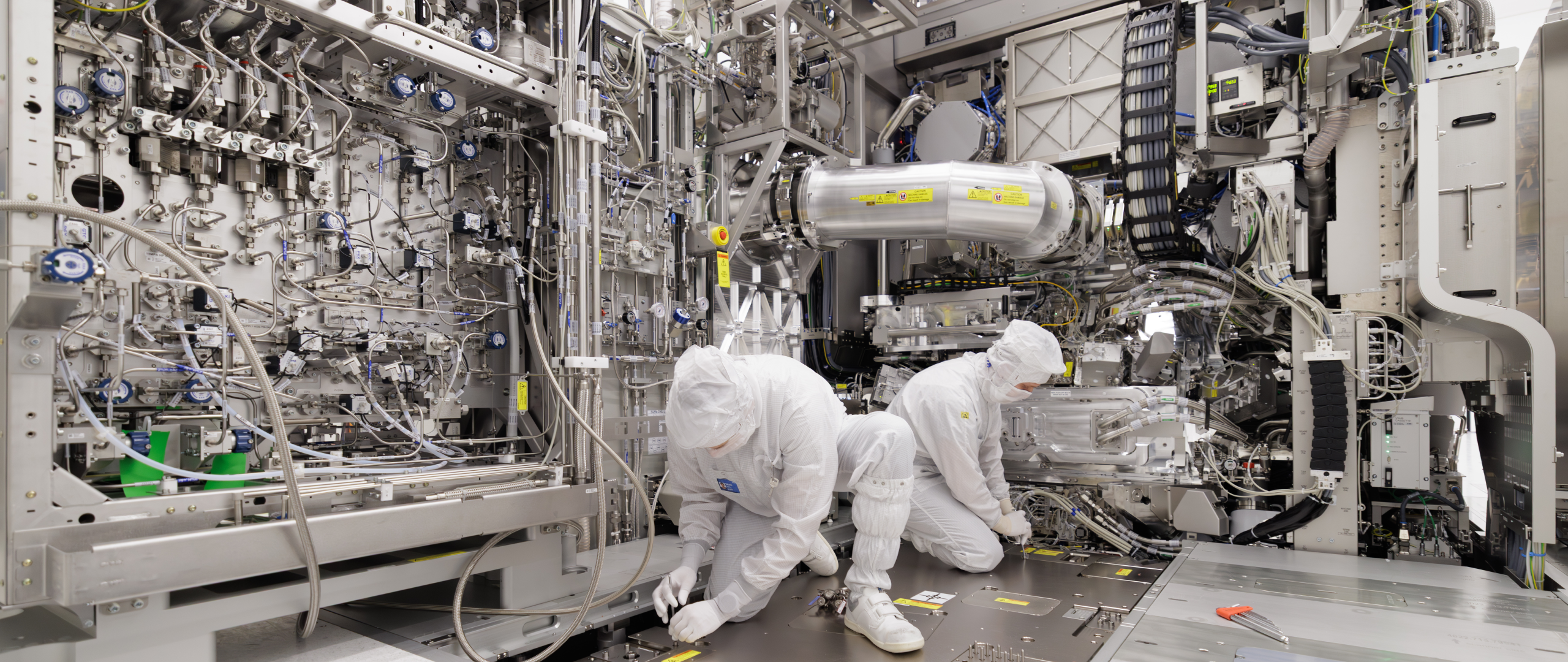
Imec's new post-exposure bake method speeds up EUV chipmaking tools, boosting production for the most advanced chips
The jump to 0.55 numerical aperture with high-NA is the largest optical leap in EUV's history, shrinking minimum resolution from 13nm, which itself was down from 30nm with DUV, to 8nm and enabling approximately 2.9 times higher transistor density in a single exposure. ASML's first High-NA tool, the EXE:5000, shipped to Intel in December 2023 as a development platform.
Each unit of the production-capable EXE:5200B weighs in at 150,000 kilograms, requires 250 shipping crates, and takes six months and 250 engineers to assemble on-site, says Intel. Priced at approximately $380 million , the EXE:5200B delivers 175 wafers per hour at 50 mJ/cm² dose with 0.7nm overlay. ASML told Reuters in early 2024 that it had taken 10 to 20 orders by that point and planned to deliver 20 annually by 2028.
Intel announced that it had completed acceptance testing of its EXE:5200B in December 2025 at its Hillsboro D1X fab and that the tool will be used for the development of Intel's 14A fabrication process. 14A is expected to be the first production node to rely on High-NA for its most critical layers, with risk production targeted for 2027 .
In September, SK hynix became the first memory manufacturer to install a commercial High-NA system at its M16 fab in Icheon, South Korea. Samsung, meanwhile, received its first EXE:5200B in October, with a second unit due in the first half of 2026 for its 1.4nm foundry node. Imec, the Belgian research institute, secured an EXE:5200 last month with a Q4 2026 qualification target for sub-2nm process development.
ASML's near-term High-NA roadmap includes the EXE:5200C, targeting 190 wafers per hour without stitching and 160 with stitching at sub-0.8nm overlay, followed by the EXE:5200D at 195/175 wafers per hour and eventually the EXE:5400E at 210/180 wafers per hour with sub-0.7nm overlay. A High Productivity variant, the EXE:5600, targets 250 wafers per hour or more.
Analysts from SemiAnalysis believe TSMC won’t adopt High-NA EUV until its 1nm-class A10 node, which would place volume deployment around 2029 to 2030 , because existing low-NA EUV systems can match High-NA's 8nm resolution using double patterning, and SemiAnalysis estimates that approach may still cost less than High-NA single patterning. High-NA tools also require substantial changes to existing fab buildings to accommodate their size.
ASML placed Hyper-NA on its official roadmap for the first time at imec's ITF World in May 2024, with former CTO Martin van den Brink commenting a few months prior that an NA above 0.7 "is certainly an opportunity that will become more visible from around 2030." The primary target is 0.75 NA, with 0.85 NA also under investigation. Zeiss has begun preliminary lens designs. Estimated tool cost: roughly $720 million per system , according to TrendForce .
At 0.75 NA, however, polarization effects begin destroying imaging contrast because one polarization orientation effectively cancels light at extreme incidence angles, thereby necessitating the use of polarizers that block photons and reduce efficiency. Depth of focus shrinks further, and resists must be made even thinner than the sub-30nm films used for high-NA, worsening etch selectivity and stochastic defects from photon shot noise. On top of all that, an electron blur of approximately 2nm may impose a solid resolution barrier regardless of optical improvements.
Pellicle development is another bottleneck. These ultra-thin membranes protect masks from particle contamination during exposure but must transmit EUV light efficiently at rising source power levels. ASML's current composite silicon-based pellicle achieves over 90% transmission at 380 W source power, but for future systems running at 600 W to 1,000 W, carbon nanotube pellicles are the next-gen technology, achieving up to 97% transmission while withstanding temperatures above 1,500 C. Mitsui Chemicals is building dedicated CNT pellicle production capacity targeting 5,000 sheets per year and commercialization aimed for this year.
EUV systems have never been sold to China, blocked since 2019 under U.S. pressure despite existing orders from Chinese customers. In addition, Dutch export controls, effective since late 2023, required licenses for advanced DUV immersion systems (NXT:2000i and newer), and by September 2024, the restrictions expanded to include the NXT:1970i and NXT:1980i .
Servicing restrictions also prohibit ASML from improving overlay accuracy or increasing throughput by more than 1% on installed Chinese systems. China represented 49% of ASML's revenue at the peak of stockpiling in Q2 2024, falling to roughly 36% for full-year 2024. ASML's management guided China to approximately 20% of revenue in 2025 and 2026, which has seen South Korea and Taiwan emerge as the primary growth markets, with SK hynix alone placing a record $7.9 billion EUV order last month covering roughly 30 systems over two years.
Canon's FPA-1200NZ2C nanoimprint lithography system, announced in October 2023 , represents the only credible alternative patterning approach. At roughly $15 to $20 million per system with 90% lower power consumption than EUV, it uses direct mechanical pattern transfer rather than optical exposure. Canon delivered the first commercial unit to the Texas Institute for Electronics in September 2024, and its current specs show some significant limitations: 80 to 100 wafers per hour (versus 195+ for low-NA EUV), 14nm minimum linewidth, and 2.4 to 3.2nm overlay (versus sub-1.1nm for EUV).
Japan's Dai Nippon Printing (DNP) is targeting 2027 mass production of 1.4nm-class nanoimprint templates , but no major foundry has committed to NIL for high-volume logic manufacturing. The technology's likely niche remains repetitive memory patterns, particularly high-layer-count 3D NAND, where its cost advantage could outweigh the throughput and overlay penalties. Defect density from direct physical contact between template and resist remains the fundamental barrier to logic adoption, where a single misplaced particle can kill an entire die.
ASML's 2025 results reflect the sheer scale of its roadmap, with €32.7 billion in revenue (up 16% year-over-year), 52.8% gross margin, and €9.6 billion net income. EUV became the leading source of system revenue at 48%, or €11.6 billion, up 39% from 2024. Net bookings surged 48% to €28 billion, with Q4 2025 alone delivering a record €13.2 billion in orders. The company recognized revenue on two High-NA systems during the year.
ASML's Q1 2026 results, published April 15, show €8.8 billion in total net sales at 53% gross margin, with €2.8 billion net income. The company shipped 16 EUV and 17 immersion DUV systems in the quarter, with South Korea accounting for 45% of system sales by region and China at 19%. ASML raised its full-year 2026 revenue guidance to €36 to €40 billion, with 51% to 53% gross margins
Each NA increase delivers diminishing resolution gains at exponentially rising cost and complexity. The most likely trajectory is not a clean generational handoff but an extended coexistence: low-NA handling the bulk of EUV layers well into the 2030s, High-NA reserved for the most critical pitches at sub-2nm nodes, and Hyper-NA arriving as a targeted tool for the most extreme features, subject to workarounds for the bottlenecks we’ve discussed above.
Luke James is a freelance writer and journalist.\u00a0 Although his background is in legal, he has a personal interest in all things tech, especially hardware and microelectronics, and anything regulatory.\u00a0 ","collapsible":{"enabled":true,"maxHeight":250,"readMoreText":"Read more","readLessText":"Read less"}}), "https://slice.vanilla.futurecdn.net/13-4-22/js/authorBio.js"); } else { console.error('%c FTE ','background: #9306F9; color: #ffffff','no lazy slice hydration function available'); } Luke James Social Links Navigation Contributor Luke James is a freelance writer and journalist. Although his background is in legal, he has a personal interest in all things tech, especially hardware and microelectronics, and anything regulatory.
Key considerations
- Investor positioning can change fast
- Volatility remains possible near catalysts
- Macro rates and liquidity can dominate flows
Reference reading
- https://www.tomshardware.com/tech-industry/semiconductors/SPONSORED_LINK_URL
- https://www.tomshardware.com/tech-industry/semiconductors/asml-lithograpy-roadmap-examined-from-duv-to-hyper-na#main
- https://www.tomshardware.com
- Google, Microsoft, Meta, and Amazon capex spending to hit $725 billion in 2026, up 77% from last year — analyst says bear thesis is 'garbage'
- Pirate RPG game is secretly looting your SSD lifespan — new Windrose patch promises smoother sailing and addresses excessive disk writing
- Tennessee bans crypto ATMs that have become 'payment portal of choice for scammers' — second state to restrict machines after Indiana
- Homebrew PlayStation DualSense controller adapter for PC can be built for just $20 with a Raspberry Pi Pico — wireless dongle delivers adaptive triggers and hap
- Developer re-enables 3D printer features that Bambu Lab disabled, firm promptly threatens legal action — OrcaSlicer-BambuLab project now shuttered
Informational only. No financial advice. Do your own research.