
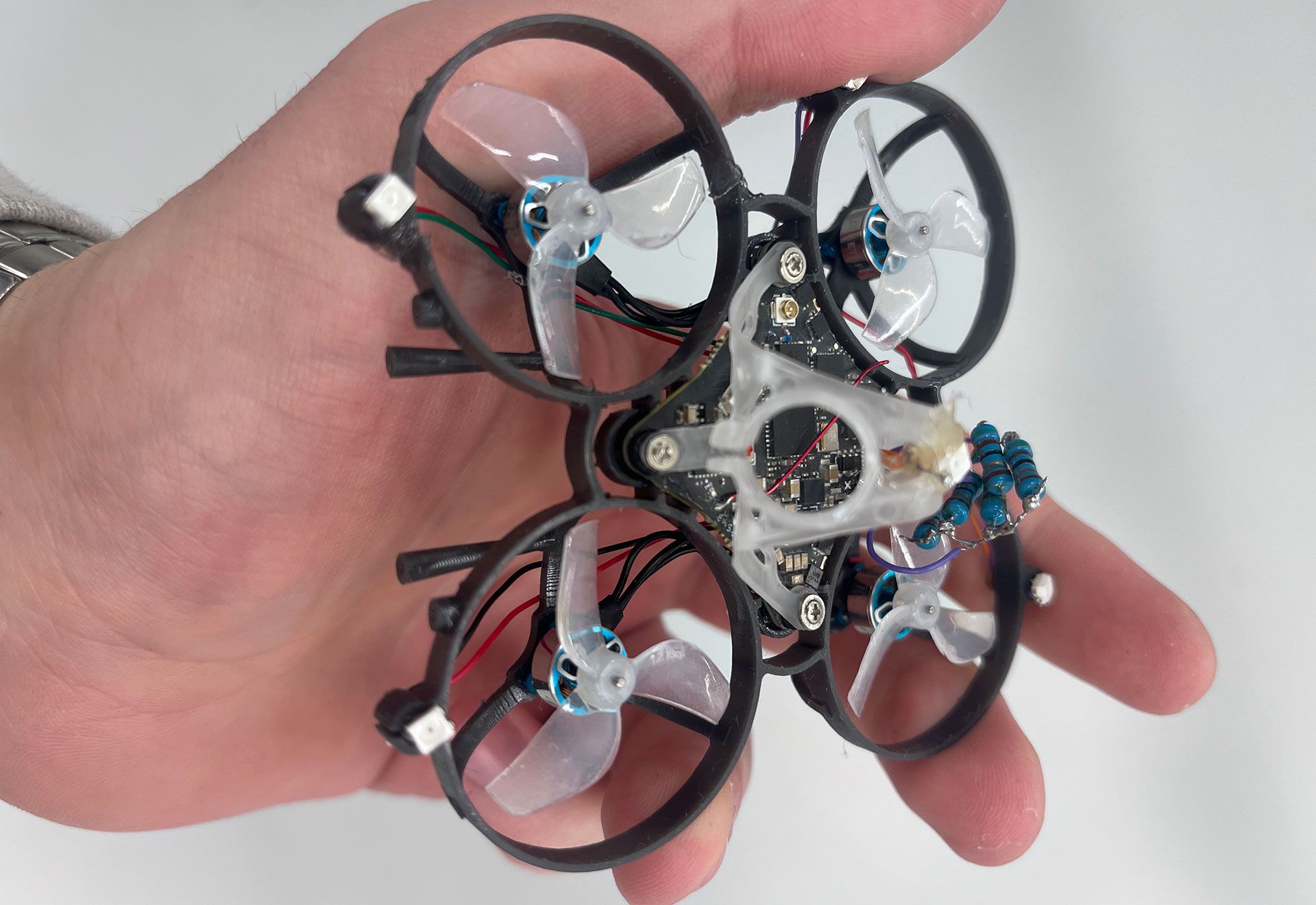
Siorus The human suffering caused by mosquitoes doesn’t happen in isolation; they also constitute an important food source for a huge variety of animals, from fish to birds and bats. There are reasonable arguments to be made to experiment with the eradication of specific species that spread diseases to humans. The case for eliminating the entire category of organisms is much thinner; there is a notably nonzero chance that total eradication of mosquitoes as a category could result in the collapse of entire ecosystems. The developer’s choice of language as reported in this article calls into question whether he has any meaningful understanding of any of this. Though, that being said, the concern is likely largely irrelevant because the biomass of mosquitoes is so large that population control via drone will never be practical. Equally worth noting is that moths are not necessarily “harmless” as posited above. I have no idea what species this thing was tested on-and that specific species could very well be-but as a group, moths damage textiles, crops, etc. to the tune of several tens of billions of dollars annually on a global basis. Some moth species are harmless, but some emphatically are not. Just like mosquitoes. Reply
bolweval My bug zapper kills 100's of them every night, and the mosquitos come to it in droves, ole school… Reply
Zaranthos bolweval said: My bug zapper kills 100's of them every night, and the mosquitos come to it in droves, ole school… Except it also kills literally every flying insect or creature small enough to touch the electrodes. Give me an AI powered drone with a laser than can kill bugs and weeds on its kill list that parks in a solar powered nest to recharge. The buzzing of mosquitoes will be replaced by the buzzing of neighborhood drones. I'm really not worried about these being a problem to the ecosystem or wildlife because they would cover a relatively small area where humans want them. Reply
bill001g bolweval said: My bug zapper kills 100's of them every night, and the mosquitos come to it in droves, ole school… Problem is bug zappers assume the insect is attracted to light. Mosquitos to some extent are but they primarily smell out CO2. I wonder how many the drone can zap per second. Maybe in the house to get a stray ones that come in but outside I have seen swarms of hundreds. Reply
davie887 Surely this is DOA, the laser based systems are much more practical Reply
Darkhands Siorus said: The human suffering caused by mosquitoes doesn’t happen in isolation; they also constitute an important food source for a huge variety of animals, from fish to birds and bats. There are reasonable arguments to be made to experiment with the eradication of specific species that spread diseases to humans. The case for eliminating the entire category of organisms is much thinner; there is a notably nonzero chance that total eradication of mosquitoes as a category could result in the collapse of entire ecosystems. The developer’s choice of language as reported in this article calls into question whether he has any meaningful understanding of any of this. Though, that being said, the concern is likely largely irrelevant because the biomass of mosquitoes is so large that population control via drone will never be practical. Equally worth noting is that moths are not necessarily “harmless” as posited above. I have no idea what species this thing was tested on-and that specific species could very well be-but as a group, moths damage textiles, crops, etc. to the tune of several tens of billions of dollars annually on a global basis. Some moth species are harmless, but some emphatically are not. Just like mosquitoes. There are around 3,700 species of mosquitoes, but only a few hundred actually bite humans, and fewer than 100 are major carriers of disease. A lot of people assume wiping out mosquitoes would collapse ecosystems, but most animals that eat them, birds, bats, fish, dragonflies, frogs, spiders, etc., aren't dependent on mosquitoes. They're generalist predators that just eat whatever insects are available. The same goes for mosquito larvae. They're only one type of aquatic invertebrate, so if they disappeared, other insects like midges would probably fill a similar niche. Even plants that mosquitoes pollinate usually have plenty of other pollinators, like bees, butterflies, and flies. Because of all that, ecologists think eliminating just the disease-carrying species, like Aedes aegypti or Anopheles gambiae, would probably have little impact on ecosystems as a whole. https://pubmed.ncbi.nlm.nih.gov/35294802/ Reply
JeffreyP55 Like my ex-wife, Mosquitos don't bother me. I have not been bitten years, by either. Reply
Siorus Darkhands said: There are around 3,700 species of mosquitoes, but only a few hundred actually bite humans, and fewer than 100 are major carriers of disease. A lot of people assume wiping out mosquitoes would collapse ecosystems, but most animals that eat them, birds, bats, fish, dragonflies, frogs, spiders, etc., aren't dependent on mosquitoes. They're generalist predators that just eat whatever insects are available. The same goes for mosquito larvae. They're only one type of aquatic invertebrate, so if they disappeared, other insects like midges would probably fill a similar niche. Even plants that mosquitoes pollinate usually have plenty of other pollinators, like bees, butterflies, and flies. Because of all that, ecologists think eliminating just the disease-carrying species, like Aedes aegypti or Anopheles gambiae, would probably have little impact on ecosystems as a whole. https://pubmed.ncbi.nlm.nih.gov/35294802/ Correct. Eliminating just the disease-causing species is broadly considered to be unlikely to cause an issue. That’s not a guarantee that it won’t, but I’d expect the likelihood of issues arising from addressing the handful of problematic species to be relatively small. Small is, notably, not zero-though one could credibly argue it’s likely trivial here. But, whether it’s trivial or not, it’s not an argument against the undertaking in principle. Just an argument for gradual, local, monitored rollouts of mitigation strategies, which is basically what the plans I’m familiar with (like Google’s current proposal) do. Reply
Key considerations
- Investor positioning can change fast
- Volatility remains possible near catalysts
- Macro rates and liquidity can dominate flows
Reference reading
- https://www.tomshardware.com/tech-industry/drones/SPONSORED_LINK_URL
- https://www.tomshardware.com/tech-industry/drones/autonomous-micro-drone-achieves-first-air-to-air-insect-kill-on-the-way-towards-completely-eradicating-mosquitoes-40-gram-unit-uses-car-parking-sensors-can-eliminate-insects-at-up-to-26-feet#main
- https://www.tomshardware.com/subscription
- Florida man arrested after allegedly stealing $220,000 in crypto using malware hidden in Steam Games — 8,000 devices infected
- TSMC confirms significant yield and performance improvements in A14 update — strong interest from AI/HPC and smartphone customers
- AI data centers must produce as much power as they use, Australia PM says — new national AI framework will also ensure water efficiency and protect intellectual
- ‘Phantom Twist’ drone spins so fast that it is nearly invisible — flying device adds motion blur to the real world
- Crazed enthusiast runs PC on 192 AA batteries, successfully boots into Hannah Montana Linux — System is stable during stress testing and even plays FreeDoom
Informational only. No financial advice. Do your own research.