
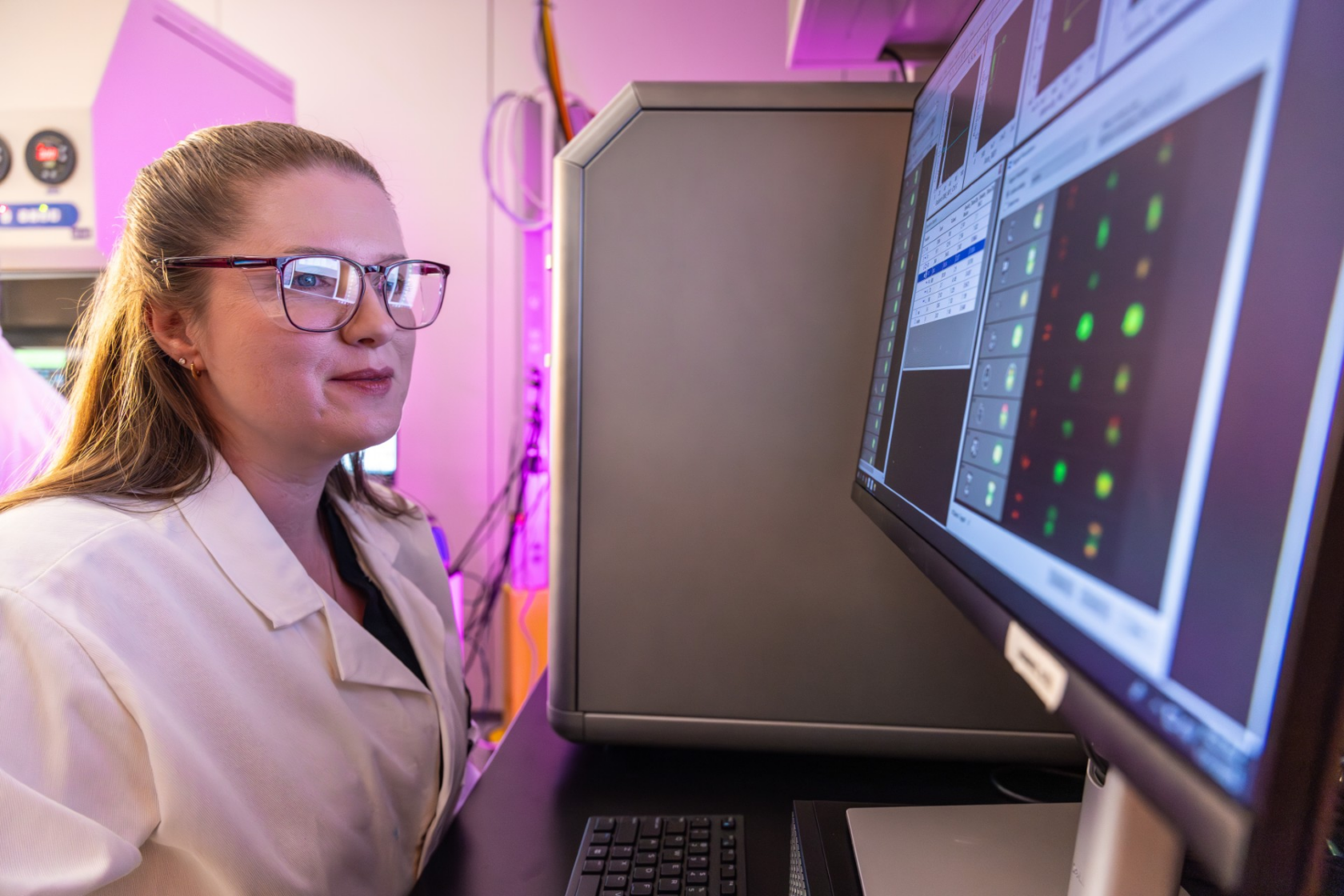
Erin Davis calls it the “SuperDuperPOD.” That’s two things in one name: pharmaceutical giant Bristol Myers Squibb (BMS) already runs one of the largest AI clusters in life sciences, with serious results to show for it. And they’re doubling down.
BMS announced today it is deploying its second NVIDIA DGX SuperPOD , this one built on eight DGX Vera Rubin NVL72 systems — the most powerful and energy-efficient AI cluster in life sciences.
“Instead of equipping a small group of researchers with access to the supercomputer, we’re opening it up to literally every scientist,” says Davis, vice president of research business insights and technology at BMS. “No one has to wait, and no one is told they have a limit.”
The eight rack-scale systems, each comprising NVIDIA Vera CPUs and Rubin GPUs, deliver up to 10x the performance per megawatt of the infrastructure it replaces. It will give researchers at the global pharmaceutical giant access to a unified AI platform — including NVIDIA BioNeMo Agent Toolkit for biological AI — for running predictions, training models and powering agentic workflows across the full drug discovery pipeline.
What Davis and other top BMS researchers are really after is what that access makes possible: faster cycles, bigger chemical spaces and a full drug discovery pipeline where researchers think about the science, not the logistics of lining up resources.
The mandate, says Payal Sheth — a scientist who spent her career inside drug discovery labs before taking on an expanded role in January as senior vice president of therapeutic discovery sciences at BMS — is moving from “sort of this abstract position of what AI can do to actually translating that to measurable impact.”
BMS has operated a DGX SuperPOD for about three years, producing meaningful results. AI-enabled target identification already saves scientists weeks of manual work, freeing time to focus on the highest-value scientific decisions. BMS’s team has used AI to expand its library of CELMoD compounds — molecules engineered to selectively degrade cancer-causing proteins, with applications in blood cancer treatment and beyond. This has opened the door to new targets and new potential medicines across a wider range of diseases. AI is also applied in lead optimization stages of drug discovery using a methodology Sheth calls “Predict First,” which informs experimental gating based on design predictions.
“We use predictions as a way to prioritize synthesis of molecules with multi parameter optimization,” she explains, “to weed out molecules that wouldn’t necessarily meet the property landscape we’re working towards. This ensures precious laboratory experiments are aligned with progressing molecules that have the highest probability of success.
These research AI applications have significant impact on compute needs across the research organization.“We’re saturated,” Davis says. “We’re in production with some very large-scale predictions around large molecules. We’re building our own foundational models, and that takes a lot of GPUs.”
With the new system coming, Davis already has her pitch for researchers thinking about where to do their best work: “Welcome to Limitless Compute.”
A computational chemist by training, Davis spent years doing the science before concluding the technology wasn’t keeping up — and that she’d rather go fix it. She spent roughly 15 years on the vendor side, building enterprise platforms at ChemAxon, Schrödinger and X-Chem. At every company, pharma was wrestling with the same bottleneck.
“It’s not the technology,” she says. “The challenge is how to get that into the hands of actual scientists and learn from it.”
She knows what’s at stake personally. Her father died five years ago, she says, “a very horrible death of Alzheimer’s.” BMS has a significant investment in brain health — a notoriously hard area. “Even if he was still going to die,” Davis says, “if there was symptom remediation along the way, it would have saved suffering for everybody in the family. Dementia is especially cruel.”
Davis’s team is combining the existing DGX SuperPOD and the new DGX Vera Rubin NVL72-powered system into a unified environment — a single data plane, accessible from every BMS site globally.
Barriers that made the earlier system hard to reach — site-specific restrictions left over from past acquisitions, the need for deep computational expertise — are being replaced with AI-native tooling managed through NVIDIA Mission Control . Researchers will be able to initiate complex predictions in plain English.
“The compute infrastructure is what connects all of our scientists together and ensures that our learnings are institutionalized,” Sheth explains. Datasets from a program run in Lawrenceville, New Jersey, feed models that a team in San Diego, California, can draw on. The learnings “can be applied in context of any program we work on.”
“There’s a cumulative learning loop today in drug discovery that did not exist when I first started my career,” Sheth explains. “Every project was treated differently, and there were discrete sets of learnings that did not compound into any kind of intelligence framework within discovery.”
Today, BMS is using AI to expand that learning loop into a discovery system where every experiment, clinical readout, and partnership compounds into higher-conviction scientific decisions, faster.
Agentic workflows can further enhance the architecture of R&D.
Key considerations
- Investor positioning can change fast
- Volatility remains possible near catalysts
- Macro rates and liquidity can dominate flows
Reference reading
- https://blogs.nvidia.com/blog/bristol-myers-squibb-building-life-science-industrys-most-advanced-ai-factory-on-nvidia-vera-rubin/#primary
- https://blogs.nvidia.com/blog/author/brian-caulfield/
- https://blogs.nvidia.com/blog/bristol-myers-squibb-building-life-science-industrys-most-advanced-ai-factory-on-nvidia-vera-rubin/#disqus_thread
- Mario Kart Wii recompiled for PC using AI, with 4K potential and uncapped frame rates — 'first static recompilation of a Wii game' supports over 200 tracks than
- Save $148 on an AMD Ryzen 7 9800X3D bundle with 32GB of RAM, motherboard, and liquid AIO — start your AM5 gaming build for just $1,039
- Joyride Through July With 12 Games Coming to GeForce NOW
- 3D printing enthusiast resurrects cancelled dbrand Steam Machine Companion Cube as DIY project — project shelved due to copyright can now be made and assembled
- ‘Phantom Twist’ drone spins so fast that it is nearly invisible — flying device adds motion blur to the real world
Informational only. No financial advice. Do your own research.