
a]:text-inherit [&>a]:underline">
When you purchase through links on our site, we may earn an affiliate commission. Here’s how it works .
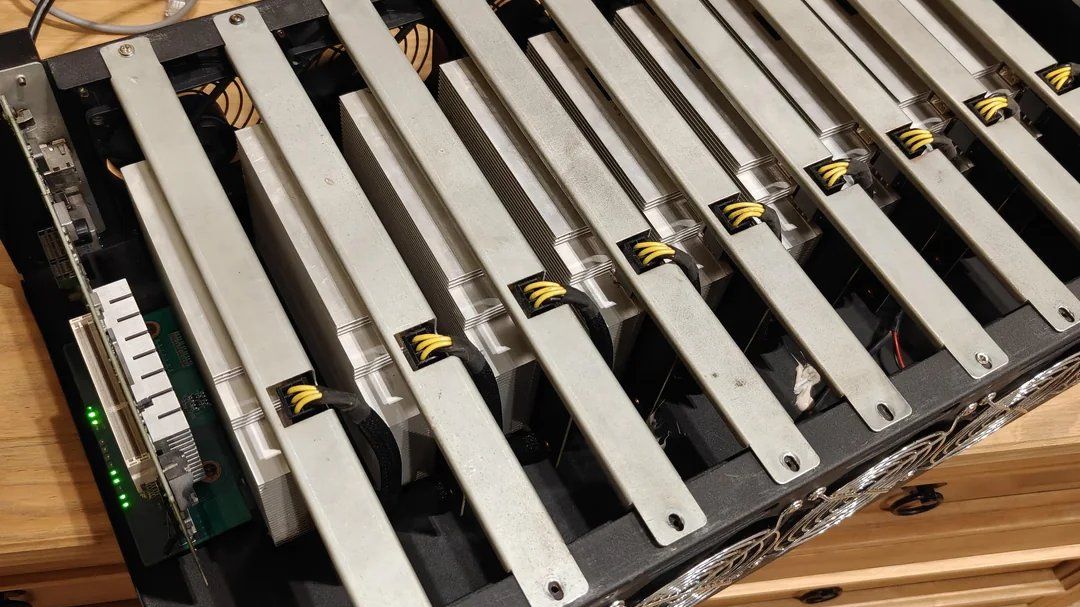
For their first trick, Tech used a Quadro RTX 4000 all on its own on the PCIe x1 slot, as opposed to the standard x16 connector. Running Qwen3-8B yielded the same 56 tokens/s output speed as before, with the only drawback being a longer model load at eight seconds — but unless you're running several models, you'll want to keep it in VRAM anyway. A number of software and hardware tweaks yielded even better results, upping tok/s to 96.
🚨 We just discovered that a PCIe x1 mining riser does NOT slow down local AI.
I took a Quadro RTX 4000, jammed it in an x1 slot on my mining rig, and tested it like crazy. The result breaks what everyone assumes about x1 risers. 🤯
⚡ Qwen3 8B: 56 tokens/sec. The same speed as a full x16 slot.
⚡ While it's writing, the x1 link carries just a few KB per second. It's basically asleep.
⚡ The only cost: 8 seconds to load the model. That's it.
Then we went hunting for hidden boosts 🔍
🔥 +24% speed in long chats by switching one memory setting (f16 KV cache)
🔥 1.75x total output: 4 requests at once = 96 tok/s
🔥 +7% tokens per watt by capping it at 110 W
🔥 A 65,000-token conversation squeezed into 8 GB
And the twist: NVIDIA locks memory overclocking on this Quadro. The driver allows exactly 0 MHz. 🔒
Every result answer-checked, every number measured.
That old mining rig full of x1 risers? It's an AI rig now. 🔥 November 25, 2026
This result alone is contrary to the general zeitgeist that says low-bandwidth slots are not useful for AI work. Much like many comments, you're probably thinking that while the setup is serviceable, the true test comes when using multiple GPUs at once that need to talk to each other, so Caveman Tech obliged.
The second setup involved three cards in what can be described as a staggeringly asymmetric configuration: a CMP 170HX with 64 GB of VRAM on the primary PCIe x16 slot, the aforementioned Quadro 4000 (8 GB) on x1. The chosen model was now GPT-OSS-120B, and the pooled VRAM totaled 72 GB.
As a slap back to the naysayers, this configuration held up surprisingly well, as it turns out that with layer splitting (wherein the harness splits the model's layers across several GPUs), even the PCIe x1 link was only 10% busy. In this setup, cards only transmit the calculation results between them, not model weights.
Reddit user pays $35 for a crypto mining rig left in a garage and gets 54GB of VRAM at 65 cents per GB
Lawyer builds private AI server with eight used Nvidia V100 GPUs
Key considerations
- Investor positioning can change fast
- Volatility remains possible near catalysts
- Macro rates and liquidity can dominate flows
Reference reading
- https://www.tomshardware.com/tech-industry/artificial-intelligence/SPONSORED_LINK_URL
- https://www.tomshardware.com/tech-industry/artificial-intelligence/caveman-repurposes-old-mining-rig-for-local-ai-pools-72gb-vram-across-mismatched-gpus-pcie-x1-slot-hits-just-10-percent-load-while-running-a-120b-model#main
- https://futureplc.com/terms-conditions/
- Onkyo's incredible Creator Series desktop PC speakers are almost 50% off — great sound and plenty of connections
- NVIDIA Announces Rubin HPC — A New GPU to Accelerate Agents for Science, Engineering and Analytics
- The HyperX Omen Max 16 laptop with a RTX 5090 and a Core i9 Ultra can be yours for amazing $1,200 off
- AMD's ultimate Ryzen 9 9950X3D2 CPU is down to its lowest price with $140 savings
- Hair dye that turns your head into a brain-computer interface
Informational only. No financial advice. Do your own research.