
LineShine also took first on HPCG, the test that rewards memory- and communication-bound workloads closer to real scientific code, at 22.00 petaflops. But on HPL-MxP, the mixed-precision benchmark that approximates AI training math, it came in only fourth at 7.92 exaflops, a 3.6 times uplift over its FP64 score.
In other words, the accelerator-based machines it beat on Linpack pull far ahead the moment precision drops. Per the TOP500 announcement, El Capitan posts 16.7 exaflops on HPL-MxP, a 9.2 times jump over its standard result, with Aurora and Frontier showing similar multipliers. Reduced-precision throughput is exactly where GPUs and APUs separate from CPUs, and LineShine has nowhere to hide it.
We can see similar issues cropping up in terms of power. LineShine draws 42,220 kW and returns 52.07 gigaflops per watt on its Linpack run. That beats Intel’s Aurora comfortably but trails El Capitan's 60.94 gigaflops per watt, so LineShine produces more total FP64 output than the Livermore system while burning roughly 42% more power to do it.
It’s worth holding onto this distinction because the TOP500 ranking is decided on FP64 Linpack, the one regime where a wide, HBM-fed CPU can still go toe-to-toe with accelerators. LineShine is a genuine double-precision champion, but it’s not a world-leading AI training machine, and its fourth-place HPL-MxP result says so.
China stopped submitting its fastest systems to the TOP500 around 2021, after a run of entity-list additions hit Sunway's Wuxi center and Sugon. The community has long believed that the country operated exascale hardware well before this entry: the Sunway successor OceanLight and the NUDT-built Tianhe-3 both appeared via Gordon Bell Prize science papers without ever appearing on the list. TOP500 co-founder Jack Dongarra has said for years that Chinese researchers told him they weren’t permitted to submit, and that omissions were about avoiding U.S. attention rather than any lack of capability.
Last June's list, which AMD topped while Chinese HPC remained absent , was especially conspicuous, but putting LineShine forward now reverses that. It has been reported that the system was developed without public funding, which lowers the political exposure of disclosing it, and the all-domestic design means there’s no dependency on Western parts for Washington to choke off after the fact.
Addison Snell, chief executive of HPC analyst firm Intersect360 Research, told Reuters he wasn’t surprised by the performance but by the disclosure itself, noting the surprise was that China submitted the result and wanted recognition for it. Ultimately, submitting a number-one system that runs entirely on indigenous parts is a statement that the sanctions regime hasn’t closed the gap China cares about.
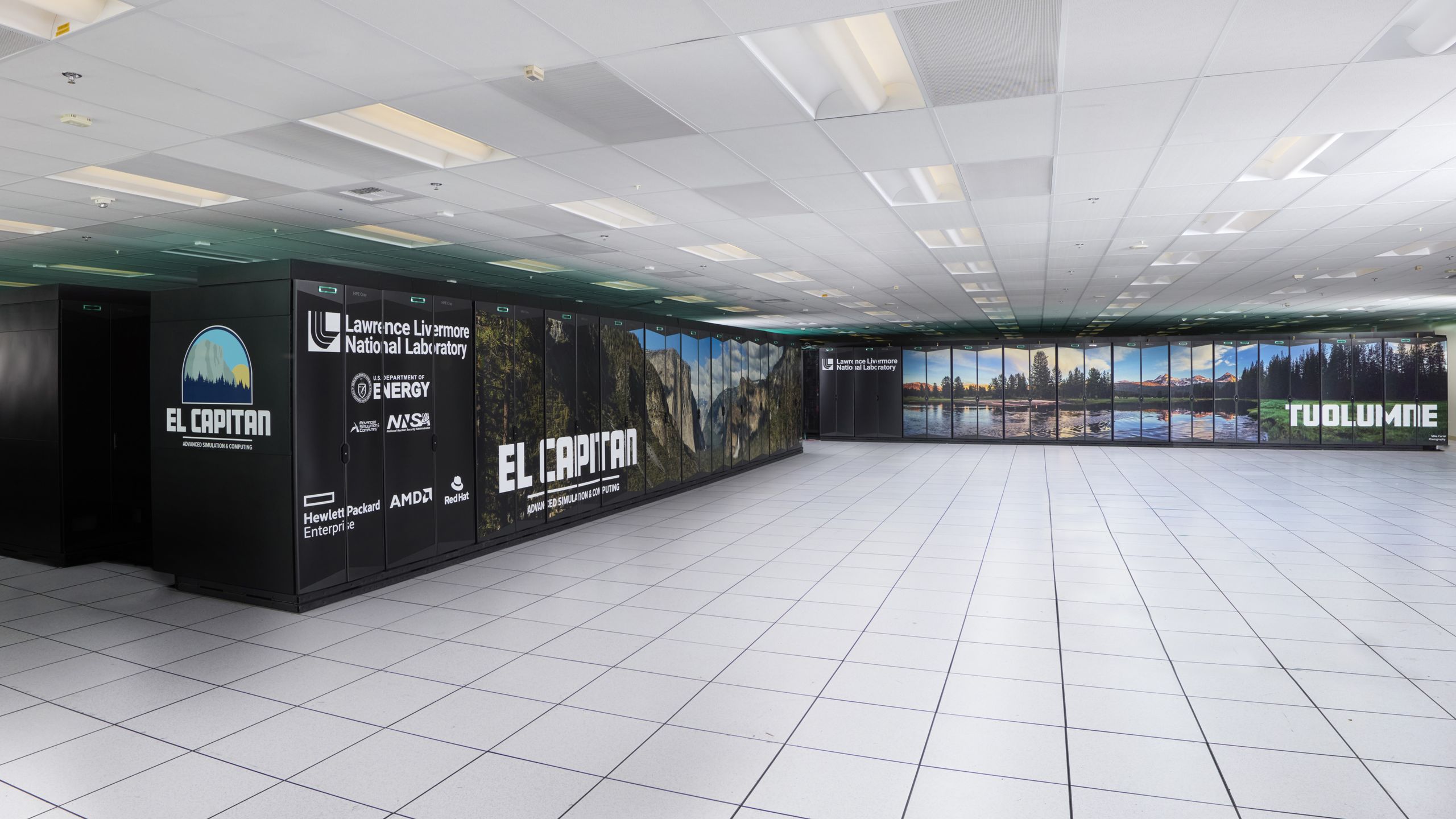
The top of the list might have changed hands, but the bulk of it hasn’t. The U.S. still dominates with three of the top five in El Capitan (1.809 exaflops), Frontier (1.353 exaflops), and Aurora (1.012 exaflops), and Germany's JUPITER Booster remains the first and only European exascale system at an even 1.000 exaflops.
AMD’s silicon underpins most of the accelerated field with the company, per its own blog, now powering 191 systems on the list, up 11% year over year, and 41% of this edition's new entries. It holds three top-10 slots — El Capitan, Frontier, and the newly deployed HPC7 at Italian energy firm Eni — and contributes more than 40% of combined top-10 Linpack performance. On efficiency, it powers 56% of the top 50 Green500 systems, and its first Instinct MI355X deployments, two Cambridge Zenith systems in the UK, entered at positions 67 and 68.
None of that is dented by LineShine, not least because the two aren’t competing for the same workload. AMD’s MI300A and MI355X parts are built for mixed-precision AI arithmetic, where LineShine places fourth, and the rest of the Western labs are optimizing for that, not FP64 leaderboard positions.
El Capitan, Frontier, and Aurora all post HPL-MxP scores several times their Linpack results, enabled by hardware that LineShine doesn’t have. So, while it’s true the TOP500 crown moved to Shenzen, it did so on a benchmark that Western labs are no longer chasing with their fastest machines.
Luke James is a freelance writer and journalist.\u00a0 Although his background is in legal, he has a personal interest in all things tech, especially hardware and microelectronics, and anything regulatory.\u00a0 ","collapsible":{"enabled":true,"maxHeight":250,"readMoreText":"Read more","readLessText":"Read less"}}), "https://slice.vanilla.futurecdn.net/13-4-24/js/authorBio.js"); } else { console.error('%c FTE ','background: #9306F9; color: #ffffff','no lazy slice hydration function available'); } Luke James Social Links Navigation Contributor Luke James is a freelance writer and journalist. Although his background is in legal, he has a personal interest in all things tech, especially hardware and microelectronics, and anything regulatory.
Key considerations
- Investor positioning can change fast
- Volatility remains possible near catalysts
- Macro rates and liquidity can dominate flows
Reference reading
- https://www.tomshardware.com/tech-industry/supercomputers/SPONSORED_LINK_URL
- https://www.tomshardware.com/tech-industry/supercomputers/china-tops-the-top500-with-a-cpu-only-supercomputer-ending-el-capitans-reign#main
- https://www.tomshardware.com/my-account
- China's LineShine supercomputer dethrones US' El Capitan, secures first place in Top 500 list — first machine in the rankings to sustain more than 2 ExaFLOPS of
- Grab these vital 3D printer maintenance tools at a discount with these Prime Day 2026 deals — up to 30% off HOTO, Creality, Wera, and iFixit kits
- Fastest, Largest, Strongest: NVIDIA Blackwell Sweeps MLPerf Training 6.0
- You can still build a great $1000 budget gaming PC with Amazon Prime Day parts — 32GB of RAM and RTX 5060 Ti power beats out the Steam Machine and cheap prebuil
- NVIDIA Vera CPU Opens the Way for Agentic Scientific AI at Los Alamos National Laboratory
Informational only. No financial advice. Do your own research.