
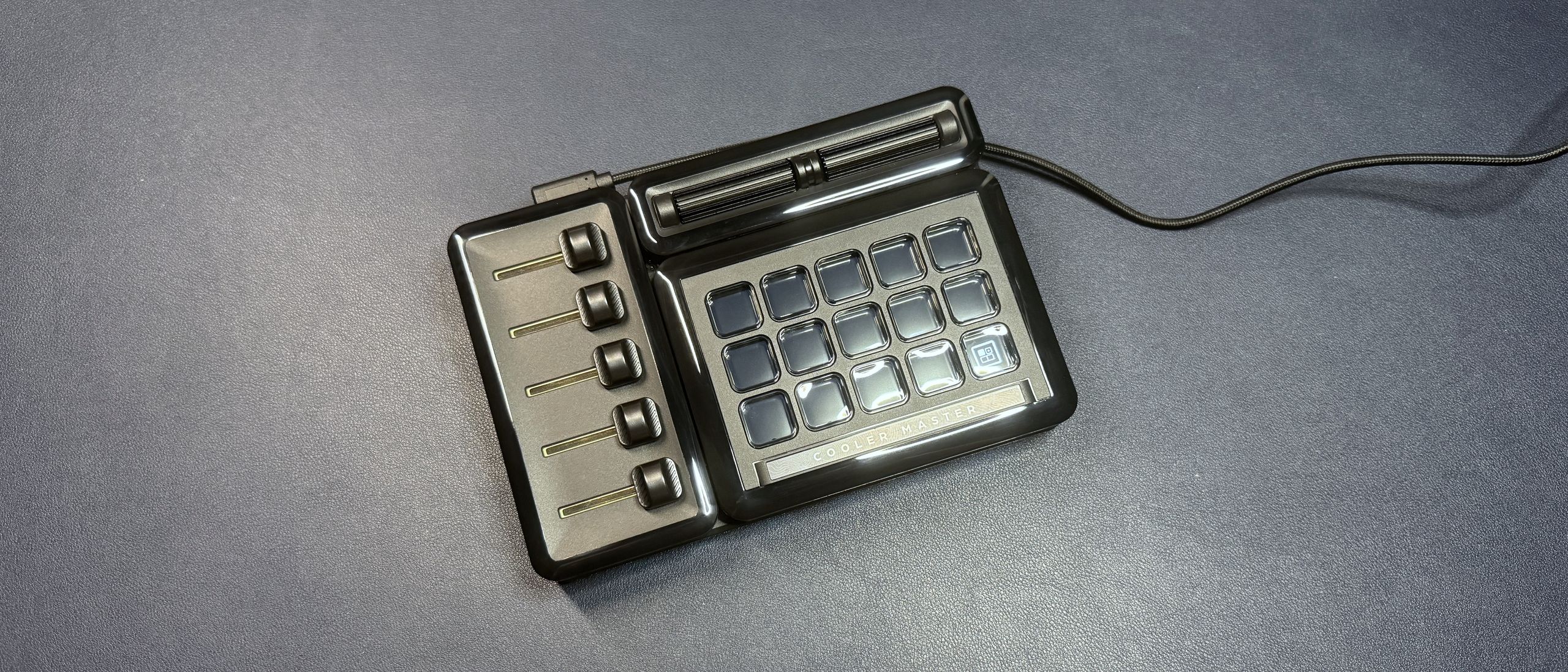
The MasterHUB comes with three modules in the main Creator Kit, and offers two additional module types sold separately. You can have more than one of the same type of module on your MasterHUB.
(Image credit: Tom's Hardware) (Image credit: Tom's Hardware) The "main" module is the 15-key IPS module, which looks similar to the LCD keys of the Elgato Stream Deck MK.2 or the Loupedeck-powered Razer Stream Controller X : 15 square 0.6-inch (15mm) clear plastic buttons over a larger, full-color (in this case, IPS) display. Each key is fully customizable for function and image/icon, and changes as the setup changes; e.g. if you have different profiles or pages of key functions on your MasterHUB. I do like the way these keys feel — they're snappy, not mushy like Elgato's, and they have more give than Loupedeck's. They're not perfect, but they feel nice and responsive to press.
The module features Cooler Master's text logo along the bottom, which I don't love, because it means you can't really use the module in a vertical position (well, it's not really set up to be used vertically at all, I suppose, and you'd have to manually rotate images for it to look right — but, technically, it could be done).
(Image credit: Tom's Hardware) (Image credit: Tom's Hardware) The 5-slider module also comes in the Creator's Kit, and features five smooth plastic sliders. I love the idea of this module, but at the moment there's not much you can do with it — as only certain controls can be mapped to the sliders, and there aren't many of them. In fact, there are only four of them as of this writing: MasterHUB brightness, system volume control, OBS Studio audio mixer, and Streamlabs audio mixer. Assuming you use all of these programs, you still can't use all five of the sliders. I assume Cooler Master has plans to add in support for other functionality, but I don't know when (if ever) that will happen.
(Image credit: Tom's Hardware) (Image credit: Tom's Hardware) The final piece of the puzzle in the Creator's Kit is the dual-roller module, which features two notched plastic rollers. These have a lot more potential functionality than do the sliders, and can be mapped to do things like control your media, switch between desktops, zoom and scale, and perform specific key actions. The rollers are not clickable.
(Image credit: Tom's Hardware) (Image credit: Tom's Hardware) The other two modules are a three-dial module, which has three clickable metal dials with light rings around each, and an encoder dial module, which has a large plastic dial with a customizable screen in the center. The three-dial module is probably my favorite — it's well-made, with premium, sturdy-feeling machined metal knobs, and it just seems to make more sense than the rollers or the sliders, especially with the current limitations of the software. The encoder dial is nice because it provides an extra screen, but what the screen can display is limited to a clock/date display, CPU/GPU usage, CPU/GPU temp, or an image of your choosing. (Of course, I'm not sure what else I'd like it to be able to display, but I feel limited regardless.)
I love the modularity of the MasterHUB, and I can certainly see situations in which different modules would be useful for different workflows. But with customizable macro pads like these, it all sort of ultimately comes down to the software — and Cooler Master's software leaves quite a bit to be desired.
The MasterHUB uses Cooler Master's MasterHUB software, which is definitely not perfect — though it has been updated twice in the past couple of months, so it's possible (fingers crossed) that it will get better. The software's layout is pretty straight-forward, especially if you've used software for similar devices before — you can click on any part of the MasterHUB to reassign functions to that button, dial, or knob; the functions you can assign will depend on the type of input (e.g. the sliders can only accept a handful of functions).
(Image credit: Tom's Hardware) (Image credit: Tom's Hardware) (Image credit: Tom's Hardware) (Image credit: Tom's Hardware) (Image credit: Tom's Hardware) (Image credit: Tom's Hardware) (Image credit: Tom's Hardware) MasterHUB also comes with some app integrations: OBS Studio, Twitch, Streamlabs, Photoshop, Illustrator, and Premier Pro, as well as MasterCTRL, which is for controlling the lighting on other Cooler Master components and peripherals. These integrations are useful, but they're nowhere near as extensive as, say, the plugins in the Elgato Marketplace for Stream Decks. Of course, many actions for various programs can be manually programmed using hotkeys and macros (most of the preset actions are, after all, just hotkeys and macros), but it's nice to not have to do the work.
You can also use the MasterHUB software to customize the device's lighting, though I was disappointed to find that I could only customize lighting by individual modules — not individual inputs. Meaning I could change the color of all three dials or all five sliders, but not the colors of individual dials or sliders (which would be much more useful for distinguishing functionality). This seems like something Cooler Master could add in the future, however.
The MasterHUB has a lot of potential, but it's still just… potential. The modular system works surprisingly well — it's easy to put together, the modules are well-built and hot-swappable, and you can set it up in several different layouts depending on what works for you. I'm actually very impressed with how well they managed to pull off the modularity aspect of the MasterHUB, as that part seemed like the trickiest to get right.
But like all macropads, stream decks, programmable… knobs, etc, the hardware is only one (relatively small) part of the equation. The MasterHUB software is definitely still a work in progress, and while it's been updated a couple of times in recent months — leading me to believe (or, well, at least hope) that Cooler Master hasn't abandoned the project — it still has quite a ways to go before it gets anywhere near as functionally as Elgato or Loupedeck.
You can pick up the entire set — the Creator's Kit and the knob and encoder modules — at B&H for $270 right now , or you can get the Elgato Stream Deck+ , which has eight buttons, four knobs, and a touchscreen display for $180. The most unique inputs on the MasterHUB are the sliders, and you can't even use all five of them with Cooler Master's current software.
Sarah Jacobsson Purewal is a senior editor at Tom's Hardware covering peripherals, software, and custom builds. You can find more of her work in PCWorld, Macworld, TechHive, CNET, Gizmodo, Tom's Guide, PC Gamer, Men's Health, Men's Fitness, SHAPE, Cosmopolitan, and just about everywhere else. ","collapsible":{"enabled":true,"maxHeight":250,"readMoreText":"Read more","readLessText":"Read less"}}), "https://slice.vanilla.futurecdn.net/13-4-24/js/authorBio.js"); } else { console.error('%c FTE ','background: #9306F9; color: #ffffff','no lazy slice hydration function available'); } Sarah Jacobsson Purewal Social Links Navigation Senior Editor, Peripherals Sarah Jacobsson Purewal is a senior editor at Tom's Hardware covering peripherals, software, and custom builds. You can find more of her work in PCWorld, Macworld, TechHive, CNET, Gizmodo, Tom's Guide, PC Gamer, Men's Health, Men's Fitness, SHAPE, Cosmopolitan, and just about everywhere else.
Key considerations
- Investor positioning can change fast
- Volatility remains possible near catalysts
- Macro rates and liquidity can dominate flows
Reference reading
- https://www.tomshardware.com/peripherals/docking-stations-hubs/SPONSORED_LINK_URL
- https://www.tomshardware.com/peripherals/docking-stations-hubs/cooler-master-masterhub-review#main
- https://www.tomshardware.com
- Netgear countersues TP-Link, saying firm 'remains, at its core, a Chinese company selling Chinese-made products' — alleges its 'American company' rebrand is fal
- Apple made marketing gold from the export ban on Power Mac G4 'supercomputer' in 1999, 'for the first time in history a personal computer has been classified as
- Score 32GB of DDR5 RAM from only $240 in these Newegg hardware bundles for Intel and AMD gaming PC builds — huge savings on premium Gigabyte motherboards couple
- Cooler Master MasterHUB review: A modular stream deck with potential
- NVIDIA Confidential Computing to Help Expand Apple’s Private Cloud Compute
Informational only. No financial advice. Do your own research.