
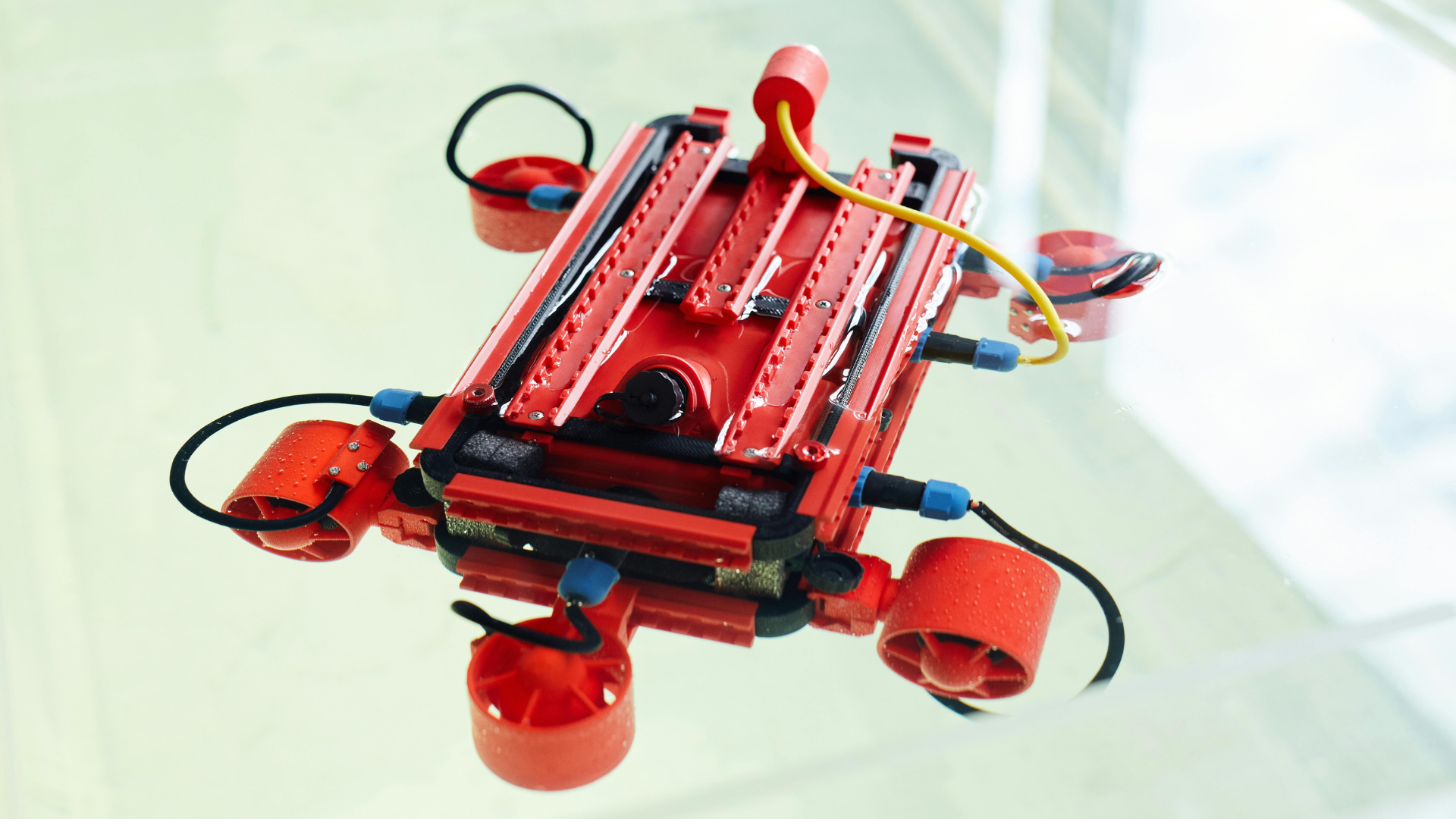
The Pentagon wants inexpensive submarine drones, and it wants to get its hands on them as quickly as possible.
When you purchase through links on our site, we may earn an affiliate commission. Here’s how it works .
The Defense Advanced Research Projects Agency (DARPA), the U.S. Department of War’s independent research and development agency, just issued a call for proposals to build an autonomous underwater drone. The program, which DARPA calls Deep Thoughts, is looking for the next generation of small autonomous undersea vehicles (AUVs) that can be built using readily available parts that allow for flexibility in the design. It also demands something that can be quickly produced, tested, and iterated on, with a development timeline of months or even weeks. More importantly, the AUV should be easily deployable from various platforms, so that users can launch it from submarines, ships, and even planes or helicopters.
Military drone development has been advancing at breakneck speed, with uncrewed aerial vehicles (UAVs) taking the stage during the ongoing Russia’s invasion of Ukraine. Ukrainian troops have taken advantage of this relatively new technology to blunt Russian armor and halt its advance, while Iran has taken to using its Shahed drones to strike targets in the Middle East when the U.S. started its bombing campaign of the country earlier this year. Chinese military scientists and engineers have also been developing drone swarms , giving individual soldiers the capacity to control up to 200 units.
The U.S. is also working on its own innovations in the UAV space —the U.S. Marine Corp introducing a 3D-printed drone called HANX , allowing units to manufacture and repair drones in-house, while a defense startup is marketing its CobraJet counter-unmanned aircraft systems (C-UAS) to defeat enemy drone swarms at a much more cost-effective way. However, it seems that the Pentagon wants to expand its drone capabilities beyond the sky and into the deep sea.
You may like Autonomous mobile drone swarm killer created in trilateral US defense company collab US and Gulf states race for Ukrainian interceptor drones, including 3D printed model that costs $1,000 apiece Cornell research shows that underwater 3D printing can be used to build or repair ocean structures in place DARPA’s project specifically targeted deep ocean exploration, saying that “gaining responsive and scalable access to this environment offers a significant strategic advantage.” While traditional defense contractors, like General Dynamics Electric Boat and Huntington Ingalls Industries, the makers of the U.S. Navy’s nuclear-powered subs, are certainly capable of building these projects for the U.S. government, the War Department is looking for novel ways to build these systems. That’s because these firms are often associated with time-consuming projects with billions of dollars in cost overruns — just look at the F-35 Joint Strike Fighter and the USS Gerald R. Ford carrier as an example.
At a time when the United States’ rivals are rapidly iterating on cheap drones, the Pentagon needs a program that can quickly adapt to changing technologies and take advantage of the latest systems without costing millions of dollars per unit. This is why both the U.S. and its Gulf allies have been purchasing 3D-printed interceptor drones that only cost $1,000 apiece , instead of deploying $4,000,000 Patriot missiles to take down a single Shahed drone that only costs $20,000 to $50,000 per unit.
Follow Tom's Hardware on Google News , or add us as a preferred source , to get our latest news, analysis, & reviews in your feeds.
Get Tom's Hardware's best news and in-depth reviews, straight to your inbox.
Key considerations
- Investor positioning can change fast
- Volatility remains possible near catalysts
- Macro rates and liquidity can dominate flows
Reference reading
- https://www.tomshardware.com/tech-industry/SPONSORED_LINK_URL
- https://www.tomshardware.com/tech-industry/darpa-calls-for-proposals-for-autonomous-underwater-drones-govt-looking-for-a-small-cheap-autonomous-sub-that-can-be-developed-and-built-quickly#main
- https://www.tomshardware.com
- New 3D device computes using living brain cells — bioelectronic device uses 3D electronic mesh design paired with living tissue
- Into the Omniverse: NVIDIA GTC Showcases Virtual Worlds Powering the Physical AI Era
- Your Walmart might be 3D printed — firm building more than a dozen 3D-printed Walmart expansions with concrete-printing robots
- More than 30,000 Samsung union members take to the streets to demand an average bonus of $400,000 per worker — May 21 strike date looms, union points to rival S
- NVIDIA and Partners Showcase the Future of AI-Driven Manufacturing at Hannover Messe 2026
Informational only. No financial advice. Do your own research.