
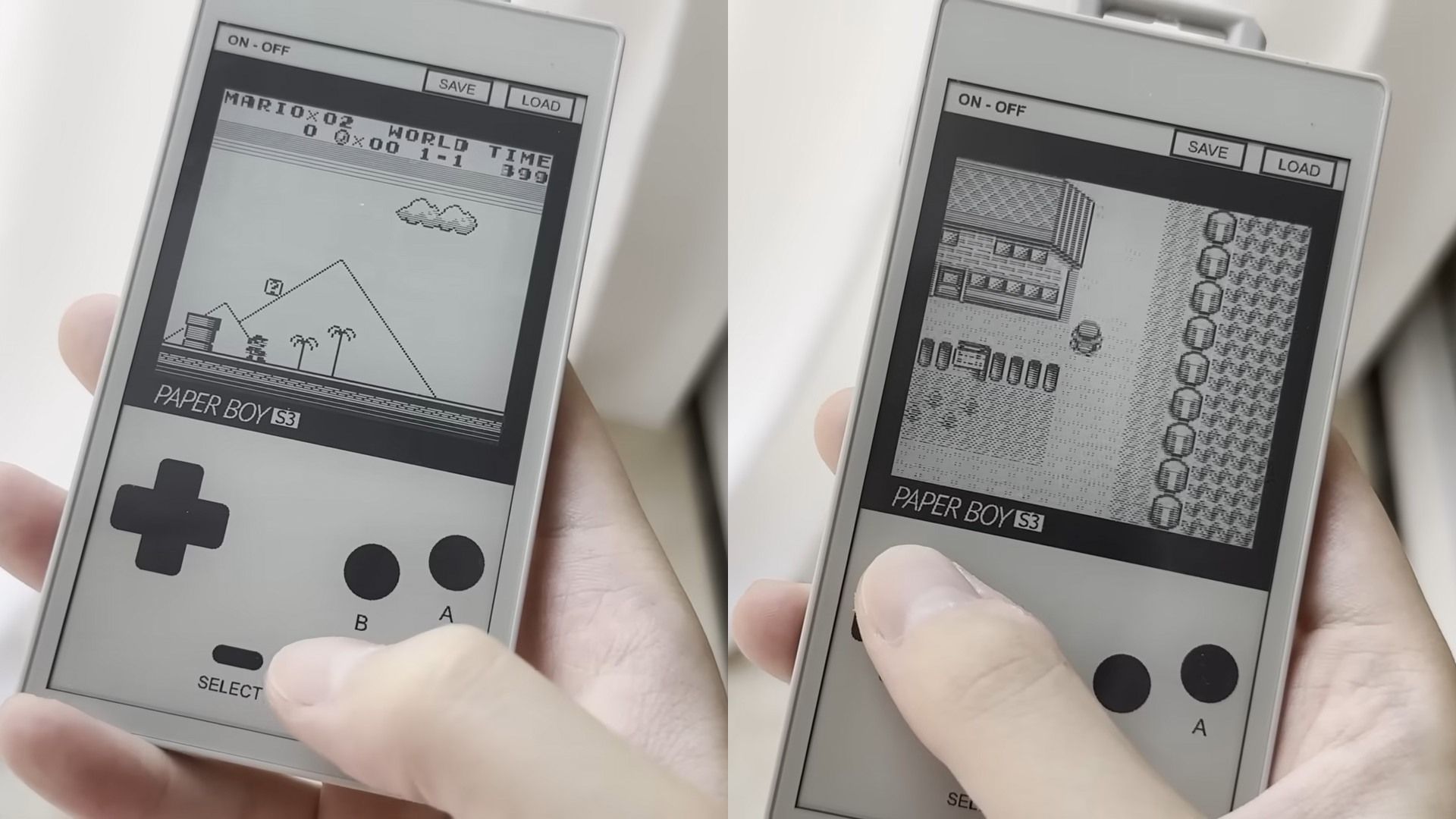
The practicality of the project isn't really the point; it's mostly a fascinating demo of hardware hacking skill.
When you purchase through links on our site, we may earn an affiliate commission. Here’s how it works .
Okay, it won't play real cartridges, the sound is kind of jank, and the performance isn't always full speed. Still, this is quite an achievement for a few reasons. The PaperS3 is an e-Ink dev kit, not really a commercial product. It's intended for prototyping and, well, exactly this sort of hardware hacking. A key detail to understand is that this device isn't powered by some multi-core Rockchip or Allwinner SoC, but rather by an ultra-low-cost ESP32-S3 microcontroller with just two cores running at clock rates measured in hundreds of MHz, not GHz. Moreover, its e-Ink display is not really intended for the kind of smooth refresh normally required for playing video games, yet Zhang pulled it off.
To understand how this Game Boy emulator is even possible, you have to understand Zhang's breakthrough with E-ink hardware, which he originally developed for his open-source monitor project, the Modos Flow . He has a whole video explaining the tech, but the summary is basically that he replaced the display controller of a typical e-Ink display with a powerful FPGA so that he could treat every single pixel as an independent display region and then only update the parts of the screen that are actually changing each frame.
How, then, did he achieve this on the embedded controller in the PaperS3? It's only possible because the Game Boy screen is very low resolution by modern standards at just 160×144 pixels. The screen on the PaperS3 is 960×540, so he was able to multiply the resolution by three to give him enough room for dithering to reproduce the four possible shades of the original Game Boy screen. This process takes up almost the entirety of the second CPU core in the ESP32, leaving just enough room for audio processing while the actual emulation happens on the first CPU core.
Watch On The end result is a very convincing facsimile of the Game Boy's display, except instead of being a tiny and dim LCD, it's a razor-sharp, crystal-clear e-Ink display . Zhang even implemented some quality-of-life features, such as partial Bluetooth LE controller support as well as dedicated quick-save and quick-load touchscreen 'buttons' to save the emulator's state. You can even load a state directly from the front-end, allowing you to instantly resume where you left off when you have to stop.
Enthusiast crams reversed-engineered PS2 into a handheld, designs custom motherboard
Lenovo appears to join retro gaming handheld race with new G02 system
Key considerations
- Investor positioning can change fast
- Volatility remains possible near catalysts
- Macro rates and liquidity can dominate flows
Reference reading
- https://www.tomshardware.com/video-games/retro-gaming/SPONSORED_LINK_URL
- https://www.tomshardware.com/video-games/retro-gaming/designer-turns-niche-e-ink-dev-board-into-a-60hz-game-boy-handheld-960×540-display-powered-by-ultra-low-cost-esp32-s3-microcontroller#main
- https://www.tomshardware.com/subscription
- China’s hollow-core fiber trial pushes 51.3 Tb/s over 128 miles without signal regeneration — milestone targets AI-era networking bottlenecks
- Into the Omniverse: Three Workflows for Improving Vision AI Agent Accuracy With Synthetic Data and Fine-Tuning
- Sony WH-1000XM5 active noise-canceling headphones for an all-time low $198 at Amazon — audiophile-grade audio and ANC for an affordable price
- Oomwoo is a new open-source robot vacuum you can 3D print yourself, sidesteps cloud security risks by running fully offline — project combines Raspberry Pi, 2D
- NVIDIA Powers Over 400 of the World’s 500 Fastest Supercomputers
Informational only. No financial advice. Do your own research.