
a]:text-inherit [&>a]:underline">
When you purchase through links on our site, we may earn an affiliate commission. Here’s how it works .
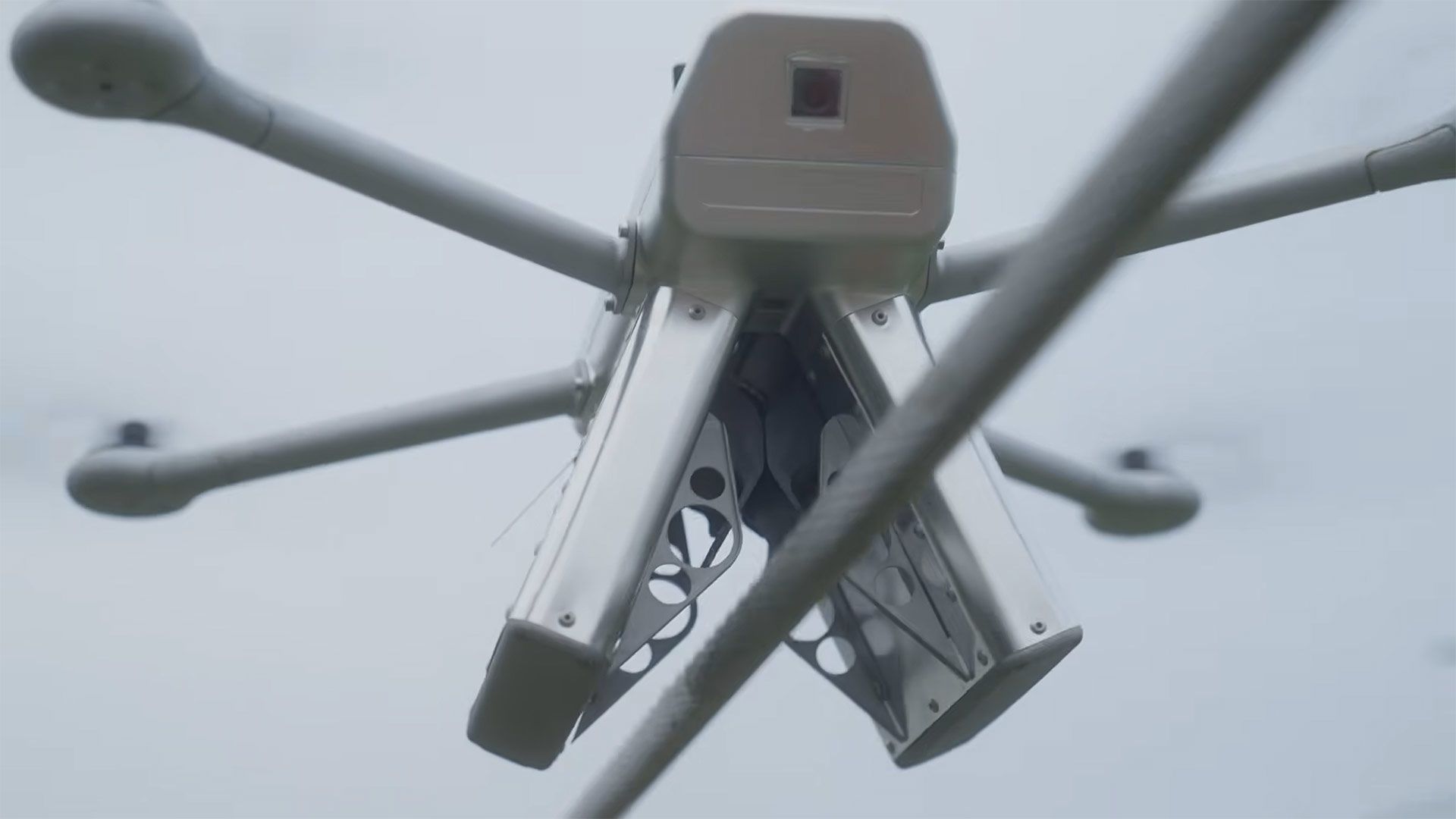
Watch On We hadn’t heard anything about the NOMAD drones until now, but Nomadic says it has tested its quadcopters for over 20,000 hours on live lines in Germany, Norway, and the U.S. “NOMADs are drones that land on live high-voltage lines, charge from the line itself, and relocate across the grid to where measurements are needed,” summarizes the startup.
The reference to measurements along the power grid reveals the current purpose of NOMAD drones. They are deployed to monitor the high-voltage lines from which they leech their energy. This is a very useful task for power companies. Nomadic explains that while modern grid operators use weather models to decide how much power each line can carry, the qualities of the lines can be quite variable. Meanwhile, the weakest point in any line “sets the limit for the whole line,” says the startup.
Fixed sensors have started to become the accepted solution for line monitoring, but mobile drones are a tantalizing alternative. In comparison to fixed sensors, the NOMAD, which recharges inductively from the line itself, seems like an ideal solution. Normally, an investigative high-voltage power line check with a human operator would also require extensive planning, heavy machinery, and the line to lose power for a short service period. Nomadic claims that a NOMAD drone can look after around 25km of line, while fixed sensors are typically positioned from 1km to 5km apart.
In addition to the drone hardware , there’s some integrated software to make the best use of the highly configurable data you can harvest from your drone fleet. “Nomadic OS combines their data with weather and grid models, giving operators a real-time picture of what is physically happening on their lines.”
DJI’s first battery-swapping dock gets drones recharged and back in the air in under 45 seconds
UK research agency backs drone-based internet service experiment with lasers, microwaves, and gravity waves used for wireless power
Researchers build a drone that navigates with physical whiskers to operate in dark, dusty or smoky places where cameras or GPS can fail
NOMAD drones are also surprisingly tough. Units have been tested in temperatures as low as minus 25 degrees Celsius, in strong winds, and on lines up to 420kV (European transmission grid typical maximum). With the new funding, Nomadic is hoping to expand its fleet and build with more partners. The startup is also looking for several new recruits, mostly in engineering roles, all based in Munich, Germany.
Download the Tom's Hardware app for up-to-the-minute updates on iOS and Android . Also follow Tom's Hardware on Google News , or add us as a preferred source , to get our latest news, analysis, & reviews in your feeds.
Get Tom's Hardware's best news and in-depth reviews, straight to your inbox.
Key considerations
- Investor positioning can change fast
- Volatility remains possible near catalysts
- Macro rates and liquidity can dominate flows
Reference reading
- https://www.tomshardware.com/tech-industry/drones/SPONSORED_LINK_URL
- https://www.tomshardware.com/tech-industry/drones/energy-companies-deploy-drones-that-can-be-recharged-by-straddling-power-lines-nomad-quadcopter-drones-can-monitor-the-grid-without-ever-returning-home#main
- https://futureplc.com/terms-conditions/
- Modder cools gaming laptop with a bounce house blower for a 35-degree drop
- Get 38% off this 20TB WD Elements external HDD in Amazon Black Friday offer — pay just 2.75 cents per GB as drive drops to $549
- NVIDIA RTX Spark Compact Desktops Out Now
- 35-year-old SNES runs ChatGPT, accelerated with a Super FX 2 chip — 21 MHz of RISC muscle speeds 2.2M parameter chatbot replies
- OLED gaming laptop with RTX 5060 and Intel Core Ultra 7 CPU price crashes by $650 in Black Friday offer
Informational only. No financial advice. Do your own research.