
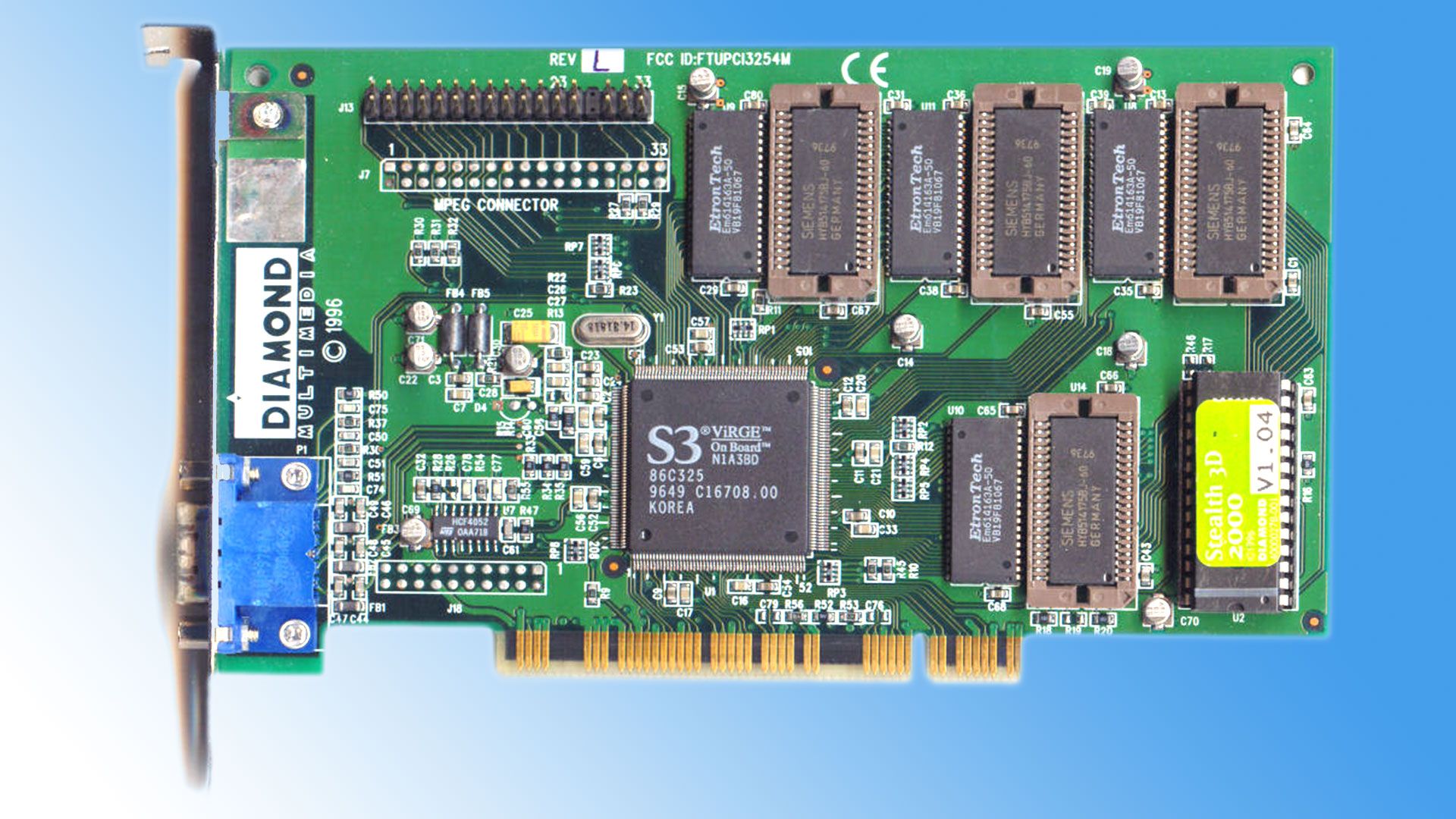
So, the tricky investigation work had been completed; now it was time to dump the VBIOS to a file, make the tweaks that had been found to work, and write it back to the hardware.
A tool called NSSI was used for the dumping. BuB then opened the freshly dumped Virge VBIOS in Hiew (HEX view, or Hacker’s view?). But when searching for the code, he found two matches in the assembly. Again, using the HEX to binary converter in Calc, he found the original pedestal bit and edited it. He modified this single hexadecimal entry from 20 to 00.
With this pedestal bit-zapping work done, the VBOIS checksum needed changing to ensure it wasn’t rejected as being corrupt. This step was demonstrated in DOS and in a friendlier Windows tool. In short, the old checksum was 77 and the new one 97 (both hex numbers).
Now the successfully edited VBIOS was flashed to a chip. BuB swapped the existing VBIOS chip with the modified one. It booted with a glorious, deep black background the first time.
Returning to the debugger, not that he needed to, BuB checked the address, which was previously 3F, and indeed it was now 1F – pedestal bit elimination confirmed. The TechTuber indicates that the same procedure should be usable across any Virge DX model. A neat solution to a 30-year-old gray problem.
Follow Tom's Hardware on Google News , or add us as a preferred source , to get our latest news, analysis, & reviews in your feeds.
Mark Tyson is a news editor at Tom's Hardware. He enjoys covering the full breadth of PC tech; from business and semiconductor design to products approaching the edge of reason. ","collapsible":{"enabled":true,"maxHeight":250,"readMoreText":"Read more","readLessText":"Read less"}}), "https://slice.vanilla.futurecdn.net/13-4-22/js/authorBio.js"); } else { console.error('%c FTE ','background: #9306F9; color: #ffffff','no lazy slice hydration function available'); } Mark Tyson Social Links Navigation News Editor Mark Tyson is a news editor at Tom's Hardware. He enjoys covering the full breadth of PC tech; from business and semiconductor design to products approaching the edge of reason.
vinay2070 Back in my school days, when I took my Pentium 100 PC to add more RAM (8 to 32MB), HDD etc, my Cirrus logic (5446?) VGA card had 1MB VRAM and I asked them if they could add one more MB to the empty slot and they said they could. Even today I dont know if that made much of a difference in gaming as most ran on CPU, but back then I was glad I did. It was the era of voodoo and voodoo 2 and stuff, but I didnt have the cash to afford them so that was the best I could. Reply
JumX You need to revise that article and change it from 85 – 86 to 96 – 97 because I can guarantee you as a reseller, I did not have one two or four MB S3 video cards until at least 96. Reply
NinoPino If 1985-6 refers to the year and not to a model number, than it is completely wrong. As already written by @JumX there is at least a decade of difference. Reply
Key considerations
- Investor positioning can change fast
- Volatility remains possible near catalysts
- Macro rates and liquidity can dominate flows
Reference reading
- https://www.tomshardware.com/pc-components/gpus/SPONSORED_LINK_URL
- https://www.tomshardware.com/pc-components/gpus/enthusiast-fixes-30-year-issue-with-s3-graphics-card-hacking-the-vbios-fixes-black-levels-by-scalpelling-out-the-virge-dxs-pedestal-bit#main
- https://www.tomshardware.com/subscription
- First Intel Wildcat Lake laptop spotted in the wild, geared to compete with MacBook Neo — features an aluminum chassis with 11W fanless mode
- No Need for Space Gear — Capcom’s ‘PRAGMATA’ Joins GeForce NOW on Launch Day
- More than 30,000 Samsung union members take to the streets to demand an average bonus of $400,000 per worker — May 21 strike date looms, union points to rival S
- Intel VP claims up to 30% of CPU performance is untapped by modern games — software optimization is critical to unlocking full potential of hybrid CPUs
- Union rally causes Samsung fab production to plummet by 58% during night shift as workers demand up to $400,000 bonuses — updated figures show over 40,000 peopl
Informational only. No financial advice. Do your own research.