
When you purchase through links on our site, we may earn an affiliate commission. Here’s how it works .
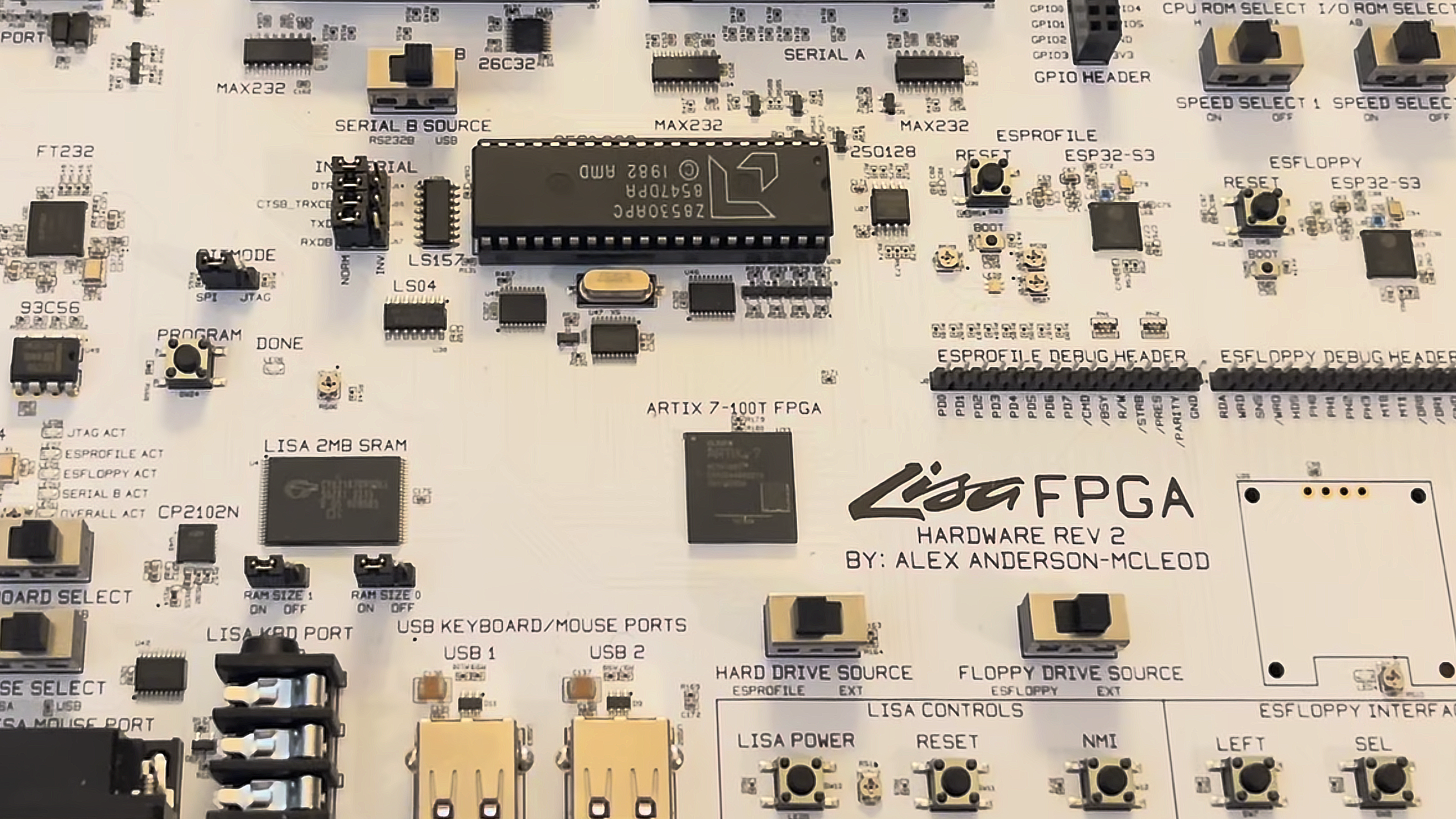
Thanks to enthusiast and Youtuber Alex Anderson-McLeod, you'll soon be able to roll your own much-improved LisaFPGA clone. Alex designed a roomy one-board system centered around an Artix 7-100T FPGA as the Lisa's brains, coupled to 2MB of SRAM and emulated hard drive, floppy, serial, and naturally, keyboard and mouse connectors.
Watch On The clone is far superior to the original, thanks to its reliance on modern hardware and Alex's design smarts. For starters, you don't need a video converter, as the board natively outputs video HDMI with a scanline option; both its main video modes are switchable on-the-fly. Although the board includes original-spec connectors for input devices, it also helpfully has USB ports for keyboard and mouse so you don't have to procure original versions.
You may like Computer History Museum unveils comically large-scale rendition of the 1986 Apple Macintosh Plus Retro Apple Mac mod implements thermal printer floppy swap Tiny Mac look-a-like alarm clock transformed to run real Mac software In a similar fashion, the serial ports can be redirected to the main USB-C connector thanks to the inclusion of a USB hub, saving you having to find USB-to-serial adapters and chunky DB25 connectors. Floppy images can be loaded from an SD card, direct connection to PC, or an original floppy drive connected to the the corresponding port.
Even for its time, the Lisa was pretty slow, thanks to its software design choices and and use of the 5 MHz variant of the Motorola 68000 CPU. As a nod to these limitations, Alex included two overclocking multipliers that can take the machine to the equivalent of 75 MHz, likewise selectable on the fly with physical switches.
The revision of the LisaFPGA featured in the video is version 2, but Alex says that version 3 is coming soon with a handful of fixes. He says the project will be fully open-sourced on Github as soon as he gets his proverbial ducks in a row. He's also considering selling the clones, and will be speaking about them at Vintage Computer Festival Southwest later in the month.
Although it was generally considered a failure due to its price and software availability, the Lisa paved the way for 1984's Macintosh, the $2,459 machine that popularized graphical interfaces and the Apple brand worldwide. The Lisa computer had an undignified ending, too, with 2,700 of them dumped in Logan, Utah, as part of a tax write-off on unsold inventory. Still, similar to how the first iPhone had major issues in hindsight, the Lisa broke ground for much greater things.
Get Tom's Hardware's best news and in-depth reviews, straight to your inbox.
Key considerations
- Investor positioning can change fast
- Volatility remains possible near catalysts
- Macro rates and liquidity can dominate flows
Reference reading
- https://www.tomshardware.com/maker-stem/SPONSORED_LINK_URL
- https://www.tomshardware.com/maker-stem/enthusiast-creates-an-fpga-powered-apple-lisa-clone-modernized-machine-faithfully-recreates-the-first-commercial-computer-with-a-gui#main
- https://www.tomshardware.com
- This must-have miniature Macintosh retro dock gives your M4 Mac Mini a 1980s makeover — equipped with a 5-inch HD display and M.2 NVMe SSD slot
- Get a DDR5 starter build with a Ryzen 5 7600X and ASRock B650M Pro motherboard for 23% off — $430 bundle helps avoid inflated RAM prices
- AMD Ryzen AI 5 435G APU breaks cover in early benchmarks — six-core Zen 5 chip goes head-to-head with the Ryzen 5 8600G for budget PC builders
- Into the Omniverse: Manufacturing’s Simulation-First Era Has Arrived
- AMD Ryzen AI 5 435G APU breaks cover in early benchmarks — six-core Zen 5 chip goes head-to-head with the Ryzen 5 8600G for budget PC builders
Informational only. No financial advice. Do your own research.