
salgado18 Intell will keep sinking if they don't address the massive power consumption of their power cores. AMD, Qualcomm and Apple have efficient cores, but Intel keeps on relying on a hybrid setup only. Reply
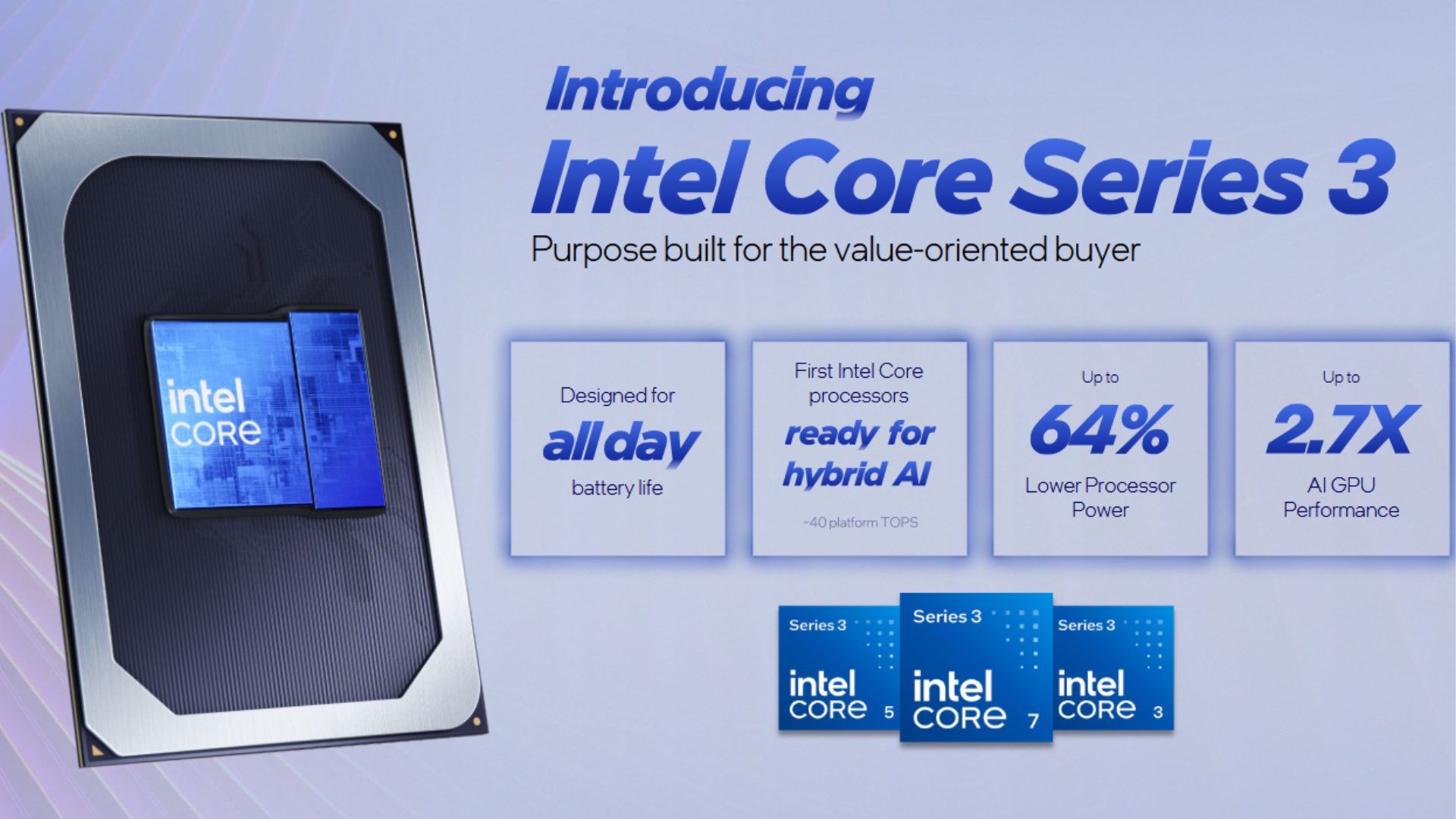
thestryker As a reminder, Wildcat Lake is the successor to Twin Lake and the Blue Team's lowest-end offering this generation. It's not its a replacement for ADL-U/RPL-U the power floor on these is 10W. The corner cutting on IO and memory channels is likely all about keeping the costs to a minimum on a leading edge process node. There hasn't been, and likely won't be for a while, a successor to ADL-N announced. I don't think we'll see it until Intel decides to update the Atom offerings with one of the new core designs. This would also point at using an internal process node of which they very much do not have capacity to spare. Reply
usertests thestryker said: It's not its a replacement for ADL-U/RPL-U the power floor on these is 10W. The corner cutting on IO and memory channels is likely all about keeping the costs to a minimum on a leading edge process node. There hasn't been, and likely won't be for a while, a successor to ADL-N announced. I don't think we'll see it until Intel decides to update the Atom offerings with one of the new core designs. This would also point at using an internal process node of which they very much do not have capacity to spare. I think it's already being treated as a replacement for ADL-N in the embedded world, especially as they can tout the NPU and its "edge AI inference" capability during this bubble. Going down to a 10W TDP can be good enough for tiny, fanless systems: https://www.advantech.com/en-us/resources/news/advantech-delivers-lightweight-edge-ai-inference-with-intel-core-series-3-processors The addition of a dedicated NPU in a mainstream Intel Core Series 3 provides power-efficient AI inference optimized for always-on edge workloads. Combined with CPU and GPU compute capabilities, the solution is well suited for lightweight edge AI inference applications such as smart retail kiosks, self-checkout systems, healthcare assistance devices, and industrial robotics—where responsiveness, efficiency, and reliability are essential. In addition to AI performance, the architecture is designed for long-term industrial use, offering up to 10 years of product availability. It also supports real-time computing capabilities through Intel Time Coordinated Computing (TCC) and Time-Sensitive Networking (TSN), enabling deterministic performance for automation and control applications. Advantech plans to introduce multiple Intel Core Series 3-based systems starting April 2026, including the MIO-5356 embedded single-board computer, the ARK-1252 DIN-rail edge computer, and the ARK-2233 fanless edge computer. These systems are designed to deliver efficient and balanced computing for lightweight edge AI inference across diverse industrial applications. This is an older roadmap putting Twin Lake and Wildcat Lake on the same footing. I think 2.5" could be referring to a class of boards smaller than Pico-ITX, but I'm not sure: https://wccftech.com/industrial-motherboard-roadmap-reveals-intel-nova-lake-u-h-cpu-planned-bartlett-lake-s-panther-lake-h-wildcat-lake-u-in-2026/https://cdn.wccftech.com/wp-content/uploads/2025/08/DFI-roadmap-1.jpg Reply
thestryker usertests said: I think it's already being treated as a replacement for ADL-N in the embedded world, especially as they can tout the NPU and its "edge AI inference" capability during this bubble. Going down to a 10W TDP can be good enough for tiny, fanless systems: https://www.advantech.com/en-us/resources/news/advantech-delivers-lightweight-edge-ai-inference-with-intel-core-series-3-processors This is an older roadmap putting Twin Lake and Wildcat Lake on the same footing. I think 2.5" could be referring to a class of boards smaller than Pico-ITX, but I'm not sure: https://wccftech.com/industrial-motherboard-roadmap-reveals-intel-nova-lake-u-h-cpu-planned-bartlett-lake-s-panther-lake-h-wildcat-lake-u-in-2026/https://cdn.wccftech.com/wp-content/uploads/2025/08/DFI-roadmap-1.jpg It's really just not though. It can exist in the same market segment without being a replacement. Technically the 850x series is cheaper than the N3xx, they can run in a lot of the same power envelopes and are used in a lot of the same devices. None of this means they're interchangeable however and the same is true here. ADL-N is not heterogeneous and can operate in a lower power envelope and the same will be true with whatever it's actual replacement is. Reply
Notton "Geared to compete with Macbook Neo" MBN is $599 for an all aluminum chassis and 13" 2408×1506/60Hz 500nits IPS screen. $499 with student pricing. Which means the expectation is to have the same $599 price with a 2560x1600p 500nits IPS screen, on top of similar build quality, sound quality, weight, battery life, performance, etc. Reply
usertests Notton said: "Geared to compete with Macbook Neo" MBN is $599 for an all aluminum chassis and 13" 2408×1506/60Hz 500nits IPS screen. $499 with student pricing. Which means the expectation is to have the same $599 price with a 2560x1600p 500nits IPS screen, on top of similar build quality, sound quality, weight, battery life, performance, etc. I've seen good ADL-U (RPL-U is identical) laptops in the $200-300 range, and I bought at around $200 (1080p plastic). If Wildcat Lake is a sidegrade or slightly better, that's where I would want it to end up, even if it starts at $400-500. Copying the build quality is the easy part. Matching the Neo's performance and battery life could be impossible, I don't know. Wildcat Lake should perform well, but it definitely shouldn't be priced at $600 given the various chips it's competing with. I would rather see Ryzen AI 7 350/450 at the $500-600 price points with a premium feel. Reply
JamesJones44 salgado18 said: Intel keeps on relying on a hybrid setup only. AMD is one of the few mainstream chip designers that doesn't use a hybrid setup primarily. Apple, Intel and Qualcomm all use the big.little design primarily. Reply
Notton AMD does offer hybrid CPUs on mobile with compact cores. Though I can understand not noticing their existence. Reply
thestryker Notton said: AMD does offer hybrid CPUs on mobile with compact cores. Though I can understand not noticing their existence. All Zen 5 mobile other than HX/Strix Halo is. Reply
Key considerations
- Investor positioning can change fast
- Volatility remains possible near catalysts
- Macro rates and liquidity can dominate flows
Reference reading
- https://www.tomshardware.com/pc-components/cpus/SPONSORED_LINK_URL
- https://www.tomshardware.com/pc-components/cpus/first-intel-wildcat-lake-laptop-spotted-in-the-wild-geared-to-compete-with-macbook-neo-features-an-aluminum-chassis-with-11w-fanless-mode#main
- https://www.tomshardware.com/subscription
- OpenAI’s New GPT-5.5 Powers Codex on NVIDIA Infrastructure — and NVIDIA Is Already Putting It to Work
- Biohacker claims to have sequenced their own genome at the kitchen table with M3 Ultra Mac Studio, Claude, and a $3,200 sequencer — DIY project requires 100GB o
- Linux may be ending support for older network drivers due to influx of false AI-generated bug reports — maintenance has become too burdensome for old largely-un
- Iran claims US exploited networking equipment backdoors during strikes — says devices from Cisco and others failed despite blackout in attack that 'indicates de
- Intel teases wider range of overclockable CPUs for future platforms — VP Robert Hallock says budget builders 'deserve the same level of features' as more well-h
Informational only. No financial advice. Do your own research.