
When you purchase through links on our site, we may earn an affiliate commission. Here’s how it works .
Nvidia’s annual report (10-K) books $14.4 billion of the license as goodwill “primarily attributable to the workforce and future development of the licensed technology” plus $2.5 billion for the technology itself. The plaintiffs concede that “no Delaware decision has directly answered the question this case raises,” but the deal is already under a reported Department of Justice (DOJ) inquiry. The lawsuit’s outcome has implications for future license-plus-hire deals. Groq told CNBC the suit is “meritless” and said its licensing agreement with Nvidia “delivered exceptional value for Groq, our investors, and our employees.”
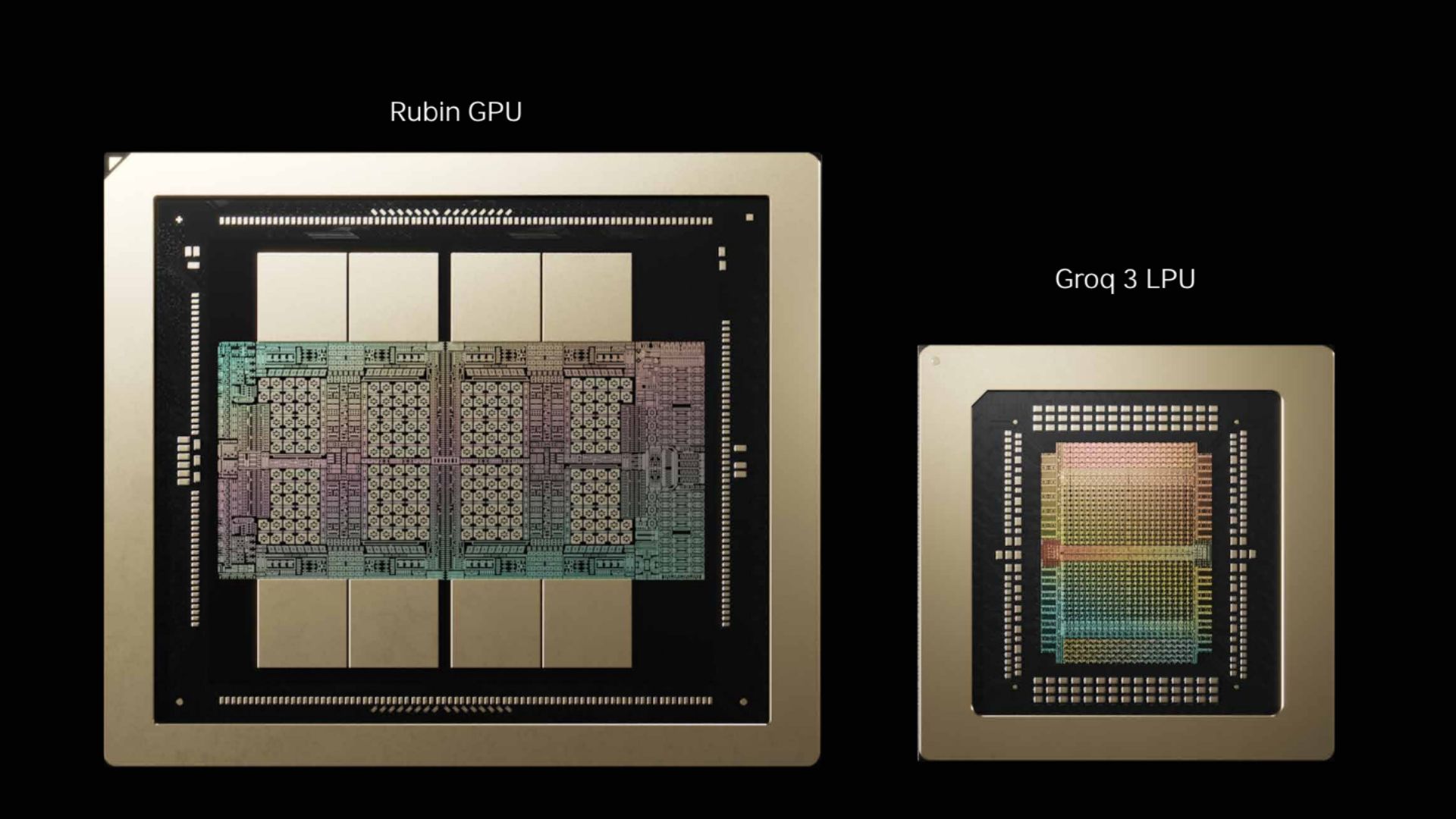
The deal involved both the LPU technology and the people who built it , including Ross, a former Google TPU engineer who founded Groq in 2016. The LP30 has 500MB SRAM per die and 150 TB/s bandwidth, uses Samsung’s 4nm process technology , and is rated by Nvidia at up to 1.23 FP8 PFLOPS. A single LPX rack has 256 LPUs with 128GB SRAM, 40 PB/s, and 315 FP8 PFLOPS in aggregate, as a decode co-processor for Vera Rubin NVL72. The LP30 appears to be the next-gen LPU Groq roadmapped in August 2023 on Samsung’s SF4X process with its first-gen Tensor Streaming architecture.
During Hot Chips in August of this year, Igor Arsovski, Groq’s former chief architect and now Nvidia VP of hardware, called the occasion “a pinch me moment for the Groq team that’s now integrated into the Nvidia group.” The rack was already in production at the time, Arsovski said. This supports the complaint’s factual premise, but does not answer the legal question about whether more is owed.
Nvidia’s 10-K notes indicate that “no customer contracts, existing products, or equity interests were purchased” with “$13.0 billion paid at closing and $4 billion, inclusive of imputed interest, payable within one year.” The goodwill number, as reported above, is about 85% of the $16.9 billion Nvidia booked and around 5.8x the value of the technology asset. Nvidia put significantly more value on the LPU design team and the technology’s future development than on the design itself.
Hot Chips 2026: Nvidia presents Groq 3 LPX architecture and unveils its first third-party inference benchmark
Early Nvidia advisor says he's owed $1 billion in stock due to a 1993 vesting error, but Nvidia rejected settlement
Nvidia denies pausing AI cloud commitments initiative after reported partner backlash
Groq said when the deal was announced that it would continue “to operate as an independent company,” and it joined the Nvidia Cloud Partner program in August. Also in August, “Groq LLC” had a $350 million Series A and a $3.5 billion valuation after raising $650 million in June. Before the deal, in September 2025, the valuation was put at $6.9 billion after a $750 million round. Groq says it now operates 13 data centers and expects to scale from 54 to 200+ MW in 2027. Nvidia was slated to participate in the Series A, which Groq says will support those seeking “clusters of NVIDIA accelerated computing.”
Groq also said in August that it is “among the first adopters of NVIDIA Groq 3 LPX” with Nvidia’s Vera Rubin NVL72, deploying with Dell . Those racks are built on the LPU technology Groq licensed to Nvidia, and Groq claims to be “the only team with hands-on experience operating LPUs in production at scale.” The Financial Times said Groq “pivoted entirely to AI cloud computing, dropping its chip design efforts.”
The suit alleges that the Groq board was conflicted, failing to secure the best terms for every shareholder and denying some of them a vote on the deal. Specifically, it says Ross and other top Groq employees were allowed to “take a discount on those shares and be paid separately for following the technology to Nvidia.” According to the suit, Nvidia hired “nearly all” of Groq’s engineers, as many as 200. However, the final payout is alleged to have ignored potential upside and synergies with Nvidia.
The plaintiffs also say that because Nvidia didn’t buy Groq outright, the $17 billion license payment was taxable as income at Groq, and that the Series A valued the remaining Groq above the price paid to the shareholders who were bought out. They say four “conflicted funds” on Groq’s board, BlackRock, Social Capital, Infinitum, and Disruptive, which are not named as defendants in the case, engineered that gap and profited by staying with Groq after the buyout.
As reported by Axios in December 2025, though, sources close to the deal said that most shareholders would get per-share payouts “tied to the $20 billion valuation.” Around 90% of employees would join Nvidia, with vested shares paid in cash and unvested shares paid in vesting Nvidia stock. Staff who stayed with Groq would be paid for vested shares and get a package including “economic participation in the ongoing company.”
As for the DOJ, the New York Times reported in September that the department sent Nvidia a formal request for information with a fine being possible. Nvidia said at the time that the Groq story was “a prime example of the American system working as designed.” The deal did not go unnoticed by some senators who, in February, put it under the “reverse acqui-hire” deal label. Federal Trade Commission Chair Andrew Ferguson said in January that the agency is “beginning to examine these acqui-hires to make sure they are not an attempt to get around” its merger review process.
The litigation comes not long after Nvidia’s agreement to acquire Hugging Face (HF) a month ago, which included a purchase price and equity for HF employees who join Nvidia, a similar split. The deal is waiting on approval, but unlike the Groq deal, it is an outright purchase of the company. When the Groq deal was announced, Nvidia CEO Jensen Huang told employees in an email, obtained by CNBC , that while Nvidia was adding Groq staff and licensing its IP, “we are not acquiring Groq as a company.”
The legal question on the Groq deal remains open, and more details will come out as the case proceeds and the defendants respond. As for the LPX customers, Nvidia calls Nebius the first AI cloud to adopt LPX and says the racks will be online there later this year. Looking ahead, Nvidia has the LP35, with NVFP4 support, alongside the Rubin Ultra and LP40 for Feynman on its roadmap .
Shane Downing Social Links Navigation Contributing Writer Shane Downing is a Contributing Writer for Tom’s Hardware, covering consumer storage, PC hardware, and AI.
Key considerations
- Investor positioning can change fast
- Volatility remains possible near catalysts
- Macro rates and liquidity can dominate flows
Reference reading
- https://www.tomshardware.com/tech-industry/semiconductors/SPONSORED_LINK_URL
- https://www.tomshardware.com/tech-industry/semiconductors/former-groq-engineers-sue-board-over-usd20-billion-nvidia-deal-saying-it-handed-nvidia-the-lpu-and-the-team-that-built-it-plaintiffs-allege-the-board-kept-billions-from-other-shareholders#main
- https://www.tomshardware.com/my-account
- Why I upgraded to a 4K OLED PC gaming monitor
- Here are the best OLED gaming monitor deals you can snag for Amazon Big Deal Days 2026
- Some of the best PC speakers and soundbars we've tested are on sale starting at just $27.99
- How Open Science Can Help Researchers Prepare for the Next Pandemic
- 30% discounts on essential 3D printer maintenance tools
Informational only. No financial advice. Do your own research.