
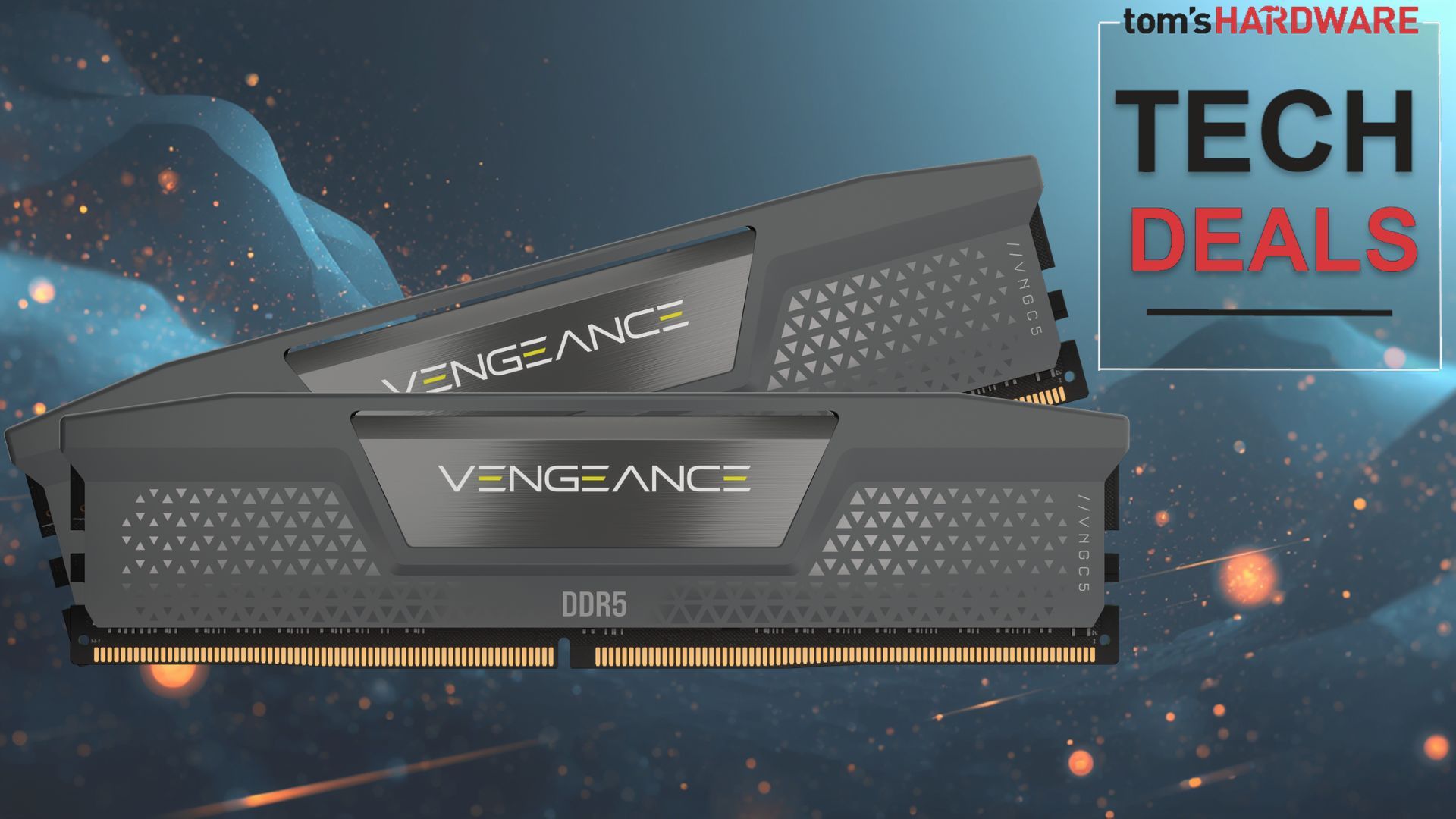
This is the cheapest DDR5 we've seen on the market in several months, with the going rate of DDR5 around $349 for 32GB.
Corsair's Vengeance RAM is a household name, featuring two sticks of 16GB RAM in a dual-channel configuration and 36-44-44-96 timings and 6,000 MT/s speeds.
It's a stealthy black color and features an aluminum heat spreader to help keep temps under control. Overclocking support comes by way of Intel XMp and AMD EXPO OC profiles.
Really, the RAM speaks for itself; the headline here is the price. We've previously covered this deal on Woot at the price of $269.99, so the extra $20 saving, courtesy of the code at checkout, is the best deal on RAM we've seen so far in 2026. Being Woot, you'll have to pay a $6 shipping fee unless you're a Prime member, but what's that amongst friends for the cheapest RAM on the market?
Naturally, there's a buy limit of one per customer, and shipping estimates are currently May 4 – May 6. The product comes with Woot's 90-day warranty; however, unlike some products on Woot, this RAM is brand new rather than returned or factory reconditioned.
If you're looking for more savings, check out our Best PC Hardware deals for a range of products, or dive deeper into our specialized SSD and Storage Deals, Hard Drive Deals , Gaming Monitor Deals , Graphics Card Deals , Gaming Chair , Best Wi-Fi Routers , Best Motherboard, or CPU Deals pages.
Stephen is Tom's Hardware's News Editor with almost a decade of industry experience covering technology, having worked at TechRadar, iMore, and even Apple over the years. He has covered the world of consumer tech from nearly every angle, including supply chain rumors, patents, and litigation, and more. When he's not at work, he loves reading about history and playing video games. ","collapsible":{"enabled":true,"maxHeight":250,"readMoreText":"Read more","readLessText":"Read less"}}), "https://slice.vanilla.futurecdn.net/13-4-22/js/authorBio.js"); } else { console.error('%c FTE ','background: #9306F9; color: #ffffff','no lazy slice hydration function available'); } Stephen Warwick Social Links Navigation News Editor Stephen is Tom's Hardware's News Editor with almost a decade of industry experience covering technology, having worked at TechRadar, iMore, and even Apple over the years. He has covered the world of consumer tech from nearly every angle, including supply chain rumors, patents, and litigation, and more. When he's not at work, he loves reading about history and playing video games.
Marlin1975 Sad that $250 for 32gb of ram is a "deal". I paid around $100 for 32gb of 7400mhz memory a little over a year ago. I thought, at the time, it was decent. But now, prices are bonkers. Reply
systemBuilder_49 I dont think the DRAM manufacturers were making ANY money at under $100. We had glut / bloodbath prices 1Y ago (china was subsiding their DRAM makers). I got DDR5-6000 For $170 in Jan 2023 – a normal peice today would be $125 imho. Reply
Syntaximus This is about what the 64GB variant would have been before AI ruined everything. Reply
S58_is_the_goat systemBuilder_49 said: I dont think the DRAM manufacturers were making ANY money at under $100. We had glut / bloodbath prices 1Y ago (china was subsiding their DRAM makers). I got DDR5-6000 For $170 in Jan 2023 – a normal peice today would be $125 imho. Cry me a river Reply
Ellesar systemBuilder_49 said: I dont think the DRAM manufacturers were making ANY money at under $100. We had glut / bloodbath prices 1Y ago (china was subsiding their DRAM makers). I got DDR5-6000 For $170 in Jan 2023 – a normal peice today would be $125 imho. technically speaking they could still make quite a lot of proffit on ram even back then. basic DDR5 (when looking at the dram chips themselves) went for around $0.4 to 0.5 per gb before prices went up(has been lower than those even) when looking at 8gb chips(these are the most desired by industry, so one can save quite some money by taking other capacity chips even compared to this, like 12gb LPDDR5 modules cost almost the same as 8gb LPDDR5 modules because no big companies want the odd numbers, but that $0.4 to $0.5 per gb was for the 8gb chips. so a 32gb ram stick with 4 8gb DDR5 DRAM modules on it went for around $16 for 32gb of DDR5. (there also is a specially extra tested version of DDR5 chips, those are more expensive and for those 32gb of DDR5 would have been around $25 to $30 back then, these are extra tested and specially binned for extreme overclocking, datacenters want those, as well as some of the high end gaming/workstation ram sticks use those chips, it essentially guarantees a company that they can deliver the ram with very high frequency and low latency without needing to test it to much or bin it themselves. 32gb is quite a small capacity for DDR5, so it is quite easily possible to make a 1 sided pcb ram stick with 32gb DDR5, this reduces cost further as the proces for one sided is very cheap and very fast, as well as very simple, the chances of something going wrong are also much smaller. unlike DDR4, DDR5 requires some additional components on it, most are almost free, the power delivery controller especially for the higher end chips where expensive in the early days but there are many super cheap great options available now. when mass producing, the pcb's themselves also aren't expensive PCB+extracomponents on the pcb required in DDR5+ 1 sided assembly can vary in price depending on the design but looking at budged sticks it can be done for around $1, and generally when a company does it, it is unlikely to get over $10, even for the better quality stuff. ofcource this doesn't take into account certain costs. as the hardware of DDR5 sticks is actually quite cheap(even now it is still cheap in hardware as only the DRAM chips really rose in price, but we are talking about $1 to $1.5 per gb, which surely is a insane price increase, as around a month or 2 ago 16GB of DDR5 cost around $20, which is insane given that before the price increases it was around <$7. but that still isn't close to the price increases charged to consumers these days. with DDR5 the main costs actually come from a few things: 1. many different designs which get sold only to a few people, while the changes are very minimal and mostly copy paste, it does require someone to add a new page to the site and such. 2. RGB and fancy sleeves. the RGB leds alone in a ram stick can be quite expensive costing several cents per led, but the custom sleeve designs and making of those fancy ram cases essentially, adds quite a bit of the cost, compared to the build prices of the rest, this purely visual factor adds a quite significant cost(also including fancy boxes and such) 3. DDR5 is just new and unlike older DDR versions it actually requires some new components and such, in previous generations most could just be copied constantly, with DDR5 now they can also copy it, but when it was just new they needed to redesign those layouts as well as rewrite the firmware. though this is mostly a cost which was a few years ago, as now they already have those they can and do again copy them and just alter a few things(like for example the default clocks or such which is a variable. 4. testing ram sticks, doesn't need to be super expensive as with a singlesided pcb the chance for defects are small. but if a company uses the normal DDR5 and a budged power controller and still wants to seriously push the clocks and latency, then it requires testing the sticks, this is not that expensive but we are talking about something where even adding 50 cents is worth looking at. and one of the biggest factors. 5. huge margins, unlike CPU's, GPU's, etc. Ram gets used for really long, people often use ram they have in multiple generations of systems. if people have ram then even if the new stuff is faster they are unlikely to actually want to spend a decent amount of money to replace it unless they really notice a problem. they are more likely to buy and add a extra stick for bigger capacity than to replace it just for the higher clocks and better latency(when looking at actual buyer behaviour). so with how many slightly different versions each company makes of their ram, and how people reuse it, or just use it for very long, this results in relatively few buyers per stick design. relatively few still is quite a lot however, but these are quite big companies, and they have investors who want to get piles of money each year, and if they sell it for really cheap then they make a lot of proffit that year, but then after that they will sell almost nothing until DDR7 releases or until things like Unreal Engine 5 happen requiring people to have way more ram suddenly.(unreal engine 5 games basicaly pushed the line of a gaming gpu needing 8gb vram and 16gb ram to run well without serious memory bottleneck to around 16gb vram and 32gb ram). So was that $100 per 32gb a disaster moment for them? no, though perhaps also a little. a little because 32gb DDR5 should just be enough for comfortable use for the coming few years(for basic desktop use 16gb is enough even), this means that the people who bought it are less likely to buy much more soon unless they do serious workstation use, or heavy memory heavy algorythms. also relatively few people where buying DDR5, this was largely due to there nor really being much cpu or apu wise on the consumer market really benefitting from DDR5, also the motherboards where expensive, and the CPU's and APU's only recently started to actually improve(mostly efficiency wise, which is something I love), though for gamers and such, the ones who would go for DDR5 back then generally got little improvement when going for the new DDR5 based platforms, especially when looking at the price. as most recent improvements where in power efficiency, and igpu's and such, many gamers care not as much about those as they have a heavy GPU in it.(not everyone agrees with me in that energy efficiency is important, and this can clearly be seen in the market behaviour), new builders where more likely to build systems with DDR5 as they needed all new anyway, or people coming from very outdated setups. the energy efficiency thing can also be seen in the gpu's released, cpu's and apu's are still made more efficient as many prebuilders care about it and mini pc's and buisiness laptops and such are popular and it maters a lot in there. but the new RTX5090 gets beaten by the 6 year old APU in the PS5 when looking at energy efficiency. the entire system in the PS5 is more efficient than only the gpu in the RTX5090 when comparing GPU performance to gpu powerdraw in the case of the RTX5090 and full system power draw in the case of the PS5(technically BC-250 but is based on the same chip, just allows one more controll than the official ps5 does.) based on node size changes, and time to improve architecture, and the RTX5090 only being a gpu, one would expect the RTX5090 to be more efficient. this just shows how little many modern buyers actually look at energy efficiency when buying hardware. so very few gamers actually saw the new DDR5 platforms as a real upgrade big enough to get all their stuff new for, they did get it if they needed some serious upgrades, but if they had a somewhat recent system, many didn't. so in the end, there wasn't really much bad going on back then to those companies, they lowered prices to make it more likely that people bought it, and lowering prices resulted in people buying larger amounts, which in the end gave more proffit. there also is one problem however that most such companies currently have the same lead investors, so the same investors decide what the companies have to do, meaning there isn't really competition anymore as it is just a hidden form of cartel. this is why the complere ram sticks rose so insanely in price recently, because they knew they could get piles of proffit like that both due to insane proffit margins on ram sold, as well as that as mentioned people wheren't really buying as much DDR5 yet(when excluding people who buy complete systems). since these price increases, people suddenly are obsessed with it, that is a calculated move, if people think they can always get it and don't really need it yet they won't want to spend much on it. now they think they can't get it and think everyone wants it, so they kind of get fear of missing out and suddenly want a lot of DDR5. that said in around a year or 2 people would have wanted DDR5 annyway, as the cpu's and apu's are advancing now. efficiency increases also mean than performance increases can be made, though they are just largely avoided now, as big performance increases result in people wanting to see other big performance upgrades before they upgrade. Reply
Key considerations
- Investor positioning can change fast
- Volatility remains possible near catalysts
- Macro rates and liquidity can dominate flows
Reference reading
- https://www.tomshardware.com/pc-components/SPONSORED_LINK_URL
- https://www.tomshardware.com/pc-components/get-32gb-of-corsair-vengeance-ddr5-ram-for-just-usd249-act-fast-and-dont-miss-woots-blowout-sale#main
- https://www.tomshardware.com
- ASML's roadmap for chipmaking lithography tools examined — from DUV to Low-NA, High-NA, Hyper-NA, and beyond
- Press Start on April: GeForce NOW Brings 10 Games to the Cloud
- Get 32GB of RAM and 2TB SSD for $406 when paired with AMD's new 9950X3D2 — Asus ROG X870E Apex gets you a monster overclocking AM5 bundle for $2,048, $400 off
- Chinese GPU maker Cambricon's Q1 revenue hits $423 million as country's homegrown AI chip market accelerates — Chinese chipmakers continue to leech market share
- 45 years later, earliest DOS source code transcribed from a stack of old printouts found in a garage — code was open-sourced to mark 86-DOS 1.00’s anniversary
Informational only. No financial advice. Do your own research.