
Gigabyte includes the typical accessories, including two SATA cables and two 2-pin thermistors, a front panel connector, a Wi-Fi EZ Mag connector for the Wi-Fi Antenna, a manual, and an Aorus sticker. It also includes the CPU Thermal Matrix, two plates (a backplate and one that mounts on top) designed to mount around the socket to reduce VRM and RAM temperatures by up to 8.5 degrees Celsius, which can benefit both the average user and the extreme overclocker.
(Image credit: Future) (Image credit: Future) (Image credit: Future) (Image credit: Future) (Image credit: Future) (Image credit: Future) (Image credit: Future) Image 1 of 7 View Original
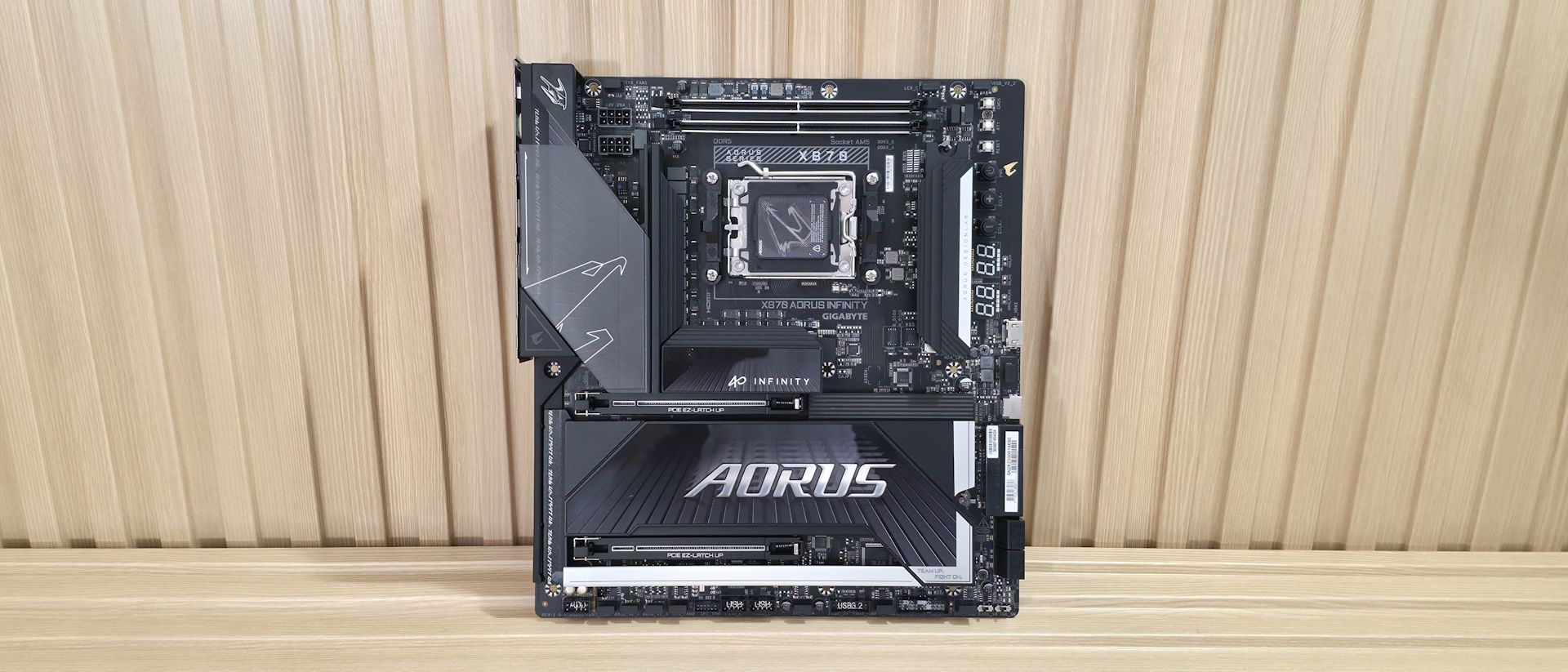
The Aorus Infinity's design stands out primarily for its rotated socket area and top DRAM slots. The left VRM area features a unique heatsink with a plastic cover that slides open to install 8-pin EPS connectors, and slides closed to cover them. On top is the Aorus Falcon, representing the brand, and it's backlit by RGB lighting from below. Where you’d normally find the top M.2 socket (below the CPU socket) is now populated with VRMs, and the M.2 is to the right, running vertically where the DRAM slots normally are. In essence, the entire socket area primary M.2 socket and DRAM slots are rotated 90 degrees counterclockwise. The bottom portion of the board uses reinforced PCIe slots and plate-style heatsinks with DIY-friendly features like PCIe EZ Latch Up (which works similarly to Asus’ method they had to change) and EZ Latch Plus/Click for screwless M.2 mounting. Overall, it’s a good-looking board that looks good inside any dark chassis.
Starting our tour in the top left, we get a better look at the sliding cover on the large, heatpipe-connected (big 8mm heatpipes) heatsinks. The smoked plastic piece on top slides down to allow access to the two 8-pin EPS connectors (one required). Connect the leads from the power supply, then slide the piece up to hide the unsightly wires. The only RGB element on the board is the Aorus Falcon flying high on the VRM heatsink, with RGB lighting radiating a frosted glow from below. The two DRAM slots on top of the board have locking mechanisms on both sides. Gigabyte lists support up to an incredible 9600 MT/s and has/had a record on this board reaching an insane 11,400 MT/s (surely that’s achieved with cherry-picked processors and RAM kits) with heavy manual tweaking. Still, it is possible. In a nod to how well this dual-DIMM-slot board handles RAM, it’s one of the rare motherboards that lets our Ryzen 9 9900X run our Klevv DDR5-8000 kit. Normally, that’s only reserved for the APU and its superior IMC or other (but not all) two-DIMM boards. Moving past the socket, we hit our first M.2 slot, running vertically where you would normally see RAM slots. It’s also one of two CPU-connected M.2 sockets, both supporting PCIe 5.0 x4 (128 Gbps) speeds and 110mm drives. Above that are two (of eight) 4-pin fan headers, each supporting PWM or DC-controlled devices. The BIOS or Gigabyte Control Center (GCC) controls these headers. Above that are two RGB headers, a 3-pin ARGB (one of three) and a 4-pin RGB header. The RGB Fusion app in GCC controls the integrated RGB feature and anything attached through the headers.
Last but not least, on the top half of the board is the Overclocking Kit and EZ-Debug area. This is what makes the board unique compared to ‘normal’ motherboards (ones that aren’t focused on overclocking). Here we see three simple white buttons: a CMOS clear button, a cold reset button for cold boot, and a reset button.
On power delivery, we see a high-end solution with 22 phases, 18 dedicated to Vcore. Power comes from the 8-pin EPS connector(s) and goes to the Infineon XDPE192C3D 12-phase PWM controller using a teamed configuration. From there, it moves to the powerful Infineon PMC41430 110A Smart Power Stage (SPS) MOSFET/gate driver. The 2,200A available will easily handle anything you throw at it, including flagship-class processors like Ryzen 9 9950X or Ryzen 9 9950X3D2 , even with extreme cooling methods
Get Tom's Hardware's best news and in-depth reviews, straight to your inbox.
Key considerations
- Investor positioning can change fast
- Volatility remains possible near catalysts
- Macro rates and liquidity can dominate flows
Reference reading
- https://www.tomshardware.com/pc-components/motherboards/SPONSORED_LINK_URL
- https://www.tomshardware.com/pc-components/motherboards/gigabyte-x870-aorus-infinity-motherboard-review#main
- https://futureplc.com/privacy-policy/
- Two killed, one seriously hurt in explosion at Intel’s chip plant in Israel
- All Systems Go: Global PC App Ecosystem Ready for NVIDIA RTX Spark
- Experiment shows liquid metal TIM doesn’t dry out; it turns solid
- ASML struggling to keep up with demand for chipmaking equipment as AI spending continues to boom
- SpaceX limits Starlink service for Ukraine’s high-speed military drones without prior warning
Informational only. No financial advice. Do your own research.