
Power button (white LED) (1) USB 3.2 Gen2x2 (20 Gbps) Type-C (1) USB 2.0 (480 Mbps) (1) 3.5mm audio jack
Up to 3 Top – 240/280/360mm Front – 240/280/360mm Rear – 120mm Bottom – None Side – None
Three RS120 fans included, Rear-connec/BTF compatible, high-airflow front panel, angled bottom fan mount, integrated GPU strut
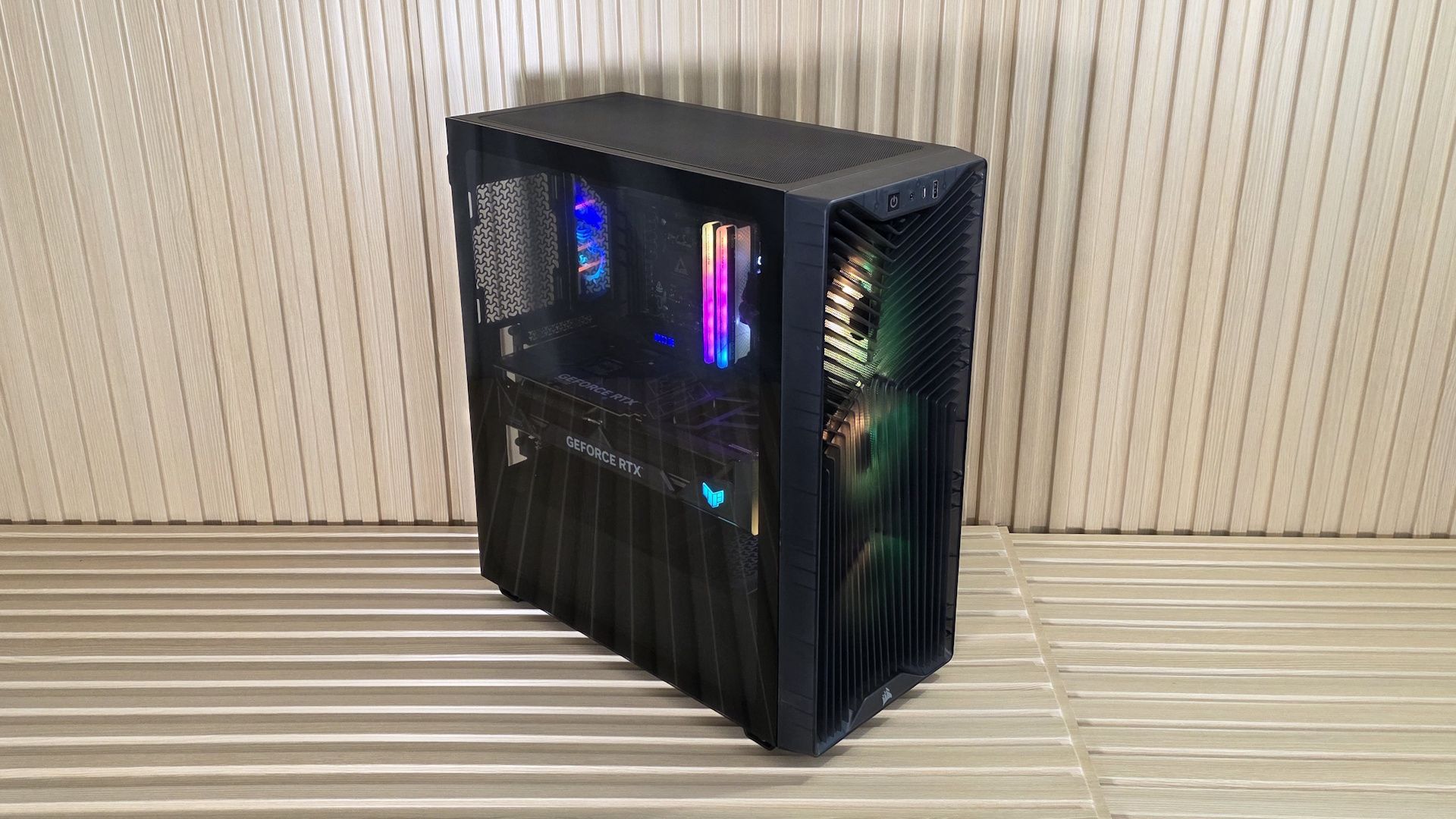
(Image credit: Future) (Image credit: Future) (Image credit: Future) (Image credit: Future) (Image credit: Future) (Image credit: Future) Starting with the outside, the mid-tower chassis measures 19.4 x 18 x 8.6 inches, which is typical for this kind of case. The chassis is made of steel, tempered glass, and plastic, and feels lightweight yet sturdy as a whole. The smoked tempered-glass panel is dark enough to hide some unattractive internals, yet still light enough to show off what’s inside, especially with lighting. The open face on the front with the unique Y-pattern allows plenty of cool air to flow in, which should bode well for thermals, regardless of air or AIO / custom water cooling. The bottom has venting, and another simple dust filter/mesh (not magnetic) slides into its space for the power supply. The other side panel, secured with captive thumbscrews, features an indented design element that looks better than the boring flat panel, but can limit cable routing space. On top of the case is a simple mesh filter that prevents dust from coming into your case when it’s off. I do wish the magnet holding the mesh were a bit stronger, as it tends to move around and can get offset (this is my OCD talking). Looking at the rear of the case, we see room for the motherboard I/O and a 120mm fan, which you can adjust the height of. Below that are seven case expansion slots, which provide plenty of room for large graphics cards and add-in cards. Below that is the power supply, held in place by two captive thumbscrews. Vertical mounting of the video card is not possible.
The front I/O panel includes a power button with a white LED that lights when the device is powered on. Next to that is a 3.5mm audio plug, a USB 3.3 Gen 2×2 (20 Gbps) Type-C port, and, finally, a USB 2.0 Type-A port, rounding out connectivity. Seeing USB 2.0 on the front panel of a brand-new case in 2026 was a curious design choice, but Corsair has announced the next version will upgrade it to USB 3.0 (the speed wasn’t explicitly mentioned, but we’d guess 5 Gbps/3.2 Gen 1).
Really, there’s nothing spectacular or extraordinary in the case. It’s an inexpensive mid-tower that includes three fans. And there’s absolutely nothing wrong with that. You won’t find fancy adjustable rails for fans / radiators, moveable motherboard trays, or fan hubs. That said, you do get three high-quality Corsair RS120 ARGB fans with the case (a three-pack was on sale for $44 at Corsair when this was edited), which is a plus for a name-brand chassis in the sub-$80 price range.
(Image credit: Future) (Image credit: Future) (Image credit: Future) Inside the chassis, the 3200D RS supports Mini-ITX to ATX motherboards, but does not list E-ATX, even though there may be enough room (if you remove the Anti-sag strut). It’s also BTF/rear-connect compatible, supporting motherboards from Asus, ASRock, Gigabyte, and MSI with rear-panel connections instead of the front. There’s plenty of room for routing and hiding wires that come out the front (or behind, in the case of the rear-connect motherboards). The company also includes several zip-ties to secure the wires to the case for clean routing.
Get Tom's Hardware's best news and in-depth reviews, straight to your inbox.
Key considerations
- Investor positioning can change fast
- Volatility remains possible near catalysts
- Macro rates and liquidity can dominate flows
Reference reading
- https://www.tomshardware.com/pc-components/pc-cases/SPONSORED_LINK_URL
- https://www.tomshardware.com/pc-components/pc-cases/hands-on-corsair-3200d-rs-argb-mid-tower-pc-case#main
- https://www.tomshardware.com/subscription
- Intel challenges AMD’s handheld dominance with new Arc G3 chips — Panther Lake silicon brings up to 14 cores, Arc B390 graphics to handhelds
- Intel challenges AMD’s handheld dominance with new Arc G3 chips — Panther Lake silicon brings up to 14 cores, Arc B390 graphics to handhelds
- Startup unveils underwater drone designed for protecting undersea cables — small drone dives to 1,640 feet, comes with four-hour battery endurance or unlimited
- Veteran programmer finishes retro game sequel and publishes it after 37 years — Colin Porch started Head Over Heels home computer title in 1989, but it was shel
- NVIDIA, Ineffable Intelligence Team Up to Build the Future of Reinforcement Learning Infrastructure
Informational only. No financial advice. Do your own research.